

Managing a complex supply chain is difficult enough without disconnected data, inaccurate demand forecasts, and limited inventory visibility. While e2open helps businesses coordinate supply chain planning, logistics, and procurement, its broad enterprise focus may not fit every company.
Fortunately, plenty of e2open competitors are worth considering in 2026. Some specialize in transportation and logistics, others focus on procurement or demand planning, while some help consumer goods brands understand retail demand and make better inventory decisions.
In this guide, we’ll compare 10 of the best e2open alternatives, covering their key features, advantages over e2open, and pricing to help you find the right supply chain management software for your business.
TL;DR: e2open competitors at a glance
| Best for | Standout features | |
|---|---|---|
| Alloy.ai | CPG brands that need better retail visibility and demand forecasting | Retail sales analytics, inventory optimization, demand forecasting, automated replenishment |
| SAP | Large enterprises already using SAP ERP systems | Integrated business planning, supplier collaboration, production planning, inventory management |
| Oracle | Enterprises managing complex manufacturing and supply chain operations | Demand management, supply planning, warehouse management, ERP integration |
| Locus | Businesses optimizing transportation and delivery operations | Route optimization, automated dispatch, carrier management, delivery tracking |
| ClickPost | Ecommerce businesses managing shipping and returns | Automated carrier selection, shipment tracking, delivery exception management, returns automation |
| Blue Yonder | Retailers and manufacturers with complex planning and fulfillment requirements | Demand forecasting, warehouse management, transportation planning, inventory optimization |
| Kinaxis | Enterprises requiring concurrent supply chain planning | Scenario modeling, demand forecasting, supply planning, inventory optimization |
| Infor Nexus | Global enterprises coordinating suppliers and international shipments | Supply chain visibility, supplier collaboration, global transportation management, supply chain financing |
| Precoro | Small and midsize businesses improving procurement and spend control | Purchase order management, approval automation, budget tracking, supplier management |
| FourKites | Enterprises requiring shipment visibility and logistics orchestration | Predictive shipment tracking, exception management, yard management, transportation analytics |
Get the better e2open alternative built specifically for retail analytics. Book a demo with Alloy.ai today.
Why look for e2open alternatives anyway?
e2open offers extensive supply chain management capabilities, but its broad functionality comes with some trade-offs. Many customers appreciate its planning tools and logistics network, but others report issues with performance, customization, usability, and customer support.
Here are four common reasons businesses consider e2open competitors, based on feedback from actual users.
1. Slow performance when processing supply chain data
Supply chain teams depend on accurate, accessible data to monitor inventory, evaluate demand, and respond to disruptions. However, some e2open users report slow performance when retrieving historical information or working with large datasets.
In a G2 review, Mandi N., a senior Java developer, mentioned occasional problems with inventory automation accuracy and speed:
“Extraction of old data and working on it takes a lot of time.”
Another G2 reviewer, Tabish A., reported slow data collection and occasional system freezes.
These issues can make it harder to analyze historical inventory movements, prepare reports, and quickly identify supply chain problems.
2. Limited customization of logistics views
Every business has different reporting requirements, operational priorities, and supply chain processes. While e2open offers extensive logistics management functionality, some users have encountered restrictions when customizing what the platform displays.
For example, Chih H., a senior supply chain manager, explained in a G2 review:
“The information displayed in the loading list cannot be customized.”
The reviewer also mentioned difficulties tracking workloads across the network and identifying specific shipments.
If you have complex distribution networks, you may prefer supply chain software that gives you more control over operational views, reporting configurations, and the information employees see during daily tasks.
3. A steep learning curve and complicated onboarding
e2open covers demand planning, procurement, global trade, logistics, and supplier collaboration. That range of functionality can be valuable for large enterprises, but it can also introduce complexity during implementation and onboarding.
An April 2026 review on Gartner Peer Insights describes the platform as having strong planning and execution capabilities but identifies an outdated interface and steep learning curve as drawbacks.
Another G2 reviewer suggested allowing more time for employee training during implementations across multiple sites.
If you’re considering alternatives, consider how much training employees will need, how easily they can access relevant information, and how quickly new users can become productive.
4. Inconsistent customer support
Reliable technical support matters when supply chain software supports daily purchasing, inventory, and transportation operations. Delayed responses can make it harder to resolve system issues or address problems during critical business processes.
In a G2 review, Amit K., an associate director, identified customer support response times as an area for improvement:
“Customer care service can be a bit slow at times”
Similar concerns appear in Gartner Peer Insights reviews, where users mention slower support responses and limited customization assistance.
If you’re considering e2open alternatives, you should compare technical support availability, onboarding assistance, response commitments, and the level of ongoing support included in their subscription.
The best e2open competitors for supply chain management in 2026
Here are some of the best alternatives to e2open in 2026, whether you want more data sources, more transparent pricing, or better customer support.
1. Alloy.ai
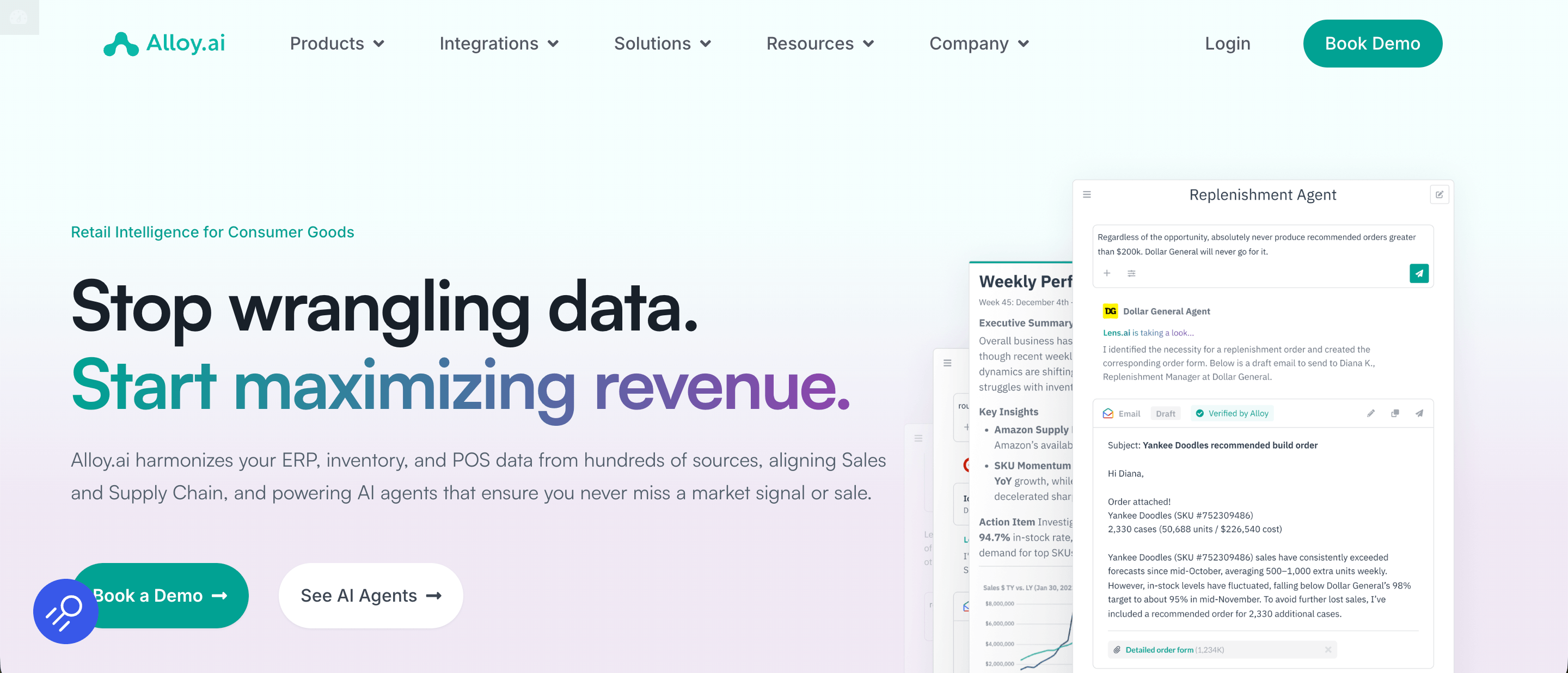
Alloy.ai is a retail analytics, forecasting, and supply chain intelligence platform built specifically for consumer goods brands. It connects sales, inventory, and supply chain data from over 500+ sources, including retailers, distributors, e-commerce platforms, and internal ERP systems.
While e2open covers everything from transportation management to global trade compliance, Alloy.ai helps CPG companies understand consumer demand, improve inventory availability, and make better replenishment decisions. Its detailed visibility into retail sales and inventory makes it particularly useful for brands selling through multiple retail partners.
Why choose Alloy.ai over e2open?
- Better visibility into retail demand: Alloy.ai combines point-of-sale (POS) data with retailer inventory and internal supply chain information. Teams can track sales and inventory at the SKU, store, and distribution center level, rather than relying primarily on shipment data to understand demand.
- Purpose-built for consumer brands: Unlike e2open’s broader enterprise supply chain platform, Alloy.ai focuses on the problems CPG companies encounter every day, including phantom inventory, retail stockouts, excess inventory, and product availability across retail partners.
- More actionable demand forecasting: Alloy.ai uses actual consumer sales, inventory levels, historical trends, and seasonality to generate detailed demand forecasts. Brands can identify upcoming shortages, estimate weeks of supply, and adjust production or replenishment plans before problems affect sales.
- Automated replenishment and reporting: Alloy.ai offers specialized AI agents that help teams identify inventory issues, prepare replenishment orders for approval, and generate performance reports. This connects retail analytics with the actions needed to improve product availability.
Alloy.ai pricing: Alloy.ai offers custom enterprise pricing based on your company’s requirements. It has no publicly listed pricing plans, but you can request a personalized quote from its sales team.
Book a demo with us to see how the platform can improve retail visibility, forecasting, and inventory management.
2. SAP
SAP is an enterprise software provider offering a wide range of solutions for supply chain management, demand forecasting, inventory optimization, procurement, and logistics. Its supply chain portfolio includes SAP Integrated Business Planning (SAP IBP), SAP Business Network, and SAP S/4HANA, which help businesses connect planning activities with operational and financial data.
As an e2open alternative, SAP is particularly attractive to large manufacturers, retailers, and consumer goods companies that already use its ERP software. Instead of managing supply chain planning in a separate platform, businesses can connect demand forecasts, production schedules, procurement activities, and inventory data to their existing SAP systems.
Why choose SAP over e2open?
- Integration with enterprise systems: SAP’s supply chain applications integrate with SAP S/4HANA and other SAP products, allowing businesses to connect financial, procurement, manufacturing, and inventory data. This can reduce the need for additional integrations when SAP is already the primary ERP system.
- Advanced demand and supply planning: SAP IBP supports statistical forecasting, demand sensing, inventory optimization, and sales and operations planning. Businesses can use scenario simulations to evaluate changes in customer demand, production capacity, and material availability before adjusting their supply chain plans.
- Supplier collaboration: SAP Business Network connects manufacturers with suppliers and other trading partners. Companies can share forecasts, monitor supplier commitments, track production capacity, and identify potential shortages across multiple supplier tiers.
- Manufacturing and logistics management: SAP offers additional solutions for production planning, warehouse management, transportation, and manufacturing operations. Businesses can manage these activities alongside procurement and financial processes within the broader SAP ecosystem.
SAP pricing: SAP uses a combination of subscription pricing and custom quotes, depending on the products and modules selected. SAP IBP production plans generally require a personalized quote, while some SAP supply chain packages have published subscription rates. Implementation, integration, and licensing requirements can add to the total cost.
3. Oracle
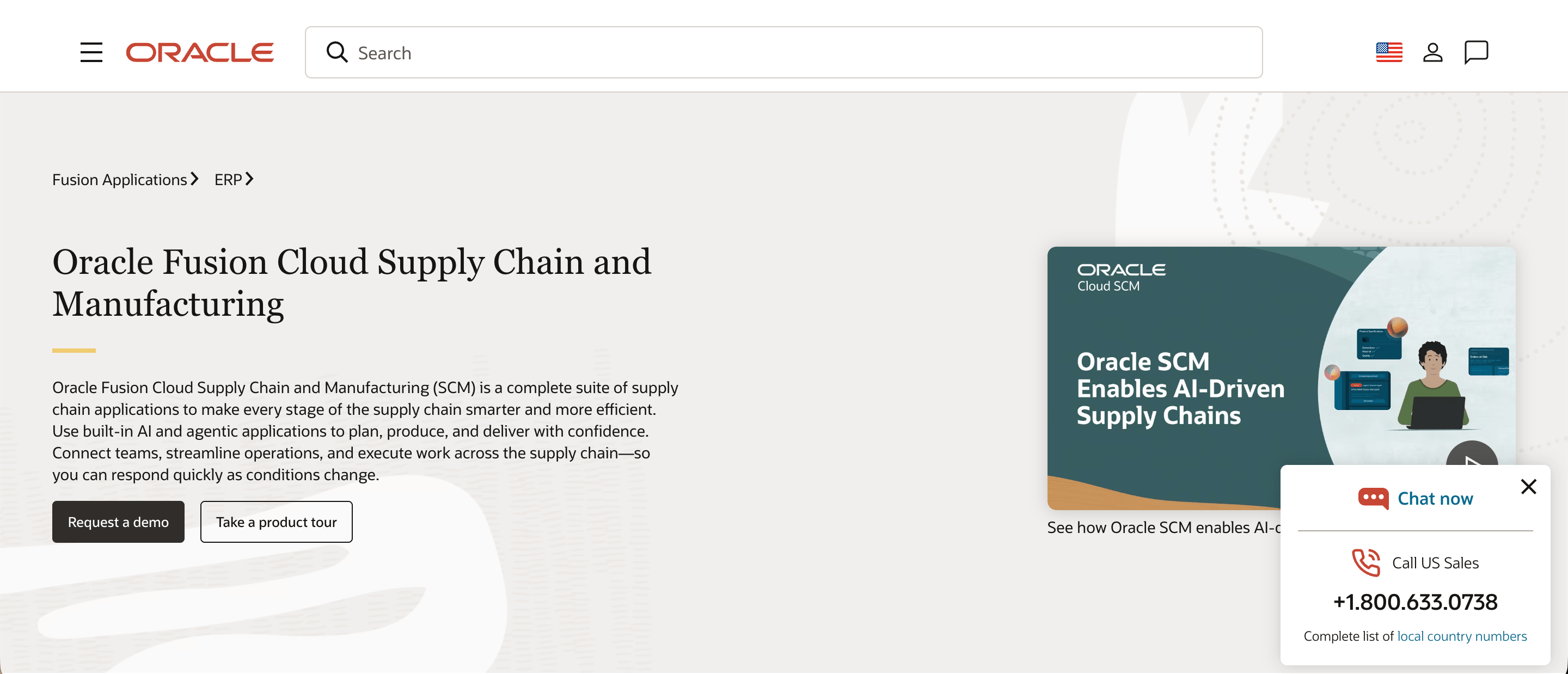
Oracle offers a suite of cloud applications for supply chain management, manufacturing, procurement, inventory optimization, and logistics. Its flagship solution, Oracle Fusion Cloud Supply Chain and Manufacturing (SCM), helps enterprises connect demand planning, production, order fulfillment, and financial operations within a single platform.
As an e2open competitor, Oracle is particularly relevant for large manufacturers, distributors, and consumer goods companies that need to manage complex supply chains. Its integration with Oracle Fusion Cloud ERP also lets businesses link supply chain decisions to financial planning, purchasing, and other enterprise operations.
Why choose Oracle over e2open?
- Integrated supply chain and ERP capabilities: Oracle Fusion Cloud SCM connects with Oracle’s ERP applications, allowing companies to manage procurement, inventory, manufacturing, and financial data together. This gives supply chain teams access to operational and financial information without switching between separate enterprise systems.
- Advanced demand forecasting: Oracle Demand Management combines historical sales, orders, shipments, and external data signals to predict future demand. It supports demand sensing, seasonal forecasting, and promotional planning, helping consumer goods companies anticipate fluctuations and adjust inventory accordingly.
- Supply planning and inventory optimization: Oracle Supply Planning evaluates material availability, production capacity, supplier constraints, and lead times to identify potential shortages. Businesses can simulate different supply scenarios, calculate safety stock requirements, and generate purchasing and production recommendations.
- Warehouse and transportation management: Oracle provides dedicated applications for warehouse management, transportation planning, and global trade management. Companies can coordinate warehouse operations, manage shipments, monitor logistics performance, and handle international trade compliance across their distribution networks.
Oracle pricing: Oracle uses subscription pricing that varies by application and number of users. According to its October 2026 price list, Oracle Fusion Demand Management and Supply Planning each have a list price of $1,250 per named user per month, with a minimum of 10 users. Sales and Operations Planning starts at $625 per user per month and also requires a 10-user minimum. Standard cloud subscription terms are three years, and implementation costs are additional.
4. Locus
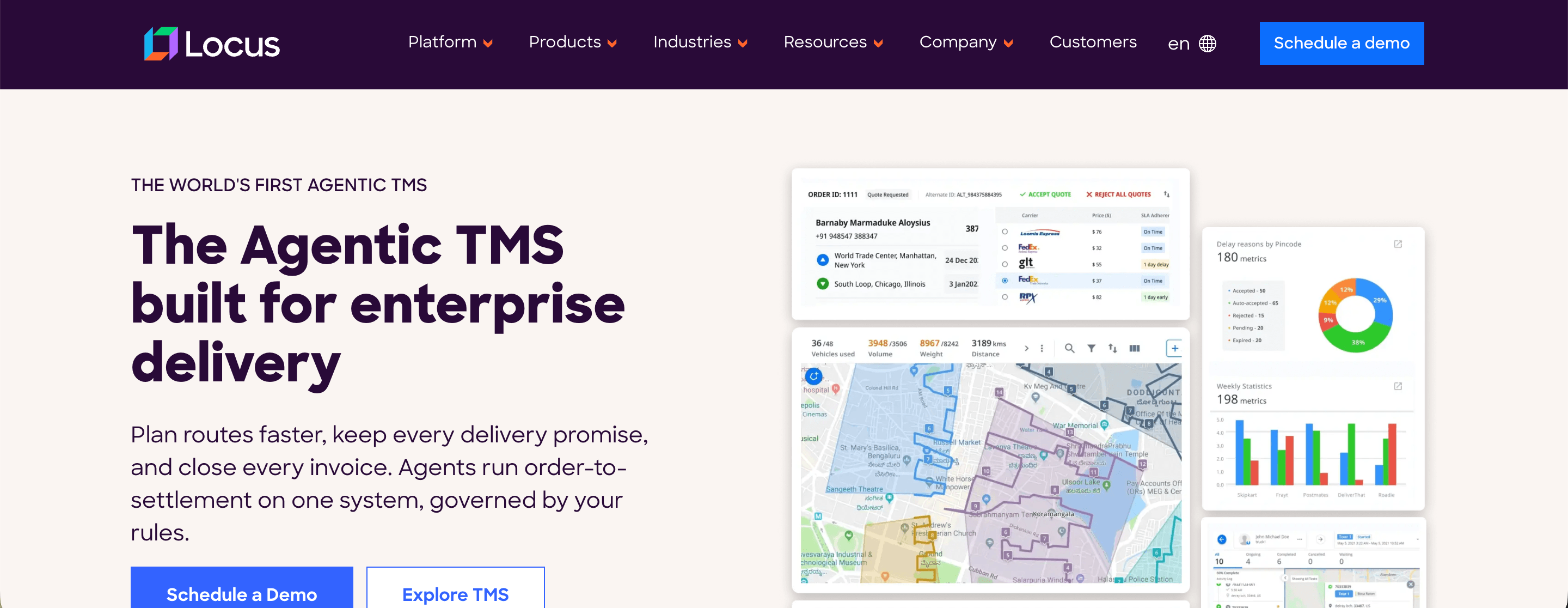
Locus is a logistics management and transportation optimization platform that helps businesses automate route planning, dispatch operations, fleet management, and delivery execution. It serves enterprise retailers, CPG manufacturers, logistics providers, and distributors that manage high shipment volumes across multiple locations.
Compared to e2open’s broader supply chain management suite, Locus focuses more heavily on transportation execution and delivery optimization. Its platform combines automated dispatch, dynamic route planning, carrier management, and real-time shipment tracking to help businesses improve delivery performance and manage logistics operations.
Why choose Locus over e2open?
- Advanced route optimization: Locus optimizes delivery routes based on more than 250 operational constraints, including vehicle capacity, traffic conditions, delivery windows, and driver availability. Routes can be recalculated as conditions change, helping businesses respond to delays and unexpected delivery demands.
- Automated dispatch management: The platform automatically assigns orders to drivers and vehicles based on available capacity, location, and service requirements. Dispatchers can monitor deliveries, adjust assignments, and manage exceptions without rebuilding entire delivery schedules.
- Flexible carrier management: Locus supports owned fleets, contracted carriers, and third-party logistics providers. Businesses can automate carrier selection, compare available delivery capacity, and coordinate shipments across different transportation partners.
- Real-time delivery visibility: Locus provides a centralized control tower to track shipments, monitor delivery performance, and identify operational disruptions. Teams can receive alerts about potential delays, track driver activity, and take corrective action before deliveries miss their scheduled windows.
Locus pricing: Locus offers custom enterprise pricing based on deployment scope, shipment volume, fleet size, operational complexity, and required modules. There are no publicly available subscription rates, and businesses must contact the sales team for a personalized quote. Implementation and integration requirements can also affect the total cost.
5. ClickPost
ClickPost is a logistics management platform that helps ecommerce businesses, retailers, and consumer goods companies manage shipping, carrier selection, order tracking, and returns. It connects businesses with more than 600 shipping carriers through a single API, allowing them to coordinate deliveries across multiple logistics partners.
Unlike e2open, which covers broader supply chain planning, procurement, and transportation operations, ClickPost focuses primarily on shipping execution and the customer experience after an order is placed. Its platform helps businesses automate carrier allocation, monitor shipments, resolve delivery exceptions, and manage returns from a centralized dashboard.
Why choose ClickPost over e2open?
- Automated carrier selection: ClickPost evaluates shipping carriers based on delivery costs, service availability, transit times, and historical performance. Businesses can automatically assign shipments to suitable logistics partners based on their delivery requirements and existing carrier contracts.
- Real-time shipment visibility: ClickPost consolidates tracking information from different carriers into a single dashboard. Teams can monitor shipment progress, spot potential delays, and receive alerts when deliveries risk missing their expected arrival dates.
- Delivery exception and returns management: The platform automates responses to failed delivery attempts, including customer notifications, delivery rescheduling, and carrier coordination. It also offers branded returns portals, exchange management, and automated refund workflows.
- Carrier analytics and performance reporting: ClickPost provides reports on delivery success rates, shipping costs, transit times, and carrier performance. Businesses can compare logistics partners, identify recurring delivery problems, and adjust their shipping strategies as market trends and customer expectations change.
- Easy integrations and ongoing support: ClickPost integrates with ecommerce platforms such as Shopify, Magento, and WooCommerce, alongside warehouse and order management systems. The company also provides dedicated onboarding assistance, API documentation, and ongoing support to help businesses maintain their integrations.
ClickPost pricing: ClickPost offers custom pricing based on shipment volume, selected modules, and business requirements. Companies can purchase specific capabilities, such as carrier allocation, shipment tracking, returns management, and delivery analytics. It does not publish subscription rates, so businesses must contact the sales team for a personalized quote.
6. Blue Yonder

Blue Yonder is an enterprise supply chain management software provider offering solutions for demand forecasting, inventory optimization, warehouse management, transportation, and order fulfillment. Its cloud platform connects planning and execution activities, helping manufacturers, retailers, and consumer goods companies manage complex supply chains.
As an e2open alternative, Blue Yonder is particularly relevant for businesses that need advanced demand planning and operational control over warehouses, inventory, and distribution. While e2open emphasizes collaboration across external trading partners, Blue Yonder combines supply chain planning with detailed warehouse and fulfillment capabilities.
Why choose Blue Yonder over e2open?
- Advanced demand forecasting: Blue Yonder uses machine learning, statistical models, and external demand signals to predict sales and inventory requirements. Businesses can account for promotions, seasonality, and changing customer behavior when preparing demand forecasts and replenishment plans.
- Warehouse management capabilities: Blue Yonder provides dedicated warehouse management software for inventory tracking, picking, packing, labor management, and warehouse automation. Companies can coordinate warehouse operations with transportation and order fulfillment through a single platform.
- Inventory optimization: The platform supports inventory planning across multiple distribution centers, warehouses, and retail locations. Businesses can calculate optimal stock levels, identify potential shortages, and use scenario planning to evaluate how changes in demand or supply could affect product availability.
- Transportation and fulfillment management: Blue Yonder helps businesses plan shipments, select carriers, optimize transportation routes, and coordinate order fulfillment. Its transportation management capabilities also connect with warehouse operations, allowing teams to adjust shipment plans based on inventory availability and operational constraints.
- Integration with enterprise systems: Blue Yonder integrates with enterprise resource planning systems, including SAP and Oracle, as well as other business applications. Companies can connect procurement, manufacturing, financial, and logistics data without replacing their existing ERP infrastructure.
Blue Yonder pricing: Blue Yonder offers custom enterprise pricing based on the selected applications, deployment requirements, and business size. It does not publish public subscription rates for its main supply chain solutions. Businesses must request a quote, and implementation, customization, and integration requirements can affect the total cost.
7. Kinaxis
Kinaxis is a supply chain management platform that helps manufacturers, retailers, and logistics companies manage demand forecasting, supply planning, inventory optimization, and transportation. Its flagship platform, Kinaxis Maestro, connects planning and execution activities to help businesses respond to supply chain disruptions and changing customer demand.
As an e2open alternative, Kinaxis focuses on concurrent planning, allowing businesses to see how changes in one part of the supply chain affect other operations. Instead of updating demand forecasts, production schedules, and inventory plans separately, teams can coordinate these business processes using shared data.
Why choose Kinaxis over e2open?
- Concurrent supply chain planning: Kinaxis lets businesses update demand, supply, inventory, and capacity plans at the same time. When demand changes, or a supplier experiences delays, teams can immediately evaluate the impact on production schedules, inventory availability, and customer orders.
- Advanced scenario planning: Kinaxis Maestro supports simulations that help businesses prepare for unexpected supply chain disruptions. Companies can compare different scenarios, such as supplier shortages, transportation delays, or sudden demand increases, and evaluate their impact before making operational decisions.
- Demand forecasting and inventory optimization: Kinaxis combines historical sales, external demand signals, and machine learning to improve forecast accuracy. Inventory planning tools help businesses calculate safety stock requirements, identify potential shortages, and balance inventory levels across multiple locations.
- Transportation and order management: Kinaxis provides tools for order allocation, carrier selection, shipment tracking, and transportation optimization. Businesses can coordinate fulfillment activities with logistics companies and monitor delivery exceptions across their distribution networks.
- Integration with existing enterprise systems: Kinaxis integrates with ERP platforms such as SAP and Oracle, alongside other supply chain applications. Businesses can connect data from warehouse management systems, order management platforms, and transportation applications to support planning without replacing their existing software.
Kinaxis pricing: Kinaxis offers custom enterprise pricing based on the selected applications, number of users, and implementation requirements. Kinaxis does not offer public subscription rates for Kinaxis Maestro. Businesses must contact the sales team for a personalized quote, and integration, configuration, and implementation services may add to the total cost.
8. Infor Nexus
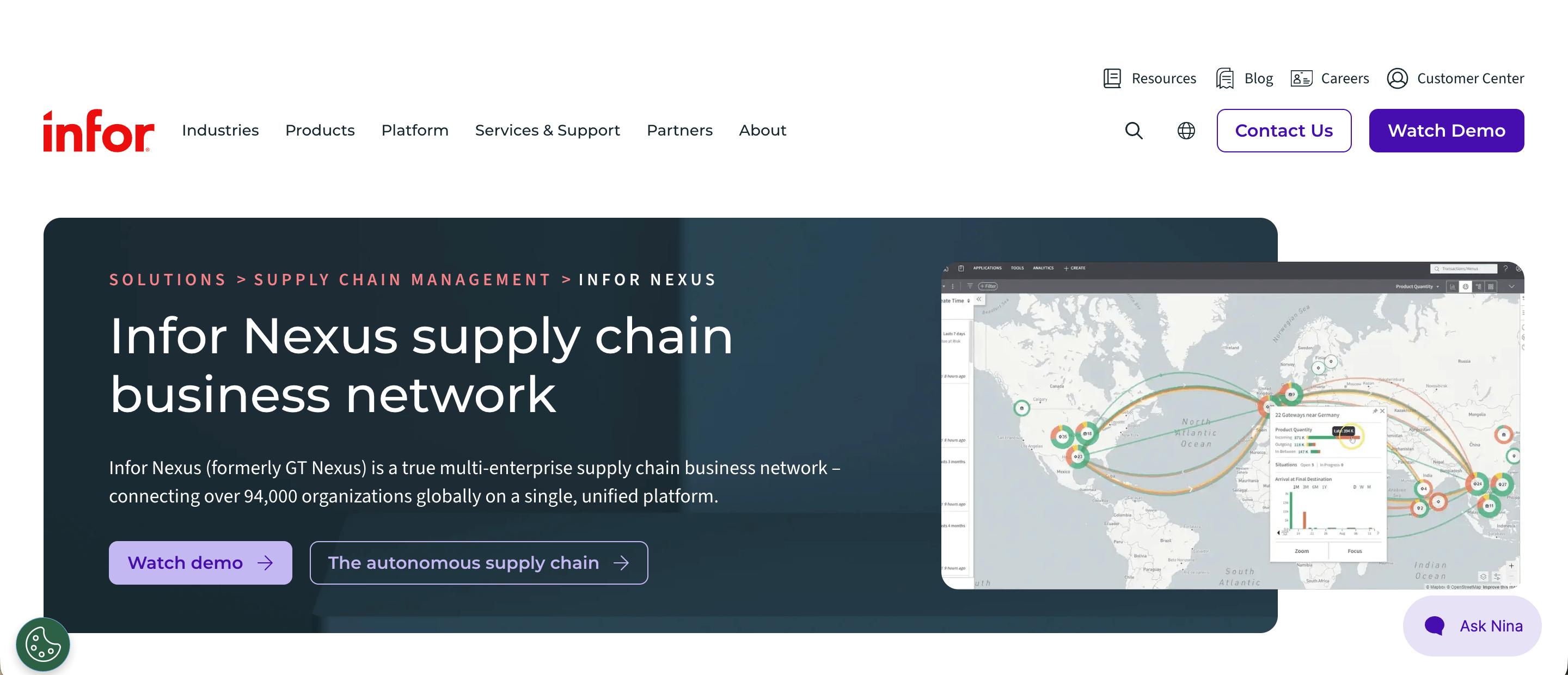
Infor Nexus is a cloud-based supply chain software platform that connects manufacturers, suppliers, logistics providers, and financial institutions through a shared business network. It helps companies manage global transportation, supplier collaboration, inventory visibility, procurement, and supply chain financing.
As an e2open competitor, Infor Nexus serves enterprises across industries such as consumer goods, retail, manufacturing, and distribution. Both platforms support global supply chain operations, but Infor Nexus emphasizes connecting external trading partners and coordinating activities across the entire supply network.
Why choose Infor Nexus over e2open?
- Extensive supply chain network: Infor Nexus connects more than 90,000 brands, manufacturers, suppliers, logistics providers, and financial institutions. Businesses can exchange orders, shipping updates, inventory information, and financial documents with trading partners through a shared platform.
- Advanced supply chain visibility: Infor Nexus Control Center provides real-time visibility into orders, shipments, and inventory across multiple supply chain partners. It uses artificial intelligence and machine learning to predict potential delays, estimate arrival times, and identify disruptions before they affect product availability.
- Global transportation management: The platform supports transportation planning, carrier selection, freight procurement, and shipment execution across ocean, air, rail, and road transportation. Companies can compare carrier performance, manage transportation contracts, and monitor shipments across international routes.
- Supplier collaboration and procurement: Infor Nexus helps businesses coordinate purchase orders, production schedules, shipment documentation, and quality assurance with suppliers. Its procurement tools also automate invoice processing and payment approvals, improving visibility into outstanding orders and financial obligations.
- Supply chain financing and digital transformation: Unlike many traditional supply chain management platforms, Infor Nexus includes dedicated supply chain financing capabilities. Businesses can connect with financial institutions, offer suppliers early-payment options, and manage working capital alongside procurement and logistics.
Infor Nexus pricing: Infor Nexus uses custom subscription pricing based on the selected modules, number of users, transaction volumes, and integration requirements. Public pricing information is not available for its main applications. Businesses must request a personalized quote, and implementation, onboarding, and additional support services may affect the total cost.
9. Precoro
Precoro is a procurement management platform that helps businesses manage purchasing, supplier relationships, budgets, and accounts payable from one platform. It connects purchase requests, approvals, purchase orders, invoices, and payments, giving finance and procurement teams greater visibility into company spending.
Compared to e2open’s broader supply chain management capabilities, Precoro focuses on procurement operations and spend control. It’s particularly relevant for small and midsize businesses that need to automate purchasing, improve supplier management, and make connected decisions without implementing a full enterprise supply chain system.
Why choose Precoro over e2open?
- Centralized procurement management: Precoro brings purchase requisitions, approvals, purchase orders, invoices, and payments into one platform. Businesses can configure approval rules by department, purchase amount, and available budget, keeping purchasing activities consistent across locations.
- Real-time tracking of purchasing activities: Precoro provides real-time tracking of purchase orders, approval statuses, supplier deliveries, and budget utilization. Teams can identify delayed approvals, monitor outstanding orders, and verify received goods against purchase orders before approving invoices.
- Supplier and contract management: The platform centralizes supplier information, contracts, purchasing history, and communication. Businesses can onboard new vendors, compare supplier quotes, manage contract renewals, and track supplier performance through a dedicated portal.
- Budget control and spend analytics: Precoro allows companies to set purchasing limits for departments, projects, and locations. Its reporting tools provide actionable insights into spending patterns, supplier performance, and purchasing trends, helping finance teams identify unnecessary expenses and prevent purchases that exceed approved budgets.
- Accounting and ERP integrations: Precoro connects with accounting and enterprise systems, including QuickBooks, Xero, and NetSuite. Businesses can synchronize purchasing and financial records, supporting connected decisions across procurement, accounting, and operational departments.
Precoro pricing: Precoro offers published subscription pricing, with its Core plan starting at $499 per month and Automation starting at $999 per month, both billed annually. The Enterprise plan uses custom pricing for organizations with more advanced requirements. A separate AP Automation module starts at $499 per month, billed annually. The final price depends on the selected plan, additional modules, and integration requirements.
10. FourKites
FourKites is a supply chain visibility and orchestration platform that helps businesses track shipments, predict delivery delays, and coordinate logistics operations. It connects data from carriers, transportation management systems, warehouses, and other supply chain partners to provide a single source of information about shipment status and operational performance.
As an alternative to e2open, FourKites focuses primarily on transportation visibility, predictive analytics, and logistics execution. Its platform helps manufacturers, retailers, and consumer goods companies improve decision-making and responsiveness when disruptions affect shipments, inventory availability, or customer deliveries.
Why choose FourKites over e2open?
- Real-time shipment visibility: FourKites tracks shipments across road, ocean, rail, and air transportation networks. Businesses can monitor shipment locations, receive updated arrival estimates, and identify potential delays through a centralized control tower.
- Predictive analytics and exception management: FourKites uses machine learning and historical transportation data to predict delays and identify shipments that require attention. Teams can create automated alerts, prioritize high-risk deliveries, and take corrective action before disruptions affect customers.
- Intelligent supply chain orchestration: FourKites connects shipment, order, inventory, and facility information to support coordinated decisions across different business functions. Its automation capabilities let teams respond to shipment exceptions, update delivery appointments, and communicate changes to relevant stakeholders.
- Yard and appointment management: FourKites Dynamic Yard and Appointment Manager helps businesses coordinate trailer movements, dock assignments, and delivery schedules. These tools connect incoming shipment information with facility operations, supporting improved responsiveness when trucks arrive earlier or later than expected.
- Supply chain analytics and performance monitoring: FourKites provides reporting tools for analyzing carrier performance, delivery reliability, facility operations, and transportation delays. Businesses can use these insights to identify recurring problems, evaluate the impact of logistics decisions, and support operational growth as shipment volumes increase.
FourKites pricing: FourKites offers custom enterprise pricing rather than publicly listed subscription plans. Its current commercial model focuses on operational outcomes, with pricing components covering its digital twin platform, network intelligence, analytics, and automated agent workflows. Total investment depends on the organization’s operational footprint and selected capabilities, and businesses must contact FourKites for a personalized quote.
Get the better e2open alternative to improve your operational efficiency
e2open offers a broad range of supply chain management capabilities, but not every business needs an enterprise platform that covers everything from global trade management to transportation and procurement.
For consumer goods brands, the bigger challenge is often understanding what’s happening at the retail level. Without accurate sales and inventory data, forecasting demand, preventing stockouts, and making informed replenishment decisions is difficult.
At Alloy.ai, we help CPG brands solve these problems by connecting retail sales, inventory, and supply chain data in one place.
With Alloy.ai, you can:
- Get a clear picture of retail performance with sales and inventory data from 500+ sources, including retailers, distributors, and e-commerce platforms.
- Improve demand forecasting with actual consumer sales data, inventory trends, and predictive analytics to anticipate demand changes.
- Reduce stockouts and excess inventory by identifying potential shortages, slow-moving products, and replenishment opportunities before they affect sales.
- Make faster inventory decisions with automated reporting, actionable recommendations, and AI agents that help teams identify and resolve supply chain issues.
Instead of spending hours gathering information from disconnected systems, your team can focus on improving product availability, meeting retailer expectations, and making better supply chain decisions.
Ready to see what Alloy.ai can do for your business? Book a demo and discover how better retail visibility can improve your operational efficiency.