
- Logan Ensign
A few years back, a small action-camera brand got the break it had been chasing: a six-week test in about 400 stores at one of the country’s biggest electronics retailers. For a challenger trying to break into that channel, this was existential. Make the test work, earn the shelf.
Within days, the data told a quiet, expensive story. A handful of their best stores were already losing sales, and not the stores you’d guess. The ones in travel and vacation markets, where people buy a camera while on vacation, were going out of stock almost the moment they were restocked.
The cause wasn’t dramatic. The retailer replenished those stores once a week. For a small pilot, it defaulted to the peanut butter strategy: when inventory dropped below two units, the store reordered; in a destination market moving ten times that, two units is a rounding error. The shelf sat empty for days at a stretch, and the test was quietly failing in exactly the stores that should have carried it.
What the brand did next is the whole point. They didn’t ask the retailer to overhaul everything. They went in with one specific, low-cost ask: for these eight stores, raise the reorder point to eight or ten units, and keep everything else the same. The retailer agreed, the lost sales stopped, and with full shelves, the product finally showed its real velocity, which is what earned it a place on shelves chain-wide.
That’s going deep on key accounts. And in a year with no volume tailwind, that’s where the growth is.
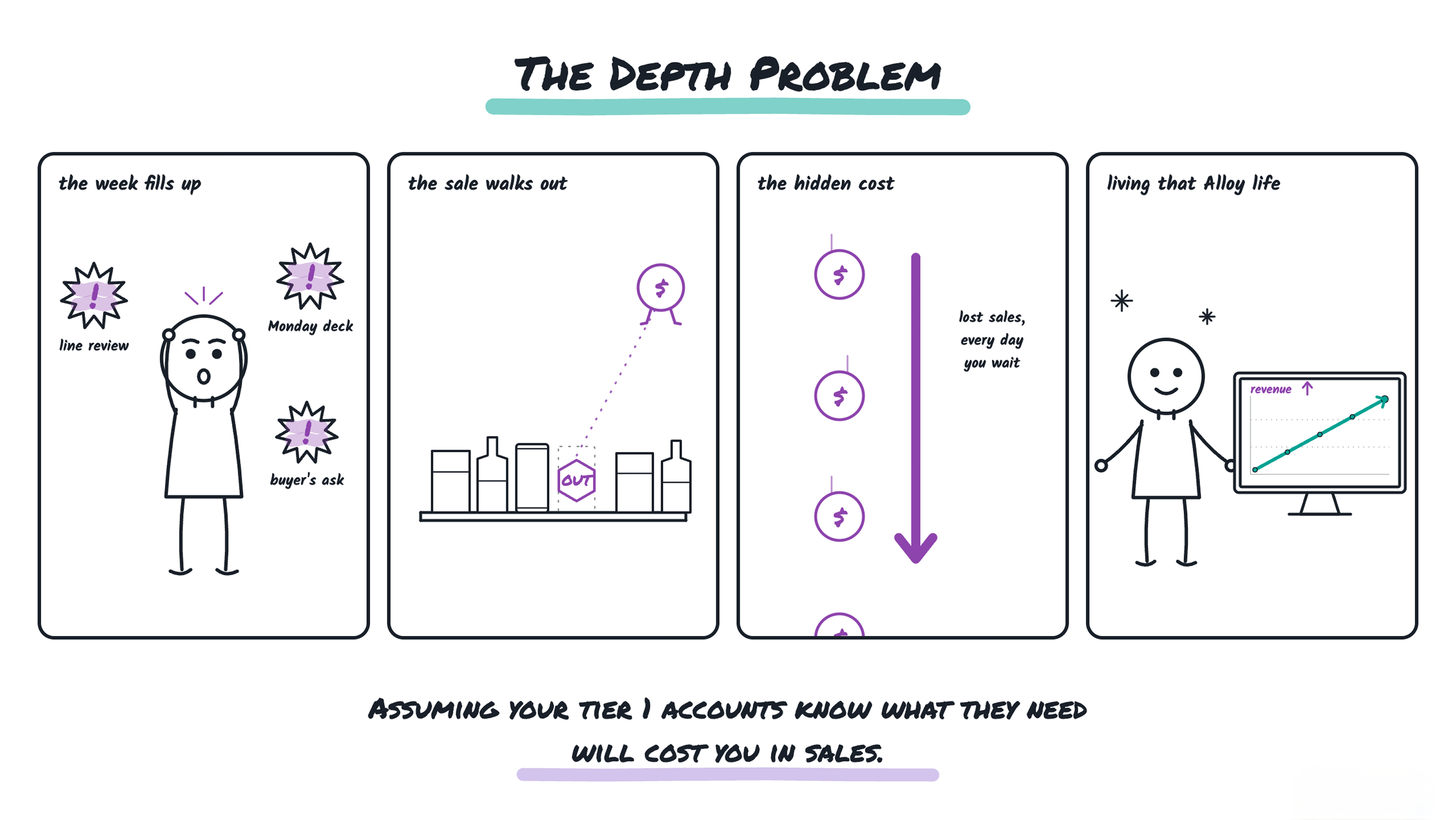
We call this the depth problem: the revenue, risk, and waste that stay buried inside your biggest accounts because no one can see deep enough to act on them.
The Bind
Here’s the situation a lot of brands are in right now. When volume is flat and budgets tighten, you’re forced to cut and reallocate. But you can’t cut intelligently if you can’t see deep enough into any single account to know what’s actually working.
Day to day, the urgent fires eat all the oxygen: an out-of-stock on a hero SKU, a chargeback, a line-review deadline. So the buried stuff never surfaces. The overstock is tying up cash. The product the system swears is on the shelf but isn’t. The SKU is quietly overperforming in a region nobody’s watching. The display you paid for was never actually set up.
Underneath all of it is a mindset shift I put to every sales and supply chain leader I talk to: stop assuming a retailer, especially a top five retailer, is smarter than you about your own brand. They’re not being lazy. They’re managing tens of thousands of SKUs across hundreds, maybe even thousands, of stores. They cannot possibly know that one club store moves a category at a volume that looks like a data error until you dig in and find the real local reason behind it. You can know that. And the brands that make it their job to know it, to actively do the retailer’s job for them, are the ones that stay on the shelf.
I’ve watched the alternative. A brand in a category that a new buyer had decided was basically undifferentiated nearly got commoditized out of its own shelf space, because that buyer looked at a crowded supplier list and saw an easy place to consolidate. The brands that survive that moment aren’t the ones that argue they’re special. They’re the ones who’ve made themselves the easiest, smartest, most useful partner the buyer has: the one whose data quietly does the buyer’s homework for them.
What “going deep” actually surfaces
A few patterns I see again and again. Every one of them is something the retailer can’t see well enough to do for you, which makes it yours to do for them:
- Store-level demand that the retailer’s logic can’t see. The reorder point set too low in your best stores. The regional spike doesn’t fit the national average. This is hyper-local, store-and-SKU work, and it isn’t reasonable to expect a retailer to do it for you across their whole footprint. It is reasonable to expect it of yourself.
- Phantom inventory. One confectionery brand changed its case pack to something harder for store teams to break down. So the store teams, reasonably, left the new packs in the back room. The system is fully read in stock. The shelf was actually empty. Sales went to zero on that SKU in those stores, and nothing in the inventory data flagged it, because on paper, the inventory was there. That gap between what the system says and reality only shows up when someone looks closely.
- The opportunity you’re late to. Going deep isn’t only about catching problems. A sales lead at an arts-and-crafts brand caught one SKU running well ahead of the retailer’s own demand plan, got in front of it before the retailer’s system reacted, and turned it into roughly $100K in incremental sell-in inside of a week. The signal was sitting right there. She was just deep enough to act on it first.
- The money you’ve already spent. Trade spend is one of the biggest line items a sales team controls, and a lot of it walks out the door unverified. You pay for an endcap, or a working demo unit, in hundreds of stores. Is it actually live in all of them? Field teams can spot-check, but nobody visits every store every week. The data can tell you which stores got the program and aren’t seeing the lift their peers are, which is usually where the execution quietly broke.
- The forecast that both your teams should be reading. This is the one that changes who needs to be in the room. Your biggest retailers tell you what they intend to order from you over the next several months. On the sales side, that isn’t abstract planning; that’s the buyer telling you what they’re going to buy, and whether they’re quietly under-ordering something you should be pushing back on. Here’s the catch. Usually, only the sales team can even see that retailer forecast. The supply chain team, the people who actually have to make sure you can fill those orders, often can’t. When both teams see the same shift the week it happens, sales can push back on the order, and the supply chain can get ahead of filling it, instead of finding out when the PO lands. Getting both onto the same view, and watching how it moves week to week, is one of the highest-leverage things a brand can do. It’s where going deep stops being one person’s hustle and becomes a cross-functional team sport.
None of these is a heroic, once-a-quarter insight. Each one is small. That’s exactly why they get skipped, and exactly why they add up. “The retailer will reorder” feels reasonable in the moment. It’s also a hidden tax you pay in lost sales every single day you wait.
Where technology comes in
This is the gap we built Alloy to close, and not with a single feature. The pattern underneath all five problems is the same: the signal already exists, but it’s scattered across every store, every SKU, and every commerce partner, far more than any team can hold in their head or their spreadsheets. So no one acts on it. Alloy’s job is to pull all of it into one place. The agents are what happens once it’s there.
The Replenishment AI Agent watches for at-risk inventory and brings the order back ready to approve, so the fire drill doesn’t eat the day. The Performance Reporting AI Agent hands teams their Monday read instead of making them build it, so the hours go to the strategic work and not the reporting. And the retailer-forecast visibility and forecast-adjustment work is aimed at the thing that prevents fire drills in the first place: helping the retailer order better, so you’re not forever catching stockouts after they happen.
We’re not done, either. We’ve talked publicly about a Trade Promotion AI Agent and a Forecast Adjustment AI Agent on the way. The idea is to take more of the repetitive, valuable-but-not-strategic work off your team’s plate, so the people who know your brand best spend their time on the calls that actually move it. Capacity, not cuts.
But going deep on your top three to five commerce partners is only half the story. Doing it across your whole footprint, including the long tail of retailers that never hand you a forecast at all, is the other half. That’s the breadth problem, and it’s a conversation for another day.
For now, the takeaway is simple. In a flat market, you don’t grow by finding new demand. You grow by finding the demand that’s already sitting inside the accounts you have. The signal’s there. The only question is whether anyone’s deep enough to see it.

Logan Ensign
Logan Ensign is vice-president of client solutions at Alloy Technologies, Inc. where he works with customers to maximize value from the data, analytics and planning platform by ensuring fast implementation, delivering trainings, sharing ongoing best practices and conducting regular business reviews.
Book a Demo
See Alloy.ai
Synchronize execution to eliminate waste, mitigate risk, and capture every revenue opportunity.
Once you submit a demo request form:
- A sales rep will email you within 24 hours to schedule a brief intro call.
- Our team will provide an overview of Alloy.ai and learn more about your data goals and objectives.
- We’ll create and walk you through a live demo, customized to your specific data needs.