
- Logan Ensign
Or trying to.
I’ve had some version of the same conversation with sales leaders probably a hundred times. It usually starts with something like: “Our top accounts are covered. We’re on it. We know exactly what’s happening at Costco, Target, the big ones.”
And then I ask about the next twenty. Or the next fifty.
The answer is almost always some version of: “We get to them when we can.”
I want to be clear that this isn’t a failing of the people carrying those accounts. The teams I’m talking to are good at their jobs. What’s happening is a math problem, not a talent problem. No team of humans can monitor every SKU at every location across hundreds of commerce partners and still have the bandwidth left over to act on what they find.
So the tier-1 accounts get coverage. The rest of the network gets whatever’s left.
What “Whatever’s Left” Actually Costs You
Here’s what I find interesting about the long-tail problem: the brands that feel it most aren’t the brands with bad data. They’re the brands with good data that their teams don’t have time to read.
You have visibility into your secondary accounts. You can see what’s happening at the regional distributor, the specialty retailer, the ecommerce partner that punches above its weight during certain seasons. The data is there. What’s missing is the hours to act on it before the window closes.
A demand surge at a secondary account looks like this from the inside: a small signal appears in the data, nobody catches it in time, the shelf goes empty, the sale is lost, and two weeks later it shows up in a report as a line item that someone has to explain in a Monday meeting. By that point, the conversation is about what happened, not what to do about it.
We call the distance between sensing that signal and having the power to act on it before it costs you the Execution Gap. And what I’ve observed from working with customers across the consumer goods spectrum is that the Execution Gap isn’t evenly distributed across your network. It’s widest exactly where your team’s attention is thinnest.
The Depth Problem Is Just As Real
The long-tail problem is the more visible one, but there’s a companion issue worth naming: even on your tier-1 accounts, most teams are only surfacing the loudest signals.
The slow-building gap — the SKU-location that’s been quietly drifting toward an out-of-stock for three weeks — rarely makes it onto anyone’s radar until it’s already a problem. Not because the data isn’t there. Because someone would have to be watching that specific combination of SKU and location, across all the locations, at a granularity that human bandwidth simply doesn’t allow.
What I hear from sales leaders is that they feel like they’re always reacting. A buyer calls with a complaint. An OTIF fine arrives. A competitor takes shelf space during a gap. The response is good — the team is capable — but it always comes after the fact.
That’s not a strategy problem. It’s a capacity problem.
What Closing This Gap Actually Looks Like
Joel wrote about the Execution Gap from the product and market angle last week. What I want to add is what it looks like from the inside of the customer teams I work with.
The shift isn’t about getting access to more data. The brands I work with already have the data. It’s about what your team can do with it before the moment to act passes.
When I describe the Replenishment AI Agent to sales leaders, the thing that lands isn’t the technology. It’s this: every account in your network — from your biggest retail partner to the regional distributor your team hasn’t had time to check this week — gets the same level of attention. Not because you hired more people. Because the agent is doing the monitoring and preparation work your team never had hours for.
Your team moves from finding the gaps to approving the fixes. The discovery and the drafting are already done.
For a sales leader, that means something specific: the accounts that used to be invisible to your replenishment team until something went wrong are now visible before the problem develops. Demand surging at a secondary account gets caught in time. The recommendation is ready. The shelf stays full.
The Other Half of the Capacity Problem
There’s a second place I see the Execution Gap show up for sales leaders, and it’s just as consistent: the Monday morning meeting.
The replenishment problem is about acting on signals in time. The reporting problem is about understanding them in time. Even when your team has the data in front of them, getting from “something moved” to “here’s why it moved and here’s what we should do about it” takes hours of analysis that the window often doesn’t allow. By the time the brief is ready, the moment to get ahead of it has narrowed considerably.
What I hear from sales leaders: “we can see what happened, but by the time we’ve worked through the data capture, the cleansing, the root cause analysis, and turned it into something the leadership team can act on, we’re already a step behind.”
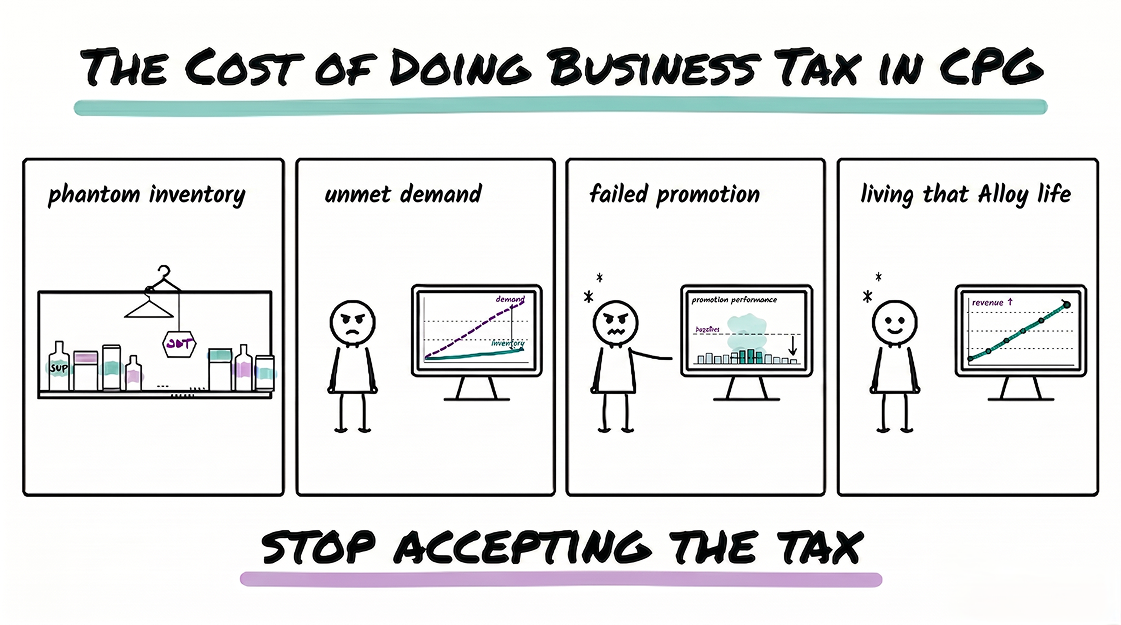
The Performance Reporting AI Agent closes this part of the gap. Every week, it goes beyond surfacing what happened — it identifies the root cause behind performance shifts across your commerce network. Phantom inventory. Promotion execution gaps. Localized voids. And it packages all of that into a complete executive brief, with narrative commentary, live charts, and actionable recommendations, before your team’s first meeting of the week.
For a sales leader, that means walking into Monday with a strategy instead of a spreadsheet. The SKU-location context is already there. When a buyer pushes back, you have the data behind you. And the follow-up questions that typically send someone back to the data for two days — those get answered in the room.
The two problems are connected. The Replenishment Agent makes sure the right actions happen before the window closes. The Reporting Agent makes sure your team understands why the windows are opening and closing in the first place — so the strategic calls get better over time, not just faster.
What Time Gets Spent On Instead
I’m genuinely curious to watch how this changes what teams do with the hours they get back. The early signals from the customers we’ve had in beta are that the time doesn’t just get reallocated to more monitoring — it goes toward the relationships and the decisions that actually require human judgment. The buyer conversation. The strategic call on a new account. The edge case that the agent correctly surfaces but that the team needs to evaluate with context the agent doesn’t have.
That’s the version of this I find most interesting. Not the time saved. What the time gets spent on instead.
If This Is Your Problem
If any of this sounds familiar — the tier-1 coverage, the long-tail gap, the reactive cycle — I’d encourage you to read Joel’s launch piece from last week for the full product context.
And if you’re already an Alloy.ai customer and want to understand what activation looks like for your team specifically, reach out to your CSAM. That’s the conversation worth having.

Logan Ensign
Logan Ensign is vice-president of client solutions at Alloy Technologies, Inc. where he works with customers to maximize value from the data, analytics and planning platform by ensuring fast implementation, delivering trainings, sharing ongoing best practices and conducting regular business reviews.
Book a Demo
See Alloy.ai
Synchronize execution to eliminate waste, mitigate risk, and capture every revenue opportunity.
Once you submit a demo request form:
- A sales rep will email you within 24 hours to schedule a brief intro call.
- Our team will provide an overview of Alloy.ai and learn more about your data goals and objectives.
- We’ll create and walk you through a live demo, customized to your specific data needs.