
- Joel Beal
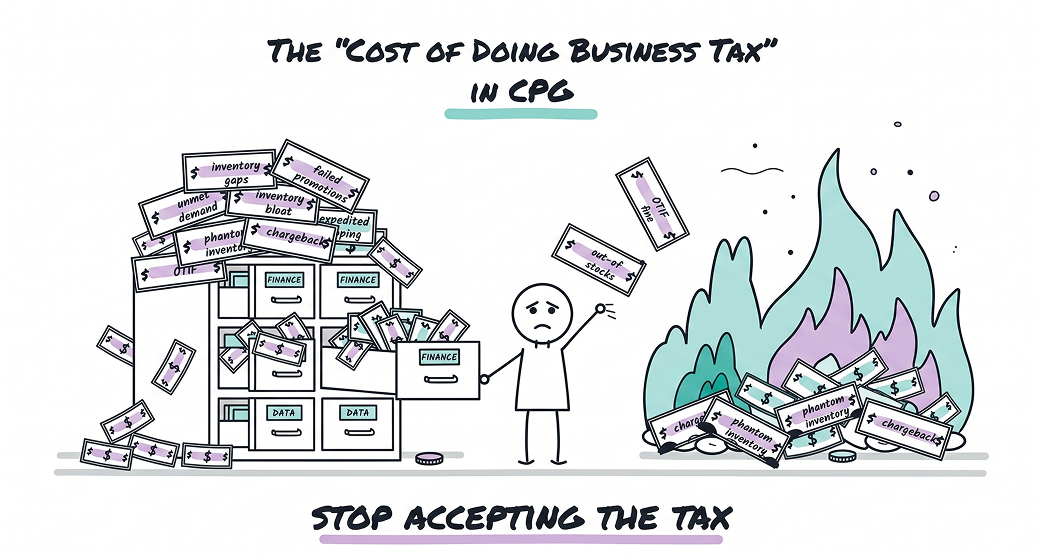
There’s a cost every consumer brand pays that no P&L isolates. It’s smeared across freight, deductions, and headcount. Visible in aggregate, invisible in cause.
It’s the revenue that walked out the door when your product was missing from the shelf. It’s the OTIF fine that arrived six weeks after the problem it was penalizing; by which time nobody could remember the shipment, let alone fix the process. It’s the expedited freight your team scrambled to cover, buried in a COGS line nobody questions. It’s the analyst hours burned every Sunday night on a report that was stale by Monday.
The supply chain industry has a name for this: “the cost of doing business.” The implication is that it’s unavoidable. A weather pattern. Something you manage around, not something you solve.
I’ve never believed that. And starting today, we’re done accepting it.
Table of Contents
The Problem We Actually Have
The industry spent years solving the first problem: visibility. Getting data out of siloed retail portals, ERPs, distributors, and ecommerce platforms and into one place where teams could finally see the full picture. That was real progress.
But it created a new problem that I don’t think gets talked about enough.
Seeing a leak in your revenue doesn’t stop the bleed.
Even with the best data in the world, most consumer brand teams are still stuck in the same cycle: a demand signal appears, an analyst catches it eventually, a report gets built, a meeting gets scheduled, and a decision gets made. And by the time the order is placed, the window has closed. The shelf was empty for two weeks. The OTIF fine already hit. The fire drill is already in progress.
We call the distance between sensing a demand signal and having the power to respond before it costs you the Execution Gap. And for most brands, it’s measured in days or weeks, not hours.
Here’s what I think is the honest diagnosis of why it persists: the Execution Gap isn’t a data problem. It’s a capacity problem. There simply aren’t enough hours in the day for your team to monitor every SKU at every location across every commerce partner, process what they find, and act on it fast enough to make a difference. The market has outpaced human bandwidth.
I’ve watched this play out over and over. A brand has great people, good data, and they’re still losing. Not because they’re doing anything wrong. Just because no team of humans can operate at the speed and scale that modern retail requires.
What We Built
Today, Alloy.ai is launching two purpose-built for consumer goods AI Agents that close the Execution Gap by doing the work your team doesn’t have the hours to do themselves.
Replenishment AI Agent
Most replenishment teams spend 80% of their time on their largest retail partners, leaving secondary accounts, regional divisions, and the long tail underserved. The result is predictable: demand surges get missed, shelves go empty, and revenue leaks out quietly while everyone is heads-down on the accounts that already have attention.
The Replenishment AI Agent fixes the capacity problem. It stays plugged into all your connected commerce partners, tracking POS and inventory data around the clock. When it finds where demand is outpacing supply, it doesn’t just flag it; it calculates the exact order quantity needed to restore optimal stock levels, and drafts the recommendation with supporting data and charts, ready for you to review and approve in a single click.
Your team moves from portal-hopping and spreadsheet-building to reviewing and approving. Every account gets the attention of a tier-1 account.
“Replenishment planning has always forced a tradeoff — the more time we spend managing underperforming items, the easier it is for overperforming ones to fall through the cracks,” says Melissa & Doug Sales Analyst Peter Choi. “The Replenishment Agent changes that. It catches the risks we don’t have bandwidth to find ourselves and surfaces them ready to act on. That’s exactly what we’ve needed.”
Performance Reporting AI Agent
If you’ve ever spent a Sunday night downloading Excel files, pasting data into slides, and writing commentary for a Monday morning meeting. You know the drill. By the time you’re done, the report is already backward-looking.
The Performance Reporting AI Agent ends the scramble. Every week, it automatically monitors your POS, shipments, and inventory levels across your entire commerce network, identifies the root cause behind every performance shift, from phantom inventory and localized voids to unexecuted promotions, and delivers a complete executive brief before the first meeting of the week.
Narrative commentary. Live charts. Execution-ready recommendations. Before your first cup of coffee.
The result isn’t just time saved. It’s the difference between walking into a Monday meeting with a spreadsheet and walking in with a strategy.
We are a lean team, and the Performance Reporting Agent is potentially revolutionary for our workflow,” says BIC Omnichannel Growth & Strategy Team Lead Matt DePaolo. “The ability to use the AI to do math and manipulate data that we previously had to dig for manually is pretty earth-shattering. Having an agent automatically summarize our business performance can reduce our meeting times by half.”
How It Works
Both agents are built on the same foundation that makes everything we do at Alloy credible: a unified, trusted single source of truth.
Alloy.ai connects to 450+ commerce partners — retailers, ecommerce platforms, distributors, and ERPs — normalizing and enriching data at the SKU-location level in real time. Next, our proprietary commerce and supply chain logic is then applied to the data before it is analyzed. Every recommendation the agents produce is grounded in this contextualized data and fully explainable. Your team can audit the underlying signals in seconds. No black boxes. No mystery outputs. Just granular, high-fidelity data that your team can actually bet their P&L on.
The agents don’t replace your team’s judgment. They eliminate the grunt work — the discovery, the calculation, the drafting — so your people can focus on the decisions that actually require human expertise.
I think this distinction matters. I’ve been skeptical of all the hype and over-promising of AI in marketing. Not because AI isn’t going to change the way we work—it will—but because so many companies are just slapping it on. What I’ve seen work—in our own product and elsewhere—is AI that takes the things humans shouldn’t be doing and handles them, so humans can focus on the things only they can do. That’s what we built here.
What’s Next
The Replenishment AI Agent and Performance Reporting AI Agent are the first two releases in an expanding suite. Two more are on the immediate roadmap:
The Trade Promotion AI Agent will monitor real-time sales lift against targets and prepare corrective actions for pricing non-compliance or execution gaps, ensuring your promotional spend drives revenue rather than becoming another line item in the Cost of Doing Business Tax.
The Forecast Adjustment AI Agent will identify retailer forecast inaccuracies and prepare data-driven adjustment communications to align your supply chain with actual consumer demand signals, eliminating the data lag that forces supply chain teams into reactive mode.
Both are on track for Q3 2026. And they won’t be the last.
The Tax Is Optional
Consumer brands have been told for decades that the cost of doing business — the stockouts, the fire drills, the manual reporting, the OTIF fines — is just part of the game.
I don’t buy it. The data to prevent most of these problems has been there for years. What’s been missing is the system to act on it fast enough, at the scale required, without burning out the team in the process.
That system is now here.
The Execution Gap is real. I’ve seen it cost brands real money. But it’s not inevitable, and starting today, closing it is something your team can actually do. Before Monday morning.

Joel Beal
Joel Beal is CEO and co-founder of Alloy. He started Alloy after serving as VP of Product at Addepar, a financial analytics company. Prior to that, he worked at Applied Predictive Technologies, which specializes in business analytics software for retail and consumer goods companies (acquired by Mastercard). Joel holds an M.A. in economics from Stanford University and a B.A. in economics and mathematics from Columbia University.
Book a Demo
See Alloy.ai
Synchronize execution to eliminate waste, mitigate risk, and capture every revenue opportunity.
Once you submit a demo request form:
- A sales rep will email you within 24 hours to schedule a brief intro call.
- Our team will provide an overview of Alloy.ai and learn more about your data goals and objectives.
- We’ll create and walk you through a live demo, customized to your specific data needs.