
- Ben Merva
Retail wastes a staggering amount of money on inventory it can’t actually see. IHL Group pegs the global cost of inventory distortion—out-of-stocks plus overstocks—at roughly $1.73 trillion a year, about 6.5% of all retail sales. Why? It’s a structural problem, and a big slice of it traces back to brands flying blind on what’s really selling.
If you’re searching for SPS Commerce alternatives, you’re probably feeling some version of that blindness. SPS Commerce built a genuinely large retail and EDI (electronic data interchange) network, and credit where it’s due—for document exchange, it works. But the phrase “SPS Commerce alternatives” means two very different things depending on who’s asking.
Some people want a cheaper or easier EDI provider. Others—usually consumer brands stuck on SPS Analytics—want better retail analytics, full stop. Those are different jobs, and most listicles smush them together. We won’t.
Below are 10 alternatives grouped by the job they actually do: managed EDI, integration/iPaaS, and retail analytics. You’ll get a clear pick for each, including the best option for real-time visibility. Want the deeper version first? Here’s the complete retail analytics buyer’s guide.
Table of Contents
Why brands look for SPS Commerce alternatives

Brands leave SPS Commerce for four recurring reasons: premium pricing with contract-first sales, slow onboarding and uneven support, manual workflows, and rigid pre-built reporting. For consumer brands, the analytics gap stings most. Because SPS is primarily an EDI provider, SPS Analytics often underdelivers on flexible, real-time, SKU-location visibility.
Talk to enough supply chain leaders and the same gripes surface. Pricing tends to run high, and you usually sign before you’ve validated fit. Support and partner onboarding can drag—testing one new trading partner sometimes takes weeks, not days, and tickets pile up. And the reporting? Canned. The moment you ask the next question, you’re back in a spreadsheet.
The analytics complaint is the one that quietly costs the most. SPS Analytics hands you reports, but consumer brands need to slice demand by SKU and store in real time—and most operators would agree that’s where it runs out of road.
Common reasons brands start shopping around:
Premium pricing and a contract-first sales motion
Slow onboarding and inconsistent support tickets
Manual, clunky workflows (that wide Assortment spreadsheet, anyone?)
Canned analytics that can’t answer the next question
No real-time, SKU-location view of demand or stockout alerts
Greg Buzek, who runs IHL Group, framed the wider stakes bluntly: for retailers, it’s “evolve or get left behind.” His firm found that brands using AI and machine learning for inventory posted 2.3x higher sales growth and 2.5x higher profit growth than the laggards. Experts agree the gap between data-driven brands and everyone else keeps widening. The cost of not seeing your own customer demand isn’t abstract—it shows up in lost sales and tied-up cash.
The hidden cost of EDI and rigid reporting
Here’s the part nobody quotes you upfront. EDI compliance carries real deductions, and vendors feel them. Late or missing ASNs are the single biggest trigger of retailer chargebacks, and those fines typically run a few percent of invoice value, spiking higher in peak season on platforms like Amazon Vendor Central. One audit of billions in vendor revenue put the all-in figure at roughly $4.41 for every $1 of direct chargeback once you count admin time. Manual mapping, reconciling portal pulls by hand from each retailer website, chasing invoices—it all eats cash and team hours you’d rather spend selling. None of that is really a digital transformation; it’s lost money and lost time, and getting compliance right is how vendors save both.
What to look for in an SPS Commerce alternative
Evaluate any SPS Commerce alternative on six things: data coverage and integrations, real-time versus batch data, analytics flexibility, automation and AI, support and onboarding, and total cost. Then start from the job to be done—document exchange, system integration, or retail analytics—instead of the brand name.
Six criteria, quickly:
Data coverage—how many retailers, distributors, and systems it connects to out of the box.
Real-time vs batch—daily truth beats a weekly export.
Analytics flexibility—can you regroup and filter on the fly, or are you stuck with canned reports?
Automation and AI—does it just display data, or act on it with alerts and recommendations?
Support and onboarding—how fast to go live, and who actually picks up the phone.
Total cost and security—onboarding, per-partner fees, in-house maintenance time, and data security/governance.
Then sort the field into three buckets: managed EDI, integration/iPaaS, and retail analytics platforms. Match the tool to the job. A brand that needs to see and act on demand doesn’t need more EDI plumbing—it needs analytics. If your end goal is to build a demand-driven supply chain, that distinction is the whole ballgame.
The 10 best SPS Commerce alternatives
These 10 alternatives cover three jobs—managed EDI, integration/iPaaS, and retail analytics. Each entry tells you what the tool actually is, who it fits, where it falls short, a third-party rating signal, and how it compares to SPS. No pricing here; that’s a Sales conversation, and headline numbers rarely tell the real story. Plenty of opinions float around online; here’s ours, trade-offs and all.
1. Alloy — retail analytics and visibility
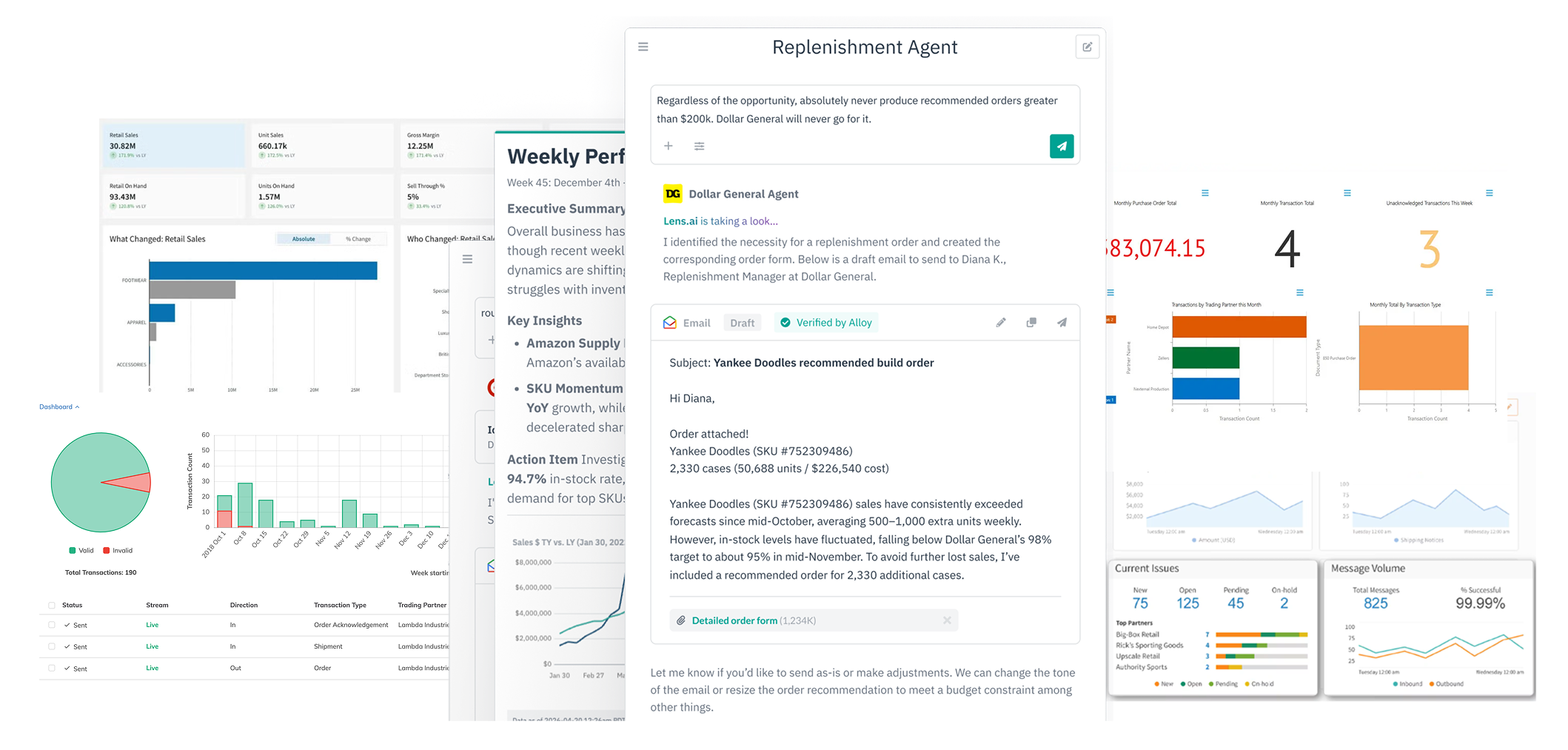
Alloy is the strongest pick for the analytics-and-visibility job. It’s a purpose-built retail intelligence platform that harmonizes POS, inventory, e-commerce, distributor, and ERP data from 450+ pre-built connectors into one real-time, SKU-location view. Where SPS Analytics hands you canned reports, Alloy lets your team zoom in, filter, and regroup to answer the next question without exporting anything.
The real differentiator is the agentic AI that acts on every SKU layered on top of that unified data. The Replenishment AI Agent detects store-level stockouts, fires alerts, and drafts recovery orders for your approval—automated retail replenishment instead of after-the-fact firefighting. The Performance Reporting AI Agent turns raw numbers into executive-ready narratives. These aren’t generic “ML-powered” features; they’re agents that surface revenue opportunities and take action.
Under the hood, there’s CPG-specific logic too: 40+ retail calendars (4-5-4 and friends), unit-of-measure mastery, cross-identifier mapping across ASINs and DPCIs, plus clean, secure exports to Snowflake, BigQuery, Tableau, Power BI, SAP IBP, Kinaxis, and Anaplan.

Best for: Consumer goods brands selling through major retailers like Target and Amazon, plus distributors, that need to respond in real time—not just exchange documents.
The proof: One Alloy customer drove $4M in incremental sales by catching phantom inventory, and brands report cutting lost sales by up to 35% while reclaiming 100+ hours a month.
How it compares versus SPS: this is the honest, winning framing—Alloy is analytics-first and ingests SPS/EDI data rather than ripping out your EDI plumbing. You can connect SPS data into your analytics and keep what already works.
Book a Demo
See Alloy.ai
Synchronize execution to eliminate waste, mitigate risk, and capture every revenue opportunity.
Once you submit a demo request form:
- A sales rep will email you within 24 hours to schedule a brief intro call.
- Our team will provide an overview of Alloy.ai and learn more about your data goals and objectives.
- We’ll create and walk you through a live demo, customized to your specific data needs.
Schedule a Demo
2. TrueCommerce — managed EDI
Full-service cloud EDI with broad ERP integration and a large trading partner network. TrueCommerce markets itself on cost savings relative to SPS, and for small- to mid-sized suppliers who just want a managed EDI swap, that pitch lands.
Best for: Suppliers wanting hands-off document exchange with solid ERP fit.
Where it’s lacking: Customization has limits, and analytics isn’t the point. You’re buying EDI, not visibility, so if your real problem is reporting, this won’t save you. The trading-partner network is genuinely deep, though, so onboarding a new retailer rarely means starting from scratch. Just go in clear-eyed—you’re solving for connectivity, and the insight layer is a separate purchase.
G2 rating: 4.4

3. Cleo Integration Cloud — ecosystem integration / iPaaS
Cleo blends EDI with API-based integration and strong data translation, aimed at teams wiring many partners and systems together.
Best for: IT-led teams with genuinely complex, multi-partner integration needs where APIs and EDI coexist.
The catch: Setup complexity and a learning curve. It’s powerful, but it’s not a weekend project—and it’s not a retail-analytics tool. Pricing climbs with complexity, so it pays off most when you have real integration sprawl to tame. For a brand that mainly wants to see store-level demand, it’s more plumbing than payoff.
G2 rating: 4.4

4. Orderful — modern API-first EDI
Orderful is the developer’s EDI solution: cloud, API-first, and known for fast onboarding. If your team would rather build once and connect to many partners through a clean API, this one’s worth a serious look.
Best for: Tech-forward teams that want modern tooling and a developer-friendly setup.
Limitation: The partner catalog is smaller than the old incumbents, so check coverage for your specific retailers before you commit. The API-first model also means your engineers, not a managed-services queue, own the pace of changes. That’s a plus if you have developers to spare, and a drawback if you don’t.
G2 rating: 4.7

5. eZCom Software EDI — managed EDIs
eZCom is fully managed EDI for brands and wholesalers connecting to major retailers, and its customer support reputation is the headline—users rate it quite high on G2, often calling out their employees by name.
Best for: Lean teams that want high-touch, hands-on EDI management and responsive customer service without staffing it in-house. It’s less ideal if you’re after API/iPaaS flexibility or analytics. For vendors that value responsive service over self-serve dashboards, eZCom helps you save real hours every week.
The flip side: everything routes through their people, so you trade some self-serve control for that white-glove touch.
G2 rating: 4.7

6. Celigo — iPaaS with EDI
Celigo is an iPaaS with a big prebuilt connector library, AI-assisted automation, and EDI workflows. If you live in NetSuite or Shopify and want order-to-cash automated, it fits nicely.
Best for: NetSuite/Shopify-centric operations automating orders and fulfillment.
Limitation: It’s a broad integration platform, not a retail-analytics specialist—great at moving data between systems, less helpful when you need to actually interrogate that data. The connector library saves real build time if your stack is mainstream. Stray outside it, though, and you’re back to custom work.
G2 rating: 4.6

7. Boomi — enterprise iPaaS
Boomi is a low-code integration platform built for B2B/EDI and application integration at scale. Big enterprises use it to standardize dozens of integrations across the business on one platform.
Best for: Organizations standardizing many integrations company-wide.
The trade-off: Cost and resourcing complexity drive demand. Overkill if all you need is retail visibility. It scales to serious enterprise volume without breaking a sweat. For a lean brand, that horsepower mostly shows up as cost and setup you won’t use.
G2 rating: 4.4

8. Crisp — retail data / analytics
Crisp is a cloud retail-data platform that connects retailer portals and surfaces sales and inventory analytics—a genuine analytics-side peer, not an EDI tool.
Best for: Brands that want connected retail data without building pipelines in-house.
Where Alloy pulls ahead, in our view: Real-time SKU-location depth and agentic AI that acts on the data with alerts, not just dashboards that display it. Of the analytics-side competitors, Crisp is a reasonable pick if connected retail feeds are the whole ask. We’d still point most consumer brands—and any growing business—toward a platform that acts, not just reports.
G2 rating: 4.4

9. RELEX Solutions — supply chain / demand planning
RELEX is a demand forecasting, replenishment, and retail planning suite—heavier machinery aimed at planning-led organizations.
Best for: Teams whose core need is forecasting and replenishment at scale.
Limitation: it’s a bigger, planning-focused deployment that takes time to stand up. If you mainly want fast visibility and the freedom to ask the next question, RELEX is more than most consumer brands need to start with. Among SPS Commerce competitors, it suits a forecasting-led business more than a scrappy DTC brand, and it won’t save a smaller team much setup time. When forecasting truly is your core job, RELEX earns its footprint. For everyone else, it’s a heavy answer to a lighter question.
G2 rating: 4.6

10. ConnectPointz — retail EDI / commerce automation
ConnectPointz brings retail EDI plus order and marketplace automation, backed by 35+ years of integration experience.
Best for: Vendors and suppliers wanting EDI alongside order and marketplace automation in one place.
Limitation: It’s EDI-centric, with limited self-serve analytics—fine for moving orders, not for digging into demand. A solid pick if document and order flow is the job; a stretch if visibility is. It can save you a separate automation tool, but it won’t save you on the analytics front. The marketplace automation is a genuine plus if you sell across many channels. But the analytics gap is real, so pair it with something that reads the demand signal.
G2 rating: 5

At-a-glance comparison
Here’s the whole field on one screen, grouped by category—something no other listicle for this keyword bothers to do. Alloy connects a single source of truth across 450+ sources and adds flexible analytics and forecasting on top. Use the table to match a tool to your job, not the other way around.
| Tool | Category | Best for | G2 | vs SPS Commerce |
|---|---|---|---|---|
| Alloy.ai | Retail analytics | Real-time POS/inventory visibility for CPG | 4.6 | Analytics-first; ingests SPS/EDI data |
| TrueCommerce | Managed EDI | Managed EDI swap with ERP fit | 4.4 | Cheaper EDI, less analytics |
| Cleo Integration Cloud | iPaaS / EDI | Complex multi-partner integration | 4.4 | More flexible, more setup |
| Orderful | API-first EDI | Developer-led, fast onboarding | 4.7 | Modern EDI, smaller catalog |
| eZCom | Managed EDI | High-touch support | 4.7 | Better support, EDI-only |
| Celigo | iPaaS / EDI | NetSuite/Shopify automation | 4.6 | Automation, not analytics |
| Boomi | Enterprise iPaaS | Standardizing integrations | 4.4 | Broad platform, costlier |
| Crisp | Retail analytics | Connected retail data | 4.4 | Peer; less real-time depth |
| RELEX | Planning | Forecasting & replenishment | 4.6 | Planning suite, heavier |
| ConnectPointz | Retail EDI | EDI + marketplace automation | 5.0 | EDI-centric, light analytics |
Book a Demo
See Alloy.ai
Synchronize execution to eliminate waste, mitigate risk, and capture every revenue opportunity.
Once you submit a demo request form:
- A sales rep will email you within 24 hours to schedule a brief intro call.
- Our team will provide an overview of Alloy.ai and learn more about your data goals and objectives.
- We’ll create and walk you through a live demo, customized to your specific data needs.
Schedule a Demo
How to choose the right SPS Commerce alternative
Choose by the job to be done. If you need document exchange, pick a managed EDI provider. If you need to wire many systems together, pick an iPaaS. If you need to see and act on real-time retail demand, pick a retail analytics platform such as Alloy. Match the tool to the job, not the brand name.
The framework is almost embarrassingly simple. Document exchange goes to managed EDI. Many systems to connect go to iPaaS. See and act on demand goes to analytics. One supply chain writer compared real-time visibility to the difference between reading yesterday’s weather report and looking out the window. If you’re running on SPS Analytics and constantly exporting to spreadsheets, you’re reading yesterday’s report, and we can all agree that’s no way to run a business. Brands in that spot tend to land on real-time POS forecasting and never look back—saving money and hours in the process. Start with the job to be done, weight the six criteria by your actual pain, and make sure you’re honest about which one is yours.
Choosing an EDI provider vs a retail analytics platform
This is where most teams get stuck, so let’s be direct. An EDI provider moves documents—purchase orders, ASNs, invoices—and keeps you compliant with each partner’s rules. A retail analytics platform tells you what’s selling, sends alerts when stores go out of stock, and helps you act. They’re not competitors; they’re different layers of the stack. The good news: you don’t have to choose one and abandon the other. Alloy sits on top of your existing EDI and portal feeds, so you keep document exchange and add the intelligence layer most consumer brands are really searching for.
The bottom line
So where does that leave you? “SPS Commerce alternatives” was never one question. If your job is document exchange, a managed EDI provider or a modern API-first option will serve you well. If your job is wiring systems together, an iPaaS earns its keep. But if you’re a consumer brand that needs to see and act on real-time demand at the SKU and store level, retail analytics is the job—and Alloy is the strongest pick for it. The best part: Alloy ingests your SPS/EDI data instead of replacing it, so switching risk stays low. Curious how Alloy stacks up to other tools?
Ready to see what real-time retail intelligence looks like for your brand?
FAQ
What are the best alternatives to SPS Commerce?
It depends on the job. For managed or modern EDI, look at TrueCommerce, eZCom, and Orderful. For integration (iPaaS), consider Cleo, Celigo, and Boomi. For retail analytics, Alloy, Crisp, and RELEX lead—with Alloy the top pick for real-time POS and inventory visibility.
Why do companies look for SPS Commerce alternatives?
Companies switch mainly over premium pricing, support and onboarding speed, manual workflows, and rigid pre-built reporting. Consumer brands also cite the analytics gap: because SPS is an EDI provider first, its reporting can lack the flexibility and real-time depth they need.
What is the best SPS Commerce alternative for retail analytics?
Alloy is the strongest SPS Commerce alternative for retail analytics. It harmonizes POS, inventory, and ERP data into one real-time, SKU-location view with flexible reporting and AI agents—the analytics depth SPS Analytics tends to lack for consumer brands.
How is Alloy different from SPS Commerce?
Alloy is analytics-first and integrates SPS/EDI data rather than replacing EDI. It adds real-time, SKU-location visibility, flexible reporting, and agentic AI—including the Replenishment AI Agent and Performance Reporting AI Agent—for sales and supply chain teams to act on.