

When you land on Stackline’s website, you can learn about their 7,000+ customers, advanced analytics features, and product lines like Beacon and Atlas… But it doesn’t include any pricing information. This makes sense because Stackline pricing depends on several factors, and getting an exact quote takes some research.
Luckily, we’ve done that research for you. This article explores Stackline pricing: how much it costs, what influences the pricing, and what other companies are currently paying based on publicly available data. If you’re interested in Stackline reviews, we’ve covered that separately, as well as an overview of the best Stackline alternatives.
TL;DR
- Stackline does not publish standard pricing. You need a custom quote based on the products, retailers, SKUs, advertising activity, and services you require.
- A realistic starting point is around $30,000 to $50,000 per year. Larger deployments can move well into six figures, especially when you combine several Stackline products with professional services.
- Every major Stackline product uses custom pricing. Atlas, Beacon, Advisor, Shopper OS, Ad Manager, and Shopper Analytics all require a sales quote rather than having public subscription prices.
- Your final cost depends heavily on scope. Retailer coverage, category access, SKU volume, data integrations, advertising activity, analytics requirements, and professional services can all affect the contract value.
- Implementation may be relatively light, but you should still ask about onboarding costs. Integrations, training, configuration, and additional services can add to your first-year spend.
- Stackline is particularly useful if you need competitive intelligence, shopper research, and retail media analytics alongside your own retail data. Its products cover market share, shopper behavior, category pricing, and advertising performance.
Get a better alternative to Stackline for CPG businesses. Book a demo with Alloy.ai today.
How much does Stackline cost?
If you’re evaluating Stackline, you will not find a public price list. Stackline uses custom pricing, so your quote will depend on the products you need, how many retailers and SKUs you want to cover, your advertising activity, and any additional services included in the contract.
Based on current third-party procurement benchmarks, you should expect Stackline pricing to start at roughly $30,000 to $50,000 per year. Your actual cost can rise considerably once you add more products, retailer coverage, data volume, and services.
- Typical contract minimum: around $30,000 to $50,000 per year
- Deployment covering roughly 1,000 SKUs: around $60,000 to $120,000 per year
- Onboarding and implementation: around $10,000 to $25,000, although this can sometimes be included in the contract
These are procurement estimates, not prices published by Stackline. Treat them as budgeting figures rather than guaranteed quotes.
If you’re considering a larger Stackline deployment, six-figure annual pricing is realistic.
A Stackline commissioned Forrester study modeled a customer using Atlas, Beacon, Drive, and professional services. The modeled company paid $250,000 in annual licensing during year one, followed by $275,000 in year two and $300,000 in year three. Once the model included ongoing analytics usage, the modeled first-year cost reached $426,300.
Those figures come from a 2022 study, so don’t treat them as current Stackline list prices. They are still useful because they show how far total spend can move once you combine several Stackline products with professional services.
Your Stackline quote is likely to depend on factors such as:
- Which Stackline products you need
- How many retailers you want to analyze
- How many SKUs you need covered
- How much advertising activity you manage
- How much additional support or professional services you require
G2 currently lists Stackline pricing as “contact sales”, so you will need a custom quote before you can calculate your actual annual spend.
For initial budgeting, $30,000 to $50,000 per year is a reasonable starting assumption. If you need extensive retailer coverage, multiple Stackline products, or additional services, you should plan for a much larger annual contract.
Stackline pricing by product
Stackline does not publish separate prices for its current products. If you want Atlas, Beacon, Advisor, Shopper OS, Ad Manager, or Shopper Analytics, you need to request a custom quote.
That means your final price can change significantly depending on which parts of Stackline you actually need.
| Public pricing | What you are paying for | |
|---|---|---|
| Atlas | Custom quote | Competitive e-commerce intelligence, market share data, traffic intelligence, advertising intelligence, pricing, promotions, reviews, and category analysis |
| Beacon | Custom quote | Your own sales, inventory, forecasting, advertising, pricing, operations, content, and retailer performance data |
| Advisor | Custom quote | Natural language analysis across Stackline data, including charts, tables, recommendations, and analysis using Atlas and Beacon data |
| Shopper OS | Custom quote | Checkout, CRM, loyalty, reviews, surveys, messaging, apps, and shopper data activation |
| Ad Manager | Custom quote | Retail media campaign management, automation, budget controls, reporting, and optimization |
| Shopper Analytics | Custom quote | Consumer behavior, retention, share of wallet, audience analysis, purchase history, surveys, and research |
Atlas pricing
Stackline describes Atlas as its competitive ecommerce intelligence product. It tracks product activity across its network and gives you data on sales, traffic, advertising activity, pricing, promotions, reviews, and competitors.
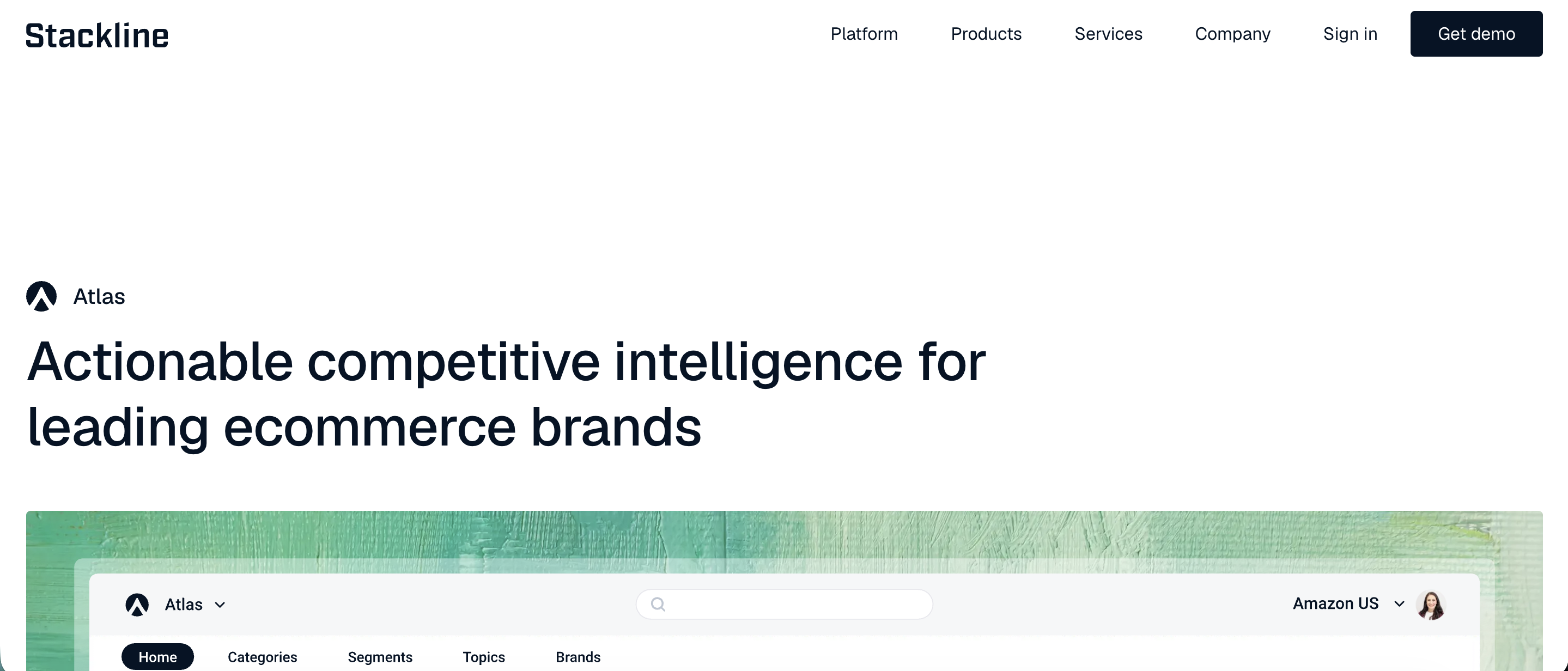
Atlas is likely to be most relevant if you want to understand:
- Market share
- Category performance
- Competitor sales
- Retail traffic
- Pricing changes
- Promotions
- Advertising activity
- Marketplace sellers
You can also use Atlas to monitor pricing across retailers and marketplace sellers to investigate changes in category performance or competitive positioning.
Stackline does not publish an Atlas subscription price. You need a custom quote.
Beacon pricing
Beacon works with your own commerce data rather than primarily analyzing the external market.
Stackline’s Beacon product brings together sales, forecasting, advertising, pricing, inventory, operations, content, reviews, and retailer performance.
If your main problem is that retail data is spread across retailer portals and internal systems, Beacon is likely to be one of the more relevant parts of your Stackline quote.
Typical use cases include:
- Monitoring retail sales
- Tracking inventory
- Reviewing retailer performance
- Forecasting demand
- Analyzing advertising performance
- Finding operational issues
Stackline does not publish Beacon pricing.
Advisor pricing
Advisor lets you ask questions across Stackline data and receive analysis, charts, tables, and recommendations without building every report yourself.
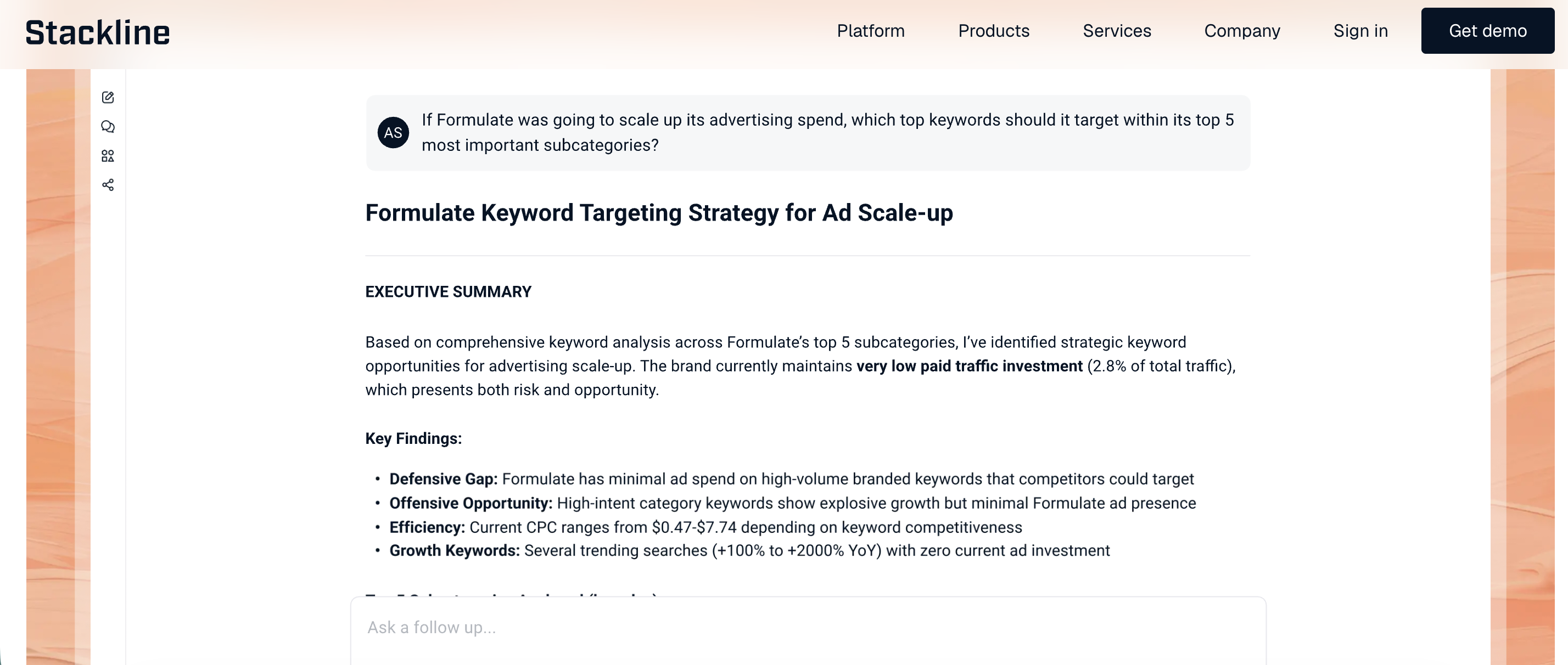
Stackline has also connected Beacon data with Advisor, allowing you to analyze your own commerce data alongside information from other Stackline products.
This can help if your team is dealing with complex data and wants a faster way to surface valuable insights without building every analysis from scratch.
There is no public price for Advisor.
Shopper OS pricing
Shopper OS covers direct shopper engagement, not just traditional retail analytics.
Depending on what you purchase, capabilities can include:
- Checkout
- CRM
- Messaging
- Rewards
- Reviews
- Surveys
- Mobile apps
- Shopper data
You should clarify exactly which Shopper OS capabilities are included in your quote because access to shopper data is very different from running loyalty or engagement programs.
Stackline does not publish Shopper OS pricing.
Ad Manager pricing
Stackline Ad Manager is designed for managing retail media campaigns across networks such as Amazon, Walmart, Target, and Instacart.
Capabilities include:
- Campaign management
- Budget controls
- Performance alerts
- Dayparting
- Automated optimization
- Retail media reporting
- Amazon Marketing Cloud analysis
Your price may therefore depend partly on the scale of your retail media activity and the amount of advertising you manage.
Stackline does not publish a standard Ad Manager price or a public formula based on advertising spend.
Shopper Analytics pricing
Shopper Analytics is centered on consumer behavior rather than campaign management or operational reporting.
You can use it to analyze:
- Market share
- Shopper retention
- Share of wallet
- Purchase behavior
- Audience segments
- Cross-retailer shopping
- Survey responses
- Search behavior
This is where Stackline moves beyond basic sales reporting into deeper shopper research.
If you are evaluating Stackline specifically to leverage advanced analytics to understand why consumers buy, where they shop, and how purchase behavior changes over time, Shopper Analytics may be one of the most important products in your quote.
Again, pricing is custom.
What is included in Stackline pricing?
What you get with Stackline depends heavily on the products included in your contract. There is no single package that automatically gives you access to every dataset, analytics tool, or service.
Before comparing Stackline with another retail analytics platform, make sure you know exactly what sits inside the quoted annual price.
Depending on your package, Stackline pricing may include:
- Retail sales analytics: Track sales performance across supported retailers and channels, then analyze data by product, retailer, category, or period.
- Inventory management data: Monitor stock levels, availability, sell-through, and other inventory signals that can help you identify potential shortages or excess stock.
- Market intelligence: Atlas can give you visibility into category performance, competitors, market share, pricing activity, promotions, and wider market size.
- Advertising analytics: Ad Manager can bring together marketing campaigns, ad spend, performance data, and retail media reporting across supported networks.
- Forecasting: Depending on the products purchased, you may have access to predictive analytics for demand forecasting and future sales performance.
- Pricing analysis: Stackline can help you monitor competitors and marketplace sellers when reviewing pricing strategies or investigating unexpected changes in demand.
- Shopper analytics: Shopper Analytics adds data around consumer purchasing patterns, retention, share of wallet, and other behavioral signals.
- Reporting tools: Dashboards and analytics features help teams turn large volumes of commerce data into reports usable across sales, marketing, planning, and operations.
Data access is only part of the contract.
Stackline also offers additional services around advertising, forecasting, retail operations, research, content, and shopper engagement. These may be priced separately from the software you are evaluating.
When you receive a quote, ask Stackline to clearly identify:
- Which products are included
- Which retailers you can access
- Which categories are covered
- Any SKU or data limits
- Which integrations are included
- Whether onboarding carries an additional charge
- Whether professional services are included
- Which managed services cost extra
- How additional retailer or category coverage is priced
Data accuracy should also be part of this conversation. If you use Stackline to make decisions about inventory, advertising, or pricing, you need to understand where each dataset comes from and how often it is updated.
Compare competing platforms based on the data and functionality included in your actual quote, rather than comparing subscription prices without knowing what each contract covers.
What affects Stackline pricing?
Stackline uses custom pricing, so two buyers can receive very different quotes even when they are evaluating the same platform.
Your cost is likely to depend on the amount of data you need and how much of the Stackline product portfolio you want to use.
The biggest pricing factors to clarify are:
- Products selected: Adding Atlas, Beacon, Shopper Analytics, Ad Manager, or other Stackline products can increase the total contract value.
- Retailer coverage: If you need data from more retailers, your pricing may differ from a deployment covering only a few major accounts.
- Category coverage: Competitive market intelligence becomes more expensive when you need access across more categories rather than analyzing a narrow part of the market.
- SKU volume: The number of products you need to monitor can affect deployment size.
- Advertising activity: Your retail media requirements can affect pricing if you are using Stackline to manage marketing campaigns and analyze large amounts of ad spend.
- Data integrations: Connecting retailer data with your ERP, inventory management systems, or other internal sources can add onboarding and implementation work.
- Analytics requirements: More advanced forecasting, predictive analytics, shopper research, or custom analysis can increase your spend.
- Professional services: If you need Stackline’s team to handle reporting, advertising, research, or operational work, these services can sit on top of the software subscription.
Your requirements can also change over time. For example, you may begin by monitoring a small number of retailers, then later expand into more categories or markets.
This is important when evaluating pricing models. Ask what happens to your contract if you:
- Add more retailers
- Expand into another category
- Add thousands of SKUs
- Increase ad spend significantly
- Add another Stackline product
- Need additional data integrations
- Expand into another country
You should also consider how much value you expect from the additional data.
A brand losing market share may value competitive intelligence far more than one primarily trying to improve operational efficiency. Likewise, a team managing significant retail media investment may care more about advertising analytics than shopper research.
Stackline pricing therefore makes the most sense when you connect the quote directly to the decisions you need the platform to support. The useful question is not simply how much Stackline costs, but which parts of the platform you actually need to make better retail decisions.
How much does Stackline implementation cost?
Stackline does not publish a standard implementation fee, so you should ask for onboarding and setup costs separately when requesting a quote.
The best public evidence suggests that the technical implementation itself may be relatively light compared with some enterprise analytics platforms.
In a Stackline-commissioned Forrester study, the modeled customer used Atlas, Beacon, Drive, and professional services. Forrester assumed that the implementation effort was negligible and did not include a separate implementation charge in its cost model. The study also reported that interviewed Stackline customers described onboarding as requiring relatively little internal effort.
That does not mean your implementation will be free.
Your setup can still involve work such as:
- Connecting retailer data: Bringing your sales, inventory, advertising, and other retailer data into Stackline.
- Adding internal data: Connecting business data that you want to analyze alongside retailer information.
- Configuring products: Setting up the Stackline products, retailers, categories, and reporting requirements included in your contract.
- Training users: Giving sales, ecommerce, analytics, and marketing teams access to the platform and showing them how to use it.
- Professional services: Stackline also sells consulting and managed services, which can extend beyond the initial software setup.
One number requires some context.
The Forrester study calculated approximately $432,000 in present value costs over three years for implementation and ongoing analytics usage. However, this was mainly the modeled cost of employees spending part of their working time inside Stackline. It was not a $432,000 implementation fee paid to Stackline.
For the modeled customer, five employees initially spent around 30% of their time working with Stackline. That internal labor cost far more than the technical implementation itself.
When you request a quote, ask Stackline to separate:
- Software subscription fees
- Initial onboarding
- Data integrations
- User training
- Professional services
- Ongoing managed services
- Additional retailer connections
- Custom reporting or research
This gives you a better picture of your first-year cost and prevents professional services from being confused with the underlying software subscription.
Stackline pricing vs Alloy.ai
Stackline and Alloy.ai overlap in retail analytics, but they are built around different buying priorities.
If you are comparing the two, the useful question is what decisions you need the platform to help you make every week.
| Stackline | Alloy.ai | |
|---|---|---|
| Pricing |
Custom quote |
Custom quote |
| Retail sales analytics |
Yes |
Yes |
| POS data |
Yes |
Yes |
| Inventory visibility |
Yes |
Core use case |
| Demand forecasting |
Yes |
POS based forecasting at detailed SKU and location levels |
| Competitive market intelligence | Strong emphasis through Atlas |
Less centered on external competitive intelligence |
| Market share analysis |
Strong emphasis |
Available through retail performance analysis, depending on data sources |
| Retail media |
Strong offering through Ad Manager |
Not the main use case |
| Shopper research |
Strong offering through Shopper Analytics |
More centered on sales and supply chain data |
| Retailer data integration |
Yes |
45o+ integrations across retailers, distributors, internal systems, and supply chain partners |
| Supply chain visibility |
Available through Beacon |
Major part of the platform |
| Replenishment and inventory planning |
Available |
Major use case |
| CPG specialization |
Consumer brands |
Built specifically for consumer goods brands |
Where Stackline makes sense for improving operational efficiency
Stackline is particularly strong when you need external market intelligence alongside your own retail performance data.
Atlas lets you analyze competitor activity, market share, pricing, traffic, advertising, and product performance. Stackline also offers Shopper Analytics for consumer research and Ad Manager for retail media management.
That combination can give you comprehensive insights when your questions extend beyond your own sales and inventory.
For example, Stackline can be useful if you need to understand:
- Why a competitor is gaining market share
- How category pricing is changing
- What competitors are spending on advertising
- How shoppers behave across retail channels
- How your retail media campaigns are performing
Stackline also supports customizable reports on pricing and other retail data, helping teams turn large datasets into material they can use for planning and retailer conversations.
Where Alloy.ai is different and gives you more insights
Alloy.ai is more directly centered on what is happening to your products across retailers and what your sales and supply chain teams should do next.
It connects retailer POS, inventory, orders, shipments, distributor data, and internal ERP information into a shared data layer. Alloy.ai supports more than 450 integrations across retailers and supply chain partners.
That setup is designed to give you a deeper understanding of:
- What consumers are actually buying
- Where inventory is sitting
- Which SKUs are approaching a stockout
- Where excess inventory is building
- How sell-through compares with your plan
- How demand is changing at individual retailers
Alloy.ai also generates POS-based forecasts using retailer demand and channel inventory signals. Its forecasting can operate at the SKU and location level, which can help planning teams react to changes before they show up in shipment data.
The practical distinction is that Stackline focuses more on competitive intelligence, shopper research, and retail media, while Alloy.ai focuses more on POS data, inventory, forecasting, replenishment, and connecting sales with supply chain decisions.
If your main questions are about competitors, category share, advertising, or shopper research, Stackline may offer more of the capabilities you need.
If your priority is using retailer POS and inventory data to improve forecasting, replenishment, and execution across retail channels, Alloy.ai is a better fit.
Both platforms can support data-driven decisions. The difference is the data and decisions each platform centers on.
Get the better Stackline alternative for CPG
Stackline can make sense if your priorities include competitive intelligence, shopper research, retail media, and category analysis.
If you care more about retail sales, inventory, forecasting, and replenishment, Alloy.ai is built directly around those day-to-day CPG decisions.
Alloy.ai combines POS, inventory, shipment, distributor, and internal data together so sales and supply chain teams can work from the same view of performance. This can help you spot inventory problems earlier, understand demand changes at retailer level, and make smarter decisions around forecasting and replenishment.
It also gives teams more insight without forcing them to manually piece together data from retailer portals and internal systems. That is especially useful when you need to connect retail execution with larger growth decisions.
Rather than trying to cover every possible retail analytics use case, Alloy.ai focuses on helping CPG teams understand what is selling, where inventory sits, and what needs attention next.
Book a demo with Alloy.ai to see how the platform can help you make better retail and supply chain decisions.
Stackline pricing FAQs
How much does Stackline cost per year?
Stackline does not publish standard annual pricing. Based on third-party procurement estimates, you should expect pricing to start around $30,000 to $50,000 per year, while larger deployments can move well into six figures.
Does Stackline charge by category?
Stackline does not publicly explain its current pricing model in enough detail to confirm a standard category-based fee. Category coverage is one factor worth asking about during the sales process, especially if you need competitive market intelligence across several product categories.
Does Stackline offer a free trial?
Stackline does not publicly advertise a standard free trial. Evaluation appears to happen primarily through the sales process and product demonstrations, so you should ask whether temporary access or a proof of concept is available.
What affects Stackline pricing?
Your quote can depend on the Stackline products you select, retailer coverage, category access, SKU volume, data integrations, ad spend, and professional services.
You should also ask how pricing changes if you add more retailers or expand into additional markets later.
Who is Stackline best for?
Stackline is most relevant if you need a mix of competitive market intelligence, shopper analytics, retail media tools, and your own commerce data in one platform.
If your main priority is using POS and inventory data to improve forecasting, replenishment, and retail execution, Alloy.ai is probably a better choice.