- Logan Ensign
When I ask supply chain leaders across consumer goods — demand planning, replenishment, S&OP — how much of their decision-making is happening on data that’s two to three weeks behind actual consumer demand, the answer is almost always some version of “more than we’d like.” Sometimes a lot more.
The data lag problem is one of those things that’s easy to accept as structural. Retailer portals update weekly. EDI feeds have restatement windows. By the time the data is in a system your team can actually use, the demand shift it reflects is already history. You’re not planning against what’s happening at the shelf — you’re planning against what was happening at the shelf when someone last ran a report.
For most teams, that gap has become the background condition of the job. You build processes to work around it. You add a buffer. You run scenario plans. You get good at reacting quickly when the gap catches you.
But it’s worth asking: what does it actually cost?
The Cost Shows Up in Three Places
What I find interesting from talking to supply chain leaders is that the data lag doesn’t announce itself as a single expensive problem. It shows up as friction, everywhere, all the time.
- The fire drills that feel unavoidable
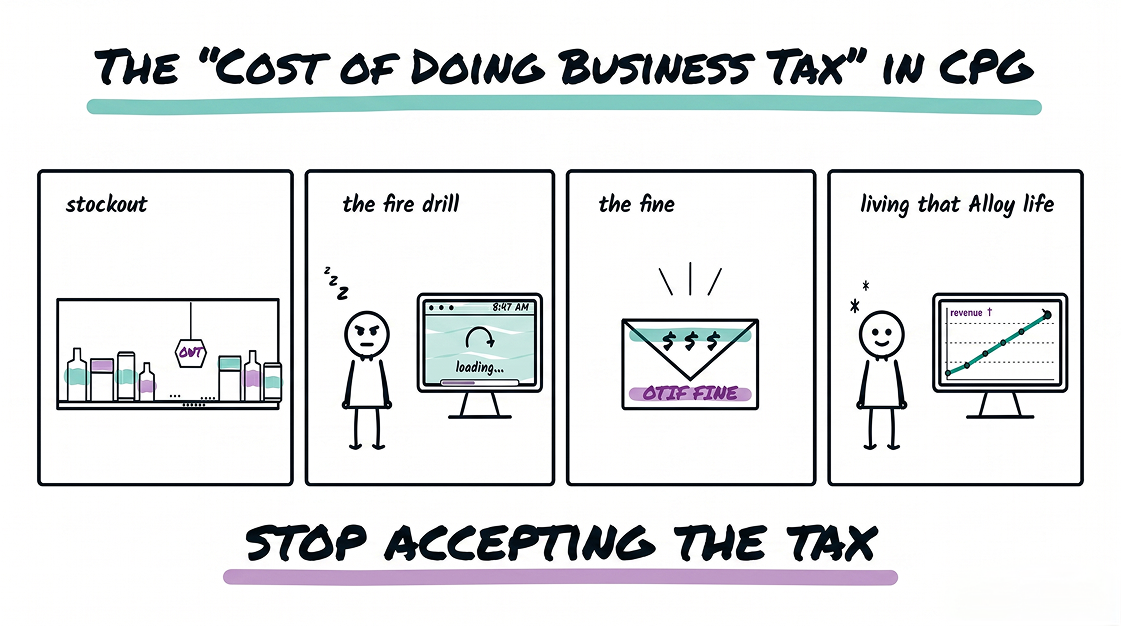
I’ve had supply chain leaders describe the same situation to me in almost identical terms: a warehouse out-of-stock that nobody caught until a retailer flagged it. An OTIF exposure that materialized because demand shifted two weeks ago, and the replenishment signal didn’t keep up. An expedited freight charge was the only way to recover in time.
These feel like operational failures when they happen. What I’d argue is that they’re mostly data lag failures. The demand signal was there. It just didn’t get to the team fast enough to act on before the cost hit.
- The planning cycle that’s always a step behind
S&OP processes are designed around the cadence of data availability. Weekly reviews, monthly forecasts, quarterly plans. That cadence made sense when data moved at that speed.
Consumer demand doesn’t move at that speed. A promotional event, a viral moment, a competitor going out of stock — these things show up in POS data in days, not weeks. But if your planning cycle is built around weekly data drops, your team is structurally behind. Not because of anything they’re doing wrong. Because the cadence of the process doesn’t match the cadence of the market.
- The analyst’s hours spent on work that should be automated
The third cost is the one supply chain leaders often overlook because it’s so embedded in how the team operates. How many analyst hours per month go into data capture, data cleansing, assembling reports, root cause identification, and formatting outputs that a decision-maker will spend 20 minutes reading?
Across the supply chain teams I work with, the answer is consistently higher than people expect when they actually add it up. Somewhere between 80 and 100+ hours per month is common. That’s time going into the mechanical work of moving data from one format to another — not into the analysis itself, not into the decisions that require expertise and judgment. Into the plumbing.
What “Real-Time” Actually Means in Practice
I want to be precise about this because “real-time data” is one of those phrases that gets used loosely — and I’ve watched it create confusion in customer conversations.
What matters isn’t just that data is current. It’s that the data is current, normalized, and connected to a system that can act on it before the window to act closes. Having a live feed of POS data from 450 commerce partners doesn’t close the Execution Gap if your team still has to manually identify where demand is outpacing supply, calculate the order, and draft the response.
The gap isn’t in the data. It’s in the steps between the data and the action.
The supply chain leaders I work with put it a consistent way: the bottleneck isn’t sensing anymore. Brands have gotten much better at visibility. It’s the distance between sensing and doing that’s still measured in days rather than hours — and that’s the part that keeps showing up as OTIF fines and expedited freight charges and fire drills that everyone knows were preventable.
Joel wrote about this in his launch piece last week — the distinction between a system that shows you where the problem is and a system that prepares the fix. That framing maps exactly to what I hear on the supply chain side.
What Closing That Distance Looks Like
When I describe the Replenishment AI Agent to supply chain leaders, the frame that lands most clearly is this: the agent handles the steps between the signal and the recommended action that your team has been handling manually.
Think about what that workflow currently looks like for a regional account your team doesn’t have time to monitor closely. A demand signal builds over two to three weeks. It either gets caught during a routine review — if the review happens to catch it — or it surfaces when the retailer flags a shortage. By then, the window to prevent it has already closed, and the conversation has shifted to damage control.
The agent monitors every SKU at every location across all connected commerce partners simultaneously — not just the accounts your team has time to check. When demand is outpacing supply anywhere in the network, it calculates the order quantity and drafts the recommendation with supporting data, ready for your team to review and approve. The signal-to-action cycle that used to take days now takes the time it takes your team to read and approve a recommendation.
For the Performance Reporting Agent, the shift is different but related. The analyst hours that go into data capture, cleansing, root cause analysis, and building the weekly brief — those get reclaimed. Your team gets a complete executive brief before the first meeting of the week: root-cause analysis behind every performance shift, live charts, execution-ready recommendations. The time that was going into building the report goes into acting on what the report says.
What I find most interesting isn’t the time saved. It’s what supply chain teams tend to do with it when they get it back. The early signals from the customers we’ve had in beta are consistent: the time goes toward the decisions that actually require expertise — the edge case the agent correctly flags, but that needs human judgment to resolve, the retailer relationship conversation that was always getting crowded out by the operational work, the scenario planning that only happens when the team isn’t buried in the data work.
That’s the version of this that I think matters most for supply chain leaders. Not a faster report. A team that’s spending its time on the right problems.
If This Is Your Situation
If the data lag problem or the analyst hour problem sounds familiar, Joel’s launch piece from last week has the full product context. I’d start there.
If you’re already an Alloy.ai customer and want to understand what activation looks like for your supply chain team specifically, reach out to your CSAM. That’s the conversation worth having.

Logan Ensign
Logan Ensign is vice-president of client solutions at Alloy Technologies, Inc. where he works with customers to maximize value from the data, analytics and planning platform by ensuring fast implementation, delivering trainings, sharing ongoing best practices and conducting regular business reviews.
Book a Demo
See Alloy.ai
Synchronize execution to eliminate waste, mitigate risk, and capture every revenue opportunity.
Once you submit a demo request form:
- A sales rep will email you within 24 hours to schedule a brief intro call.
- Our team will provide an overview of Alloy.ai and learn more about your data goals and objectives.
- We’ll create and walk you through a live demo, customized to your specific data needs.