
- Logan Ensign
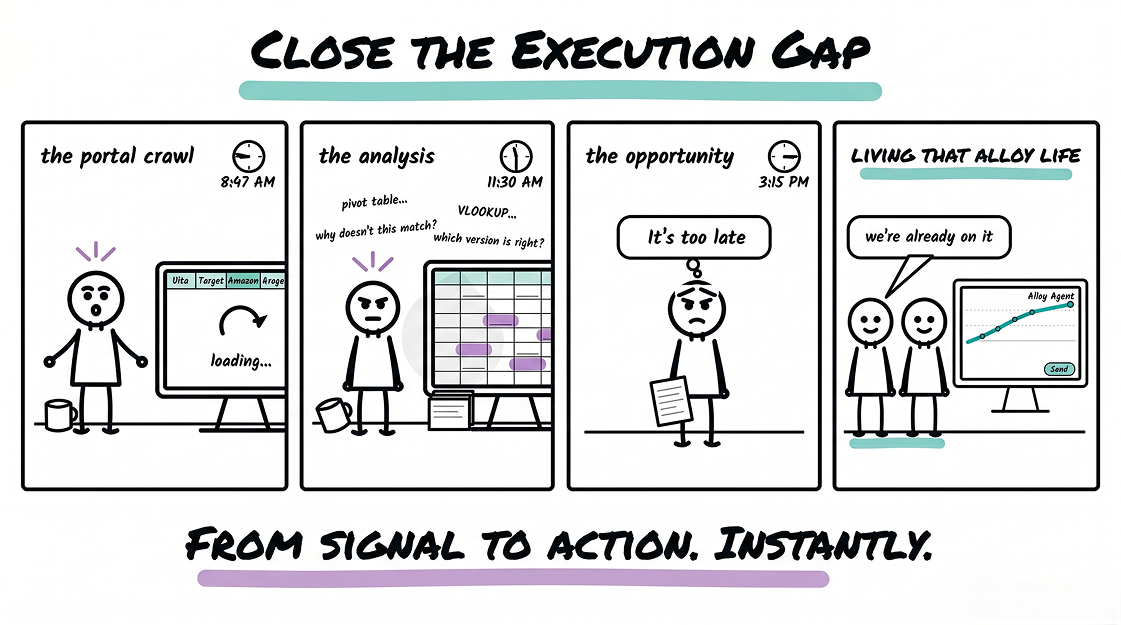
Joel wrote earlier this week about the Execution Gap — the distance between when a demand signal appears and when your team can actually do something about it. If you haven’t read it, I’d start there.
What I want to add is what I’ve seen on the customer side of that gap. Because after years of conversations with the teams living inside it — the analysts, the account managers, the supply chain teams — I think the most important thing to understand is that the Execution Gap isn’t really a data problem. Your teams already have more data than they have hours to act on.
It’s a capacity problem. And it shows up in two places more than anywhere else.
The accounts that never get enough attention
I’ve had some version of this conversation probably a hundred times. A sales leader tells me their biggest accounts are covered — they’re on it, they’re checking the portals, they’re staying ahead of it. And then I ask about the next twenty accounts. Or the next fifty.
The answer is usually some version of: “We get to them when we can.”
This isn’t a talent problem. The people carrying these accounts are good at their jobs. It’s that no team of humans can monitor every SKU at every location across hundreds of commerce partners and still have bandwidth to act on what they find. So the tier-1 accounts get coverage. The rest of the network gets whatever’s left.
The result is what Joel described: revenue that leaks out quietly. Demand surges at a regional account that nobody caught in time. A shelf that went empty for two weeks before it showed up in a report. And by then, the window to act has already closed.
The Replenishment AI Agent closes this gap by doing the work the team doesn’t have hours for. It monitors all commerce partners simultaneously — 24/7 — and when it finds where demand is outpacing supply, it doesn’t just surface an issue. It calculates the order quantity, drafts the recommendation email with supporting data and charts, and puts everything in front of your team ready to approve in a single click.
Every account gets the same coverage as your largest. Not because you added headcount. Because the agent handles the discovery and preparation that your team never had time to do.
The Sunday night that’s been costing you Monday morning
The second place I see the Execution Gap show up: the Monday morning meeting.
You already have the data. That’s the whole point of what we’ve built together. But having the data and having the insights ready to act on are still two different things — and that gap is where a lot of time and opportunity gets lost.
What I hear most often from our customers isn’t “we can’t find the data.” It’s “we can see what happened, but by the time we’ve dug into why it happened and figured out what to do about it, we’re already a step behind.” The data capture, data cleansing, and analysis take time. Identifying the root cause takes time. Turning that into a recommendation the leadership team can act on takes time. And the window to act doesn’t wait.
The Performance Reporting AI Agent closes this part of the gap. Every week, it goes beyond surfacing what happened — it identifies the root cause behind performance shifts across your commerce network. Phantom inventory. Promotion execution issues. Localized voids. And it packages all of that into a complete executive brief, with narrative commentary, live charts, and actionable recommendations, before your team’s first meeting of the week.
We are a lean team, and the Performance Reporting Agent is potentially revolutionary for our workflow,” says BIC Omnichannel Growth & Strategy Team Lead Matt DePaolo. “The ability to use the AI to do math and manipulate data that we previously had to dig for manually is pretty earth-shattering. Having an agent automatically summarize our business performance can reduce our meeting times by half.”
For sales leaders, that means walking into Monday with a strategy backed by SKU-location data — and having the answers ready when a buyer pushes back. For supply chain teams, it means catching the issues that typically become fire drills two weeks later: the service level exposure, the OTIF risk, the replenishment gap that nobody saw in time to prevent.
The shift isn’t about getting access to more data. You already have that. It’s about what your team can do with it before the moment to act passes. That’s the part I’m most curious to watch.
What the agents are — and what they’re not
One thing I want to be direct about, because I know this question comes up: these agents are not replacing your team’s judgment. What they’re replacing is the analysis and synthesis work that sits in front of that judgment — the digging into why a metric moved, the root cause identification, the translation from signal to recommendation. The decisions still belong to your people. The agents make sure your people are spending their time on decisions, not on the steps required to get there.
Joel made this point well: the goal is AI that handles what humans shouldn’t be doing, so humans can focus on what only they can do. From where I sit, the work most worth protecting — the buyer relationship, the strategic call, the judgment call on an edge case — is exactly what gets crowded out when the analysis work never ends.
“Replenishment planning has always forced a tradeoff — the more time we spend managing underperforming items, the easier it is for overperforming ones to fall through the cracks,” says Melissa & Doug Sales Analyst Peter Choi. “The Replenishment Agent changes that. It catches the risks we don’t have bandwidth to find ourselves and surfaces them ready to act on. That’s exactly what we’ve needed.”
That’s what closing the Execution Gap actually looks like from the inside. Not a system that makes the decisions. A system that clears the runway so the right people can.
What’s coming next
Both agents are live and available now. As Joel outlined, two more are on track for H2 2026: the Trade Promotion AI Agent and the Forecast Adjustment AI Agent.
The Trade Promotion agent will monitor real-time sales lift against targets and flag pricing non-compliance or execution gaps — so promotional spend drives revenue instead of becoming another line item in the “Cost of Doing Business Tax.” The Forecast Adjustment Agent will identify retailer forecast inaccuracies and prepare data-driven adjustment communications, so your supply chain is responding to actual consumer demand instead of a forecast that’s already a week behind.
Each one follows the same logic: find the places where the Execution Gap is costing you, and close it before it does.
How to get started
If you’re an Alloy customer, reach out to your CSAM — they’ll walk you through what activation looks like for your specific team and workflow. If you want to see the agents working before that conversation, we’re running demos this week.
I’m genuinely looking forward to hearing what your teams do with the hours they get back.

Logan Ensign
Logan Ensign is vice-president of client solutions at Alloy Technologies, Inc. where he works with customers to maximize value from the data, analytics and planning platform by ensuring fast implementation, delivering trainings, sharing ongoing best practices and conducting regular business reviews.
Book a Demo
See Alloy.ai
Synchronize execution to eliminate waste, mitigate risk, and capture every revenue opportunity.
Once you submit a demo request form:
- A sales rep will email you within 24 hours to schedule a brief intro call.
- Our team will provide an overview of Alloy.ai and learn more about your data goals and objectives.
- We’ll create and walk you through a live demo, customized to your specific data needs.