
- Ben Merva
Let’s be honest: if you’ve been using Crisp for a couple of years and it’s working, you’re not reading this article. You’re here because something changed. Maybe you added Target, Costco, or Kroger to your distribution and discovered that Crisp doesn’t connect to them. Maybe your supply chain lead is sick of working from a completely different dataset than your sales team. Whatever the trigger, you’re now evaluating the crisp data platform alternatives for CPG brands that have emerged as serious contenders in 2026.
The Crisp data platform connects CPG brands to approximately 40+ retailer portals, normalizes sell-through and retailer data, and pipes it into dashboards, BI tools, and cloud data warehouse systems. For emerging brands getting their first real view of retail data, it’s a reasonable starting point. But for brands selling through 20, 50, or 100+ retail accounts, or those who need ML-powered demand forecasting baked into the same platform as their POS data, the scope starts to feel limiting.
This article covers 6 Crisp data platform alternatives worth a close look in 2026. Each one is different. The right choice depends on your distribution profile, your team’s technical chops, and what you actually need the retail analytics platform to do. And yes, Alloy.ai—the CPG analytics platform built for mid-market and enterprise brands—comes first, because it’s the most direct upgrade path from Crisp. But we’ll give you the full picture.
Table of Contents
What is Crisp, and why do CPG brands look for alternatives?

The Crisp data platform connects CPG brands to 40+ retailer and distributor portals, normalizes pos data and retailer data feeds into the same format, and delivers everything into pre-built dashboards, BI tools, data warehouse destinations, and EDI compliance workflows. It earns a 4.4/5 rating on G2 (based on 137 reviews as of May 2026), with reviewers consistently praising data quality and customer support. That’s genuinely solid.
Here’s the thing, though. The Crisp data platform was built for a specific profile: emerging and natural/specialty CPG brands that need clean, accessible retail data across a focused retailer set without a lot of unnecessary complexity. Every key insight comes delivered in a clean, usable form. But CPG brands grow, and growth tends to expose exactly where a platform’s limits are.
The most common reasons brands start looking elsewhere:
-
Retailer coverage. Approximately 40+ connections are enough for many emerging brands. It is not enough for brands to have meaningful distribution at Target, Costco, Kroger, or dozens of regional grocery chains. When field reps have visit frequency requirements across that many doors, the Crisp data platform creates blind spots. The math just doesn’t work. As of late, it also doesn’t support the largest US retailer and their supplier data platform.
-
No native demand forecasting. Crisp delivers a clear picture of what happened in retail channels. It does not tell you what’s likely to happen next. No ML-powered predictive analytics, no out-of-stocks prevention based on forward-looking models.
-
Supply chain stops at the POS layer. Brands that need to connect pos systems, DC inventory, warehouse stock, ERP data, and 3PL feeds in one place find that Crisp’s scope runs out before theirs does.
-
Scale and complexity. At 50+ retail accounts and multiple retail channels, the need for cross-retailer forecasting and AI-driven recommendations starts to outgrow what a dashboard-first platform can offer.
A good example of that are PPC advertisers on Google Ads, benefiting from AI-powered conversion recommendation dashboard.
And as NielsenIQ notes, when out-of-stocks hit, the risk isn’t just a lost sale—”companies run the risk of shoppers switching to other brands,” with lasting negative effects if the substitution sticks. That’s a strong argument for getting ahead of the problem with better data.
6 best Crisp data platform alternatives for CPG brands
Six platforms. All legitimately worth evaluating. Each is built for a different version of the problem CPG brands face when they outgrow basic retail analytics. Here’s an honest look at what each one does well and where it falls short.
1. Alloy.ai—best for mid-market and enterprise CPG brands needing forecasting and supply chain integration
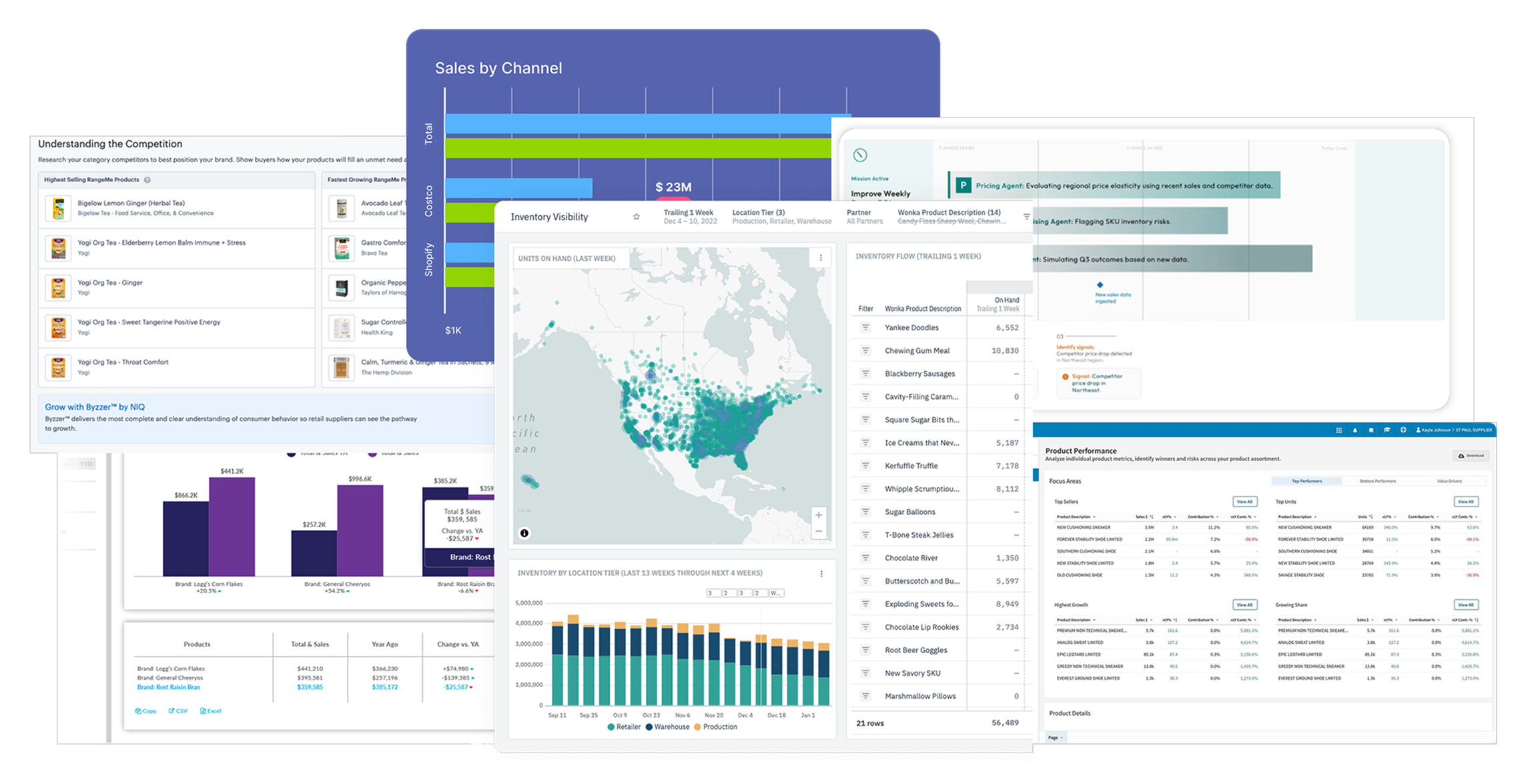
Alloy.ai is a data platform built specifically for consumer packaged goods brands—and one of the most capable retail intelligence software options for mid-market and enterprise CPG. It connects pos data, inventory, ecommerce, distributor, and supply chain data through 450+ pre-built connectors—covering retailer portals, EDI feeds, Amazon Vendor Central, ERPs, and 3PLs—and then layers AI and ML on top of all of it. The result: daily SKU/store-level retail data with actionable insights, ML-powered forecasts, and prescriptive replenishment recommendations built in.
Key features:
450+ pre-built connectors to retailer portals, pos systems, ecommerce platforms, distributors, ERPs, and 3PLs
Daily SKU/store-level retail data refresh with automatic data harmonization across all retailer formats
ML-powered demand forecasting at the SKU and store level—exportable to planning systems like SAP, Blue Yonder, and o9
AI-powered anomaly detection that surfaces insights on the most financially impactful exceptions: out-of-stocks, demand deviations, and inventory management risks
Prescriptive replenishment recommendations with AI-generated emails for retail buyer communication, powered by Alloy.ai’s Replenishment AI Agent and Performance Reporting AI Agent — purpose-built agentic AI tools that go well beyond what Crisp’s recently introduced AI features offer

Cross-retailer scorecards, promotional lift dashboards, and supply chain visibility across DC inventory and weeks of supply. Collaboration tools for sharing actionable insights with retail buyers, including assortment optimization recommendations and custom analytics by account
Full field execution tracking for planogram compliance, shelf presence, shelf photos, and out-of-stock rates across store visits—including image recognition to flag issues and route optimization for field teams
G2 rating: 4.6/5. Reviewers consistently call out data breadth, supply chain optimization, and demand forecasting accuracy as standout strengths. Customers include Crayola, BIC, Anker, Valvoline, Bosch, SimpliSafe, and Melissa & Doug.
Best for: mid-market and enterprise CPG brands and CPG companies selling through 20–200+ retail partners who need ML-powered demand forecasting, supply chain management, and a platform that actually connects data analytics to planning. The 35%+ reduction in out-of-stock rates and 5%+ bottom-line impact that customers report aren’t marketing numbers—they’re the kind of outcomes that happen when retail analytics and supply chain optimization finally live in the same place.
Limitations: custom pricing only, no self-serve tier. Pricing is custom—not the right fit for very early-stage brands that need basic dashboard access for a handful of retailers.
2. Daasity—best for omnichannel DTC and retail brands
Daasity unifies DTC, ecommerce, Amazon, and brick-and-mortar retail data—including syndicated data from NIQ (formerly NielsenIQ) and SPINS—into a single analytics layer. It was built by former CPG practitioners, which shows in how it handles marketing analytics, consumer insights, and attribution models alongside retail analytics.
Key features:
- 65+ integrations: Amazon, Shopify, Google Ads, Google Analytics, Meta, Klaviyo, Target, Whole Foods, and SPINS
- Pre-built dashboards for retail data performance, promotions, and inventory management
- Audience segmentation and consumer behavior tracking, including purchase frequency, store visits analysis, and customer journey mapping across channels

Syndicated retail data from NIQ (formerly NielsenIQ) and SPINS—useful if you need market context without a separate syndicated market intelligence contract
Custom data warehouse, custom analytics, and custom reporting capabilities—including collaboration tools for non-technical teams who need retailer data without SQL
Best for: fast-growing omnichannel brands that sell DTC and through retail, need to combine ecommerce attribution models with retail analytics, and want syndicated data context built in.
Limitations: fewer retailer portals than Alloy. No native supply chain integration or ML-powered demand forecasting. Better suited to marketing analytics and DTC analytics than to sales, supply chain management, or replenishment.
3. SPS Commerce—best for brands prioritizing EDI compliance and supply chain visibility
SPS Commerce is a supply chain cloud platform specializing in EDI compliance, retail fulfillment automation, invoice matching software, and analytics.
It’s one of the most widely used EDI platforms in US retail, and that depth of retailer connectivity is its main advantage.
Key features:
EDI compliance and automated transaction processing for 100+ retailers, with compliance scores and generating compliance score reporting. Retail execution tracking, including field execution reporting and planogram compliance monitoring
Retail fulfillment visibility across orders, ASNs, and invoices—useful for retail execution teams

Analytics for sales tracking, supply chain optimization performance, and frequency requirements across retailer accounts. Natural language reporting for non-technical teams who don’t need to build custom analytics from scratch
Integration with most major ERP systems and retailer portals
Best for: CPG brands and suppliers where EDI compliance and retail fulfillment automation are the main bottlenecks. Also strong for brands onboarding new retail accounts quickly.
Limitations: Retail analytics capabilities are less advanced than purpose-built CPG platforms. No ML-powered predictive analytics or demand forecasting. Think of it as a supply chain operations tool with analytics attached, not the other way around.
4. Bedrock Analytics—best for data-to-presentation workflows and retail buyer meetings
Bedrock Analytics was built by former CPG sales managers and retail buyers who were tired of spending a week turning syndicated data into a buyer deck. So they automated it. The platform harmonizes data sources from NIQ, Circana, SPINS, and retailer portals, then uses AI to generate consumer insights, branded presentations, and category management tools output.
Key features:
Data harmonization across NIQ, Circana, SPINS, and retailer portals—full spectrum syndicated data in one place, normalized into the same format for cross-source comparison
AI-generated consumer insights and branded PowerPoint-ready sales presentations for retail buyer meetings. Works alongside Google Analytics and Google Ads data for a complete channel picture
Category share, velocity, and distribution tracking—useful for category managers building category growth cases
Natural language querying across data sources for non-technical teams

Best for: CPG brands selling through traditional retail that invest significant time building buyer-ready presentations. Brand managers and category managers will get the most out of it.
Limitations: focused on syndicated data and the presentation layer. No POS-level sales tracking, no supply chain integration, no demand forecasting. Better as a category management tools play than a full retail analytics platform.
5. Stackline—best for brands with significant Amazon revenue
Stackline is a retail intelligence platform built for e-commerce first, specifically Amazon. If a meaningful share of your revenue runs through Amazon Vendor Central or Seller Central, Stackline gives you depth that general-purpose retail analytics platforms rarely match.
Key features:
Amazon Vendor Central and Seller Central analytics, including shopper data and shopper behavior trends
Competitor market share tracking and category trends intelligence
E-commerce trend tracking and partial demand forecasting for digital retail channels

- Advertising performance analysis across Google Ads and Google Analytics—useful for marketing analytics teams optimizing Google Ads spend and Amazon DSP. Store visits data, visit frequency, and digital shelf tracking round out the picture
Best for: CPG brands where Amazon represents a significant share of revenue and that need in-depth Amazon-specific consumer insights: share of search, competitive activity, and advertising ROI.
Limitations: primarily ecommerce-focused. Limited coverage of brick-and-mortar pos data. No supply chain optimization or inventory management. If physical retail execution is your primary need, Stackline is the wrong tool.
6. NIQ Byzzer—best for emerging brands needing syndicated category data
Byzzer is NielsenIQ’s analytics platform for smaller CPG companies that can’t justify an enterprise NielsenIQ (NIQ) contract but still need access to a syndicated market intelligence tool. Unlike the Crisp data platform, which focuses on live retailer data from portals, Byzzer delivers retrospective syndicated market intelligence—think of it as NielsenIQ’s full retail measurement dataset at a more accessible price point.
Key features:
Access to NielsenIQ’s full syndicated data on market share, distribution, pricing, and velocity
Competitive benchmarking and category trends tracking for category-level decision-making
Pre-built dashboards and customizable dashboards for common CPG scenarios
Subscription pricing—more accessible than full NielsenIQ enterprise contracts

Best for: emerging and growing CPG companies needing syndicated data for retailer presentations, category growth planning, and competitive benchmarks.
Limitations: syndicated data is retrospective and typically weekly—not built for daily pos data tracking or proactive out-of-stocks management. Byzzer doesn’t connect to retailer portals directly. It’s a context tool, not an execution platform.
Crisp vs. alternatives at a glance
| Tool | Retailer Connections | Demand Forecasting | Supply Chain Integrations | Best for |
|---|---|---|---|---|
| Crisp | 40+ | No | Partial (EDI add-on) | Emerging/natural CPG brands needing dashboards |
| Alloy.ai | 450+ | Yes (ML-powered, SKU/store level) | Yes (POS + DC + ERP + 3PL) | Mid-market to enterprise CPG brands |
| Daasity | 65+ | No | No | Omnichannel DTC + retail brands |
| SPS Commerce | 100+ (EDI) | No | Yes (EDI + fulfillment) | EDI compliance and supply chain ops |
| Bedrock Analytics | Syndicated sources | No | No | Category mgmt + buyer presentations |
| Stackline | Amazon + ecommerce | Partial (ecommerce) | No | Amazon-heavy CPG brands |
| NIQ Byzzer | Syndicated only | No | No | Emerging brands needing category data |
How to choose the right Crisp alternative for your CPG brand
There’s no single right answer here, and anyone who tells you otherwise is selling something. The right retail analytics platform is the one that maps to what your brand actually needs today—not the one with the longest feature list. The Crisp data platform is honest about what it is: a tool for data ingestion, data export, and canned reports. CPG companies that need actionable insights beyond that layer need something different. Here’s a practical decision framework.
If your primary need is broader retailer coverage, field execution visibility, and broader retailer coverage and ML-powered demand forecasting—Alloy.ai. It’s the most direct upgrade path from Crisp for CPG companies that have grown beyond Crisp’s retailer footprint and need predictive analytics on top of their retail data.
If you sell heavily through DTC and Amazon in addition to traditional retail, Daasity. It unifies e-commerce marketing analytics, Amazon, and retail data with syndicated data benchmarks. Especially useful for CPG brands that need attribution models alongside consumer insights.
If EDI compliance and retail fulfillment automation are your bottlenecks, SPS Commerce. It handles EDI transactions with major retailers at scale, and it integrates well with most ERP systems. Just go in knowing it’s a supply chain operations tool, not a data analytics platform.
If you spend significant time building data-backed sales presentations for retail buyers—Bedrock Analytics. It turns syndicated data into story-ready consumer insights and branded decks. Built by people who sat in those buyer meetings, which matters.
If Amazon is the majority of your retail data story—Stackline. The deepest Amazon-specific retail analytics on this list, with real shopper behavior, competitive market share, and marketing analytics depth.
If you’re an emerging brand that needs affordable syndicated data for category growth conversations—NIQ Byzzer. It gives CPG companies access to NielsenIQ’s syndicated market intelligence at a more accessible price point than enterprise contracts.
As Carlie Idoine, VP Analyst at Gartner, put it: “AI needs to be tightly aligned with data, analytics, and governance to enable intelligent, adaptive decisions and actions across the organization.” That’s exactly the problem with choosing a retail analytics platform that only solves one layer. If the data sources, predictive analytics, and supply chain management aren’t connected, the decisions suffer.
One more gap worth flagging: execution. Retail analytics tells you what happened, but acting on it still falls to your field sales team—visiting stores, capturing shelf conditions, managing accounts, and generating orders. That’s why many distributors and self-distributing brands pair their analytics platform with field sales and retail execution software. Tools like SimplyDepo bundle retail execution, mobile order management, route planning, merchandising, CRM, and wholesale order management into one platform—turning retailer insights into action in the field rather than just another report.
For a deeper look at how to build a data analytics strategy across your retail channels, see the CPG analytics guide.
The bottom line
The Crisp data platform is a solid starting point for emerging consumer packaged goods brands. It was not built to scale into enterprise demand forecasting, 800+ retailer connections, or end-to-end supply chain visibility. When CPG brands hit those ceilings, they need something built for a different level of complexity.
The retail analytics market is maturing fast. According to McKinsey research, traditional CPG forecasting carries a 25–40% error rate—AI-powered models bring that down to 8–15%. That’s not a marginal improvement. That’s the difference between reacting to out-of-stocks and preventing them.
The right Crisp alternative is the one that matches your brand’s actual data needs—not just the one with the most features. For CPG brands selling through 20+ retail partners that need predictive analytics, supply chain optimization, and field execution in one place, Alloy.ai is the most purpose-built option on this list.
Ready to see how Alloy.ai handles your retail network? Book a demo and see the platform in action.
FAQ
What is Crisp used for in CPG?
Crisp is a retail data platform used by CPG brands to connect to retailer and distributor portals, normalize pos data and inventory feeds, and deliver it into dashboards, BI tools, data warehouse destinations, and EDI compliance systems. It centralizes retail data from 40+ retail partners into a single view, helping brands track sales, monitor inventory management, and identify out-of-stocks. It is particularly popular among emerging and natural/specialty CPG brands that need cleaner, faster access to retail data without manual spreadsheet work.
What are the main limitations of Crisp for CPG brands?
The main limitations CPG brands cite when looking beyond Crisp are: limited retailer coverage (approximately 40+ connections vs. platforms with 400–450+), no native ML-powered demand forecasting, limited supply chain integration beyond EDI, and a product optimized for data ingestion, data export, and canned reports rather than a full predictive analytics suite. Brands that sell through large national retailers at scale, need POS-based demand forecasting, or want to connect retail data to supply chain planning systems, often find they need a more comprehensive platform.
How does Alloy differ from Crisp?
Alloy and Crisp both connect CPG brands to retailer pos data and inventory data, but they differ significantly in scope. Alloy.ai offers 450+ pre-built connectors vs. Crisp’s approximately 40+, ML-powered demand forecasting that Crisp does not offer, and full supply chain integration across DC inventory, ERP, and 3PL feeds. Alloy is designed for mid-market and enterprise CPG companies that need to go beyond dashboards into predictive analytics and supply chain optimization. Crisp is better suited for emerging brands that need clean, accessible retail analytics from a focused retailer set.
What should CPG brands look for when evaluating Crisp alternatives?
When evaluating Crisp alternatives, CPG brands should assess: (1) retailer coverage—how many retailer portals does the platform connect to, and does it include your specific accounts; (2) whether the platform offers demand forecasting at the SKU and store level; (3) supply chain integration—can it connect pos data to DC inventory, warehouse stock, and ERP systems; (4) predictive analytics and AI capabilities beyond reporting; and (5) whether the platform serves the brand’s full audience—sales teams, supply chain, and marketing analytics—rather than just one function.