

CPG Analytics: The Consumer Brand's Playbook for 2026
Trade spend runs about 15–20% of net sales for most consumer packaged goods companies. For many CPG companies, it’s the second-biggest line on the P&L after the cost of making the product, and a bigger commitment than most marketing spend. And McKinsey found that around 72% of US trade promotions lose money. Not underperform. Not break even. Lose money.
That’s the kind of problem CPG analytics exists to catch, and it’s only one of several hiding in the average brand’s raw data.
Most consumer goods brands aren’t short on data. They’re drowning in it. POS swipes from Target, inventory logs across three DCs, trade events at Kroger, distributor orders from a dozen regions. The trouble is that none of it connects. Sales pulls from retailer portals, supply chain works off ERP shipments, and marketing runs on syndicated reports that are already two weeks old. Everyone looks at a different number and calls it the number.
The result is predictable: marketing campaigns and promotions that look profitable on a slide but quietly destroy margins, demand forecasts built on purchase orders rather than real customer behavior, and out-of-stocks that the retail buyer spots first.
This guide covers what CPG analytics is, how CPG data analytics differs from general retail analytics, the data sources it draws on, the use cases that deliver the fastest results, and how to build a strategy that produces actionable, data-driven insights rather than another dashboard. The short version of where this all lives: a connected CPG data platform that pulls scattered retailer data into one place so teams can make informed decisions.
What you will learn in this article
What is CPG analytics?
CPG analytics is the practice of collecting, connecting, and analyzing data across a consumer goods brand’s commercial and operational ecosystem—point-of-sale transactions, trade promotion results, inventory levels, and supply chain feeds—to understand performance, optimize investment, and make faster decisions. It centers on the manufacturer’s perspective: how products sell through retail, where trade spend works, and how demand and supply align.
That perspective is where most coverage of the topic goes wrong. CPG analytics is not retail analytics, even when both use the same raw point-of-sale data.

Retail analytics is how retailers optimize their own stores: foot traffic, conversion, staffing, and shelf space. CPG analytics is how brands optimize performance inside those stores. The brand side of that question is exactly what analytics and forecasting tools are built to answer.
Plenty of teams use CPG analytics, each asking the same underlying CPG data different questions. Sales and key account managers prep for buyer reviews. Demand planners manage replenishment. Trade marketing proves whether a promotion worked. Category managers and brand managers fight for shelf space using data-driven evidence rather than gut feel. Underneath all of it sits the same work: data analysis on connected sources, increasingly assisted by artificial intelligence that flags what matters before a human goes looking.
CPG data analytics data sources: the five inputs for consumer packaged goods brands
CPG analytics draws on five primary data sources: point-of-sale data, syndicated data, consumer panel data, first-party and ecommerce data, and supply chain and ERP data. Each answers a different commercial question. The hard part is connecting them so a single SKU tells one coherent story from the shelf back to the plant.
Point-of-sale (POS) data
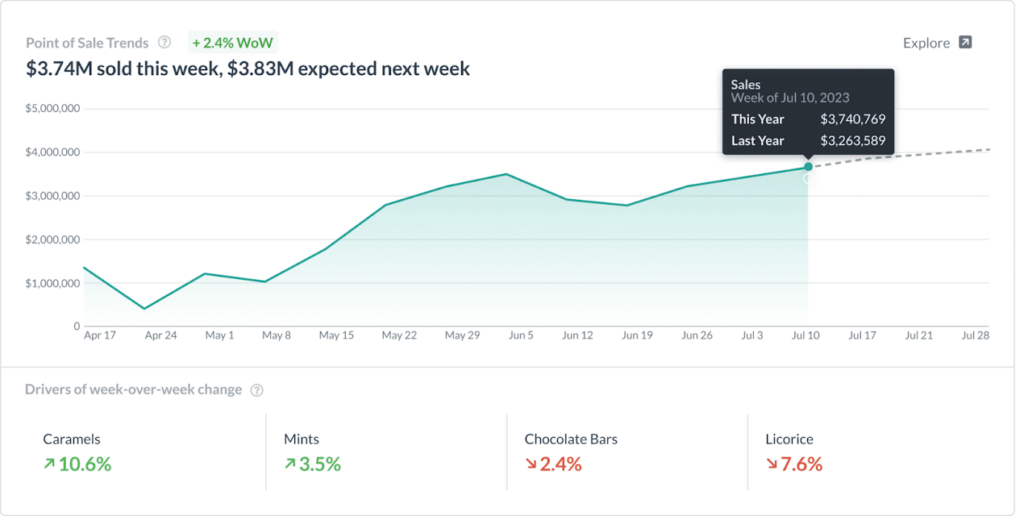
POS data is the most granular signal available: what sold, where, at what price, and when. This retailer data comes from retailer portals—Kroger’s 84.51°, Target’s vendor tools, Amazon Retail Analytics through Vendor Central, and hundreds more. Every retailer formats it differently, which is why data ingestion and normalization, not the analysis, is the real bottleneck in CPG data analytics. Pulling raw data from each portal, cleaning it, and standardizing it into one data lake is the job of a retail data platform built for the task.
Why it matters: POS data reflects true consumer demand. A retailer’s purchase order reflects a buying decision made six weeks ago. POS data tells the brand what a shopper actually grabbed off the shelf yesterday—the closest thing to live customer behavior a brand can get.
Syndicated data
Syndicated data from NielsenIQ, Circana, or SPINS provides market context: category share, competitor performance, pricing, and market trends, and channel benchmarks. This is the syndicated data brands bring into a buyer meeting or a joint business planning (JBP) conversation, because it frames their numbers against the whole CPG industry.
The catch: it’s usually a week or two delayed, expensive, and not granular enough for store-level execution. It answers “how is my category trending,” not “which twelve stores went out of stock this morning.”
Consumer panel data and consumer behavior analytics
Consumer panel data tracks shopper behavior over time—who bought, at what purchase frequency, whether they returned, and whether they’re switching to a competitor or private label. It answers a question the other sources can’t: is the brand winning new buyers, or only retaining existing ones?
That distinction shapes real marketing strategies and the choice of marketing channels. Acquiring new households is a different game from defending the base, and panel data on customer behavior tells the two apart.
First-party and ecommerce data
First-party and ecommerce data is the CPG data a brand owns outright: its DTC site, Amazon storefront, subscription platform, or loyalty program. It produces high-frequency consumer behavior signals that no retail partner shares, including the inputs for customer lifetime value, and it matters more every year as DTC grows. The upside is speed and ownership. The risk is treating one channel as the whole picture.
Supply chain and ERP data
Supply chain data and ERP data are where sell-in meets sell-through. Sell-in is what the brand ships; sell-through is what consumers buy. The gap between them is inventory health, and it’s usually the most expensive blind spot a brand has. Warehouse stock, inventory data, lead times, and production schedules all connect demand signals to replenishment and allocation decisions—the whole point of a smarter data-driven supply chain.
| Data source | What it measures | Where it comes from | Key limitation |
|---|---|---|---|
| Point-of-sale (POS) | Actual consumer purchases by SKU, store, price, and time | Retailer portals (84.51°, ARA, vendor portals) | Every retailer formats it differently; hard to normalize |
| Syndicated data | Category share, competitor, and pricing context | NielsenIQ, Circana, SPINS | Delayed, costly, not store-level granular |
| Consumer panel | Shopper behavior, loyalty, switching over time | Panel providers tracking household purchases | Sample-based, not a full census of sales |
| First-party / ecommerce | Direct consumer behavior, high frequency | DTC sites, Amazon storefront, loyalty programs | Covers only owned channels |
| Supply chain / ERP | Sell-in, inventory, lead times, production | Internal ERP, WMS, and DC systems | Disconnected from consumer demand unless integrated |
Key CPG analytics use cases that deliver actionable insights and ROI
The highest-ROI cpg analytics use cases are demand forecasting, trade promotion optimization, distribution and velocity tracking, inventory and out-of-stock management, and category management. Each applies the same connected data to a different commercial question, and the first two often cover the cost of the whole program.
Demand forecasting and POS-based planning
Demand forecasting is the place most brands find the biggest payoff. The swap is simple: replace shipment-order forecasts with models built on actual consumer POS demand. Order-based models miss seasonality, promotion lift, and distribution changes, because an order is a lagging echo of real behavior. POS data at the SKU/store/week level captures it all and gives planners a deeper understanding of why demand moves.
To forecast demand accurately, models read consumer signals directly rather than the orders that trail them. The same engine supports scenario-based planning—testing how a price change or a new launch would predict demand and incremental lift before committing inventory to it.
The payoff is documented. McKinsey found a personal-care company that improved forecast accuracy by 13%, cut product shortages by 40%, and reduced inventory by 35% after deploying an AI-driven forecasting model. That’s freed-up working capital and fuller shelves at the same time.
Alloy’s ML-powered POS forecasting runs at the SKU/store level using demand sensing and exports to existing planning systems, so it feeds the process rather than replacing it. For seasonal brands, seasonality in demand forecasting warrants a closer look.
Trade promotion optimization and CPG marketing analytics
Most promotions lose money for one reason: the analysis behind them is guesswork. Nielsen’s analysis found that roughly two-thirds of trade executions don’t break even, and weak measurement is almost always the cause.
CPG analytics fixes the measurement. It separates real incremental sales from volume that would have sold anyway, using elasticity models, historical lift curves, and cannibalization analysis—in real time, from day one of the promotion, not three weeks after it ends. Lift gets compared against baseline sales at the SKU/retailer/week level.
The practical result: a brand can see that a recurring BOGO at Kroger returns negative ROI, kill it, and shift the trade spend to something that moves incremental sales. That’s the difference between trade spend as a tax and trade spend as an investment, and it’s the core of CPG marketing analytics and any honest revenue optimization effort. The same logic applies to marketing campaigns more broadly: measure which marketing efforts actually increase sales, then move budget toward them to lift marketing ROI.
Distribution and velocity tracking
Two metrics carry the weight here. ACV (all-commodity volume) distribution shows weighted retail presence. Velocity—sales per point of distribution—shows how efficiently that presence converts to units sold.
What it surfaces:
Which retail stores, regions, or retailers beat or trail category benchmarks, so investment goes where it earns a return.
Distribution gap analysis that finds white space—chains that should carry the brand but don’t—backed by retail data, not a hunch.
New launches that are distributed but flat, which usually signal a placement or pricing problem rather than weak demand.
This is also the retail measurement that earns credibility for building stronger retailer partnerships. Buyers respect a brand that arrives with its own numbers, and the same velocity work helps the brand boost sales in the stores already carrying it.
Inventory and out-of-stock management with advanced analytics tools
Inventory and out-of-stock management delivers the fastest visible win. Monitoring weeks of supply at the DC and store level daily catches an emerging stockout while it’s still fixable, instead of after it becomes lost sales. It also flags phantom inventory—where the system shows in-stock, but the shelf is empty—so the brand can escalate to the retailer with evidence.
Brands running this well routinely see a 35%+ reduction in out-of-stocks, which lands straight on the top line. The next step turns the signal into action—specific, credible reorder requests a retail buyer will approve—which is what a retail replenishment AI agent handles automatically. Strong inventory management and inventory planning are often where advanced analytics first proves its worth as a genuinely powerful tool.
Category management and assortment analytics
Category management uses SKU-level performance by retailer and region to decide what to prioritize, rationalize, or expand. Blending a brand’s POS data with syndicated category data benchmarks performance against the full category and brings velocity and share-of-shelf evidence into JBP meetings and line reviews.
Not every SKU earns its slot. A handful of products usually do most of the work while a long tail clogs the assortment, and good analytics tools make that obvious—uncomfortable, but useful.
See it in action. See how leading CPG brands connect all five data sources in one platform. Book a demo to walk through it with your own data.
CPG analytics vs. retail analytics in the CPG industry
CPG analytics and retail analytics use overlapping data to answer opposite questions. Retail analytics helps a retailer run a better store. CPG analytics helps a brand perform better inside that store. Both rely on point-of-sale data, but the decisions, KPIs, and audiences are entirely different.
The split, plainly:
Retail analytics: foot traffic, conversion, staffing, category space allocation, private-label performance. The retailer optimizes its own building.
CPG analytics: sell-through velocity, out-of-stock rates, trade promotion ROI, ACV distribution, and demand forecasting. The brand optimizes its performance within that building.
The POS feed overlaps; the similarity stops there. A sharp brand wants both. Retail analytics provides category context—how the whole aisle is moving—while CPG analytics explains why specific SKUs over- or under-index against it. The retail analytics guide covers the retailer’s side in full.
How to build a data-driven CPG analytics strategy from your CPG data
A CPG analytics strategy works best in sequence, not as a single big-bang rollout. Brands that try to connect everything at once tend to end up with dashboards nobody opens. The better path is to start narrow, prove value, and expand—improving operational efficiency in one corner of the CPG business before scaling the approach out.
Start with the single most expensive question. Pick the one decision where better data would move the bottom line the most. For most brands, that’s trade promotion ROI or out-of-stock reduction.
Audit current data sources. Map every feed—retailer portals, syndicated providers, ERP, and ecommerce—and find where the same metric is calculated differently. What counts as a promoted week? How is a stockout defined? The inconsistencies are the point.
Connect the POS data first. POS is the foundation. The data transformation work—getting it into one normalized, daily-refreshed environment—has to happen before building any model or dashboard on top. The right platform handles this without a dedicated data scientist or heavy technical expertise on the brand’s side.
Add only the layers that answer the question. Once POS is clean, add inventory data for stockout work, trade data for promotion analytics, and supply chain data for planning. Expand outward from the question so each addition supports smarter decisions rather than more noise.
Measure decisions, not reports. The goal is faster, better calls—not prettier charts. Pick the top metrics that matter—forecast accuracy, out-of-stock rate, and promotion ROI—set a baseline, and treat the program as a continuous improvement, tracking whether each metric actually moves.
Standardizing on a shared metric set keeps sales, supply chain, and finance from arguing about whose number is right. These are the cpg KPIs worth tracking:
| KPI name | Definition | Formula | Decision it informs |
|---|---|---|---|
| ACV distribution | Weighted % of retail volume where a SKU is sold | Sum of ACV of stores carrying SKU ÷ total market ACV | Where to expand or fix the distribution |
| Velocity | Sales per point of distribution | Units sold ÷ ACV distribution points | Which stores/regions over- or under-perform |
| In-stock rate | % of store-days a SKU is available | In-stock store-days ÷ total store-days | Execution and replenishment priorities |
| Sell-through rate | % of available stock sold in a period | Units sold ÷ units available | Promotion and inventory planning |
| Weeks of supply | How long current inventory lasts at the current sales rate | Inventory on hand ÷ average weekly units sold | Replenishment timing |
| Trade promotion lift | Incremental sales above baseline during a promo | (Promoted sales − baseline sales) ÷ baseline sales | Which promotions actually work |
| Trade ROI | Profit return per dollar of trade spend | Incremental profit ÷ trade spend | Where to allocate trade budget |
| Inventory turn | How often do last inventory cycles occur in a period | COGS ÷ average inventory | Working capital efficiency |
| Out-of-stock rate | The % of store days a SKU is unavailable | Out-of-stock store-days ÷ total store-days | Lost-sales recovery |
| New buyer acquisition rate | Share of sales from first-time buyers | New buyers ÷ total buyers | Marketing and growth strategy |
| Repeat rate | Share of buyers who purchase again | Repeat buyers ÷ total buyers | Loyalty and retention focus |
| Distribution points | Count of stores/locations carrying a SKU | Total stores stocking the SKU | Distribution gap analysis |
How Alloy.ai delivers CPG analytics solutions for consumer brands
Alloy.ai connects a brand’s fragmented retail data into one daily-refreshed view, then applies AI and machine learning to turn it into decisions. It brings all your data—POS, inventory, ecommerce, distributor, and ERP—into one place, handling the massive amounts of raw retailer data that would otherwise sit in silos. What separates it from generic business intelligence is the perspective: it’s built for the brand selling through retail, tracking sell-through and real consumer demand rather than only sell-in orders.
A few capabilities worth knowing:
Connects 850+ retailer portals, EDI feeds, ecommerce platforms, distributor systems, and ERPs, and normalizes all of it automatically—no manual portal downloads or quarter-long ETL projects.
Delivers daily SKU/store/channel granularity with anomaly detection that surfaces the highest-impact issues first—stockouts, demand swings, inventory risk—so teams work on what matters.
Runs ML-powered POS forecasts at the SKU/store level using demand-sensing and exports them into SAP, Blue Yonder, or o9.
Generates prescriptive replenishment recommendations with the order math done and the emails to retail replenishment managers drafted.
Provides cross-retailer scorecards and promotion dashboards with the sell-through and sales data teams need before a buyer meeting.
Brands including Crayola, BIC, Valvoline, Bosch, SimpliSafe, and Melissa & Doug already run on it. Unlike point tools, cpg analytics solutions like this connect the full picture, which is how brands improve operational efficiency across planning, replenishment, and trade at once. The AI and predictive analytics capabilities page covers how the modeling works.
Conclusion
CPG analytics has shifted from a nice-to-have report to a commercial necessity. The brands gaining shelf and stronger retailer relationships in 2026 aren’t the ones with the most data—they’re the ones who connected it, moved from reactive reports to predictive insights, and built the infrastructure to act first. The upside is measurable: Bain & Company reports that a more granular, data-driven approach to marketing, sales execution, and revenue management can add 3 to 5 percentage points of sales growth and 200 to 300 basis points of gross margin.
The order matters. Connect the POS data first, because everything sits on it. Then go after demand forecasting and trade optimization, where ROI shows up fastest. Then build the integrated analytics layer across sales, supply chain, and marketing, because that’s the competitive advantage rivals can’t easily copy.
No brand needs to fix everything this quarter. It needs to pick the one decision costing the most right now and put real data behind it.
Ready to connect your retail data and start making faster, more accurate CPG decisions? Book a demo to see Alloy.ai in action.
FAQ
What is CPG analytics?
CPG analytics is the practice of collecting, connecting, and analyzing data across a consumer goods brand’s commercial and operational ecosystem—including point-of-sale transactions, trade promotion results, inventory levels, and supply chain feeds—to improve performance, optimize investment, and make faster decisions. It focuses on the manufacturer’s perspective: how products sell through retail channels, how trade spend performs, and how demand and supply align. It draws on POS data, syndicated data, consumer panels, first-party data, and supply chain feeds.
What is the difference between CPG analytics and retail analytics?
CPG analytics and retail analytics use similar data but answer different questions. Retail analytics helps retailers optimize their own store operations: foot traffic, conversion, staffing, space allocation, and private-label performance. CPG analytics helps consumer brands optimize their performance inside those stores: sell-through velocity, out-of-stock rates, trade promotion ROI, ACV distribution, and demand forecasting. Both use point-of-sale data, but the commercial decisions, KPIs, and audiences are entirely different.
What data is used in CPG analytics?
CPG analytics draws on five primary data sources. Point-of-sale data from retailer portals shows actual consumer purchases at the store level. Syndicated data from NielsenIQ, Circana, or SPINS provides category and competitor context. Consumer panel data tracks shopper purchase behavior over time. First-party and e-commerce data comes from DTC platforms and Amazon. Supply chain and ERP data connect consumer demand signals to inventory and production planning. POS data is the most important and the hardest to normalize across retailers.
What are the highest-ROI use cases for CPG analytics?
The highest-ROI use cases for CPG analytics are demand forecasting and trade promotion optimization. Demand forecasting using POS data rather than shipment orders reduces structural forecast error, which means fewer out-of-stocks, less excess inventory, and better working capital. Trade promotion optimization uses elasticity models and historical lift data to identify which promotions generate real incremental volume, which matters because most industry studies show the majority of CPG promotions fail to break even. Distribution tracking and out-of-stock management deliver fast, visible operational impact.

Logan Ensign
Logan Ensign is vice-president of client solutions at Alloy Technologies, Inc. where he works with customers to maximize value from the data, analytics and planning platform by ensuring fast implementation, delivering trainings, sharing ongoing best practices and conducting regular business reviews.
Book a Demo
See Alloy.ai
Synchronize execution to eliminate waste, mitigate risk, and capture every revenue opportunity.
Once you submit a demo request form:
- A sales rep will email you within 24 hours to schedule a brief intro call.
- Our team will provide an overview of Alloy.ai and learn more about your data goals and objectives.
- We’ll create and walk you through a live demo, customized to your specific data needs.