

CommerceIQ helps CPG brands manage retail media, digital shelf performance, and ecommerce operations. But depending on your business, you might need more detailed inventory analytics, better demand forecasting, stronger competitive intelligence, or more control over advertising campaigns.
The good news is that a few CommerceIQ alternatives offer specialized capabilities for different retail operations. Some focus on retail media optimization, while others connect sales and supply chain data to help brands understand what’s happening across their retail networks.
In this guide, we’ll compare seven of the best CommerceIQ competitors for 2026, covering their key advantages, potential limitations, and which types of businesses they’re best for.
TL;DR
| Biggest advantage over CommerceIQ | Best for | |
|---|---|---|
| Alloy.ai | Deeper inventory, supply chain, and demand forecasting analytics across retail networks | CPG brands managing sales and inventory across multiple retailers |
| Stackline | Detailed competitor intelligence, shopper behavior analysis, and consumer research | Ecommerce brands focused on market share and customer insights |
| Profitero | Advanced digital shelf content optimization and global retail intelligence | Enterprise brands managing product visibility across international markets |
| PacVue | Greater control over retail advertising campaigns and budget optimization | Brands and agencies managing large retail media budgets |
| NIQ Digital Shelf | Granular store-level insights combined with NielsenIQ’s consumer and market data | CPG manufacturers optimizing product availability and digital shelf performance |
| SmartScout | Detailed Amazon seller research, product sourcing, and competitive intelligence | Amazon sellers, wholesalers, and marketplace agencies |
| DataWeave | Specialized competitor pricing, assortment analysis, and brand protection | Retailers and brands focused on pricing strategy and competitive monitoring |
Get the better alternative to CommerceIQ for CPG analytics. Book a demo with Alloy.ai today.
Why look for alternatives to CommerceIQ?

1. Data inaccuracies and unreliable recommendations
CommerceIQ provides extensive retail analytics, but the information isn’t always accurate enough to use without additional checks.
One G2 reviewer from the manufacturing industry mentioned that the platform occasionally generates inaccurate recommendations. They also felt that the reporting tools didn’t offer enough alternative ways to analyze their data.
Another enterprise customer reported difficulties maintaining accurate market share data as new product subcategories appeared. Their team had to monitor SKU-level changes to keep their analysis reliable.
2. Slow performance when handling large datasets
CommerceIQ brings together large amounts of information from retailers, but some users have experienced performance issues when working with that data.
In a February 2026 review, a customer noted that the platform can be slow to load large datasets from multiple retailers. They also described its reporting interface as restrictive.
Similar concerns appear in earlier feedback from an enterprise user, who mentioned occasional loading delays.
These limitations can become frustrating when teams need to compare product performance across several retailers or regularly analyze large SKU catalogs.
3. Software bugs that disrupt daily operations
Some CommerceIQ customers have encountered bugs that interfere with campaign management and other routine tasks.
One G2 reviewer working in marketing and advertising reported problems that affected campaign spending and delayed launches. They also said they had to rely on support tickets to resolve issues that blocked certain activities.
Another retail media analyst described recurring bugs, although they acknowledged that the software had been improving.
4. Limited reporting customization and difficult data exports
CommerceIQ offers detailed reporting capabilities, but not every customer is satisfied with how they can customize and export their data.
For example, one enterprise customer explained that exported reports required considerable cleaning and formatting before they could be used in Excel.
Another customer reviewing their first year with CommerceIQ wanted more customization options for charts and reports.
These issues can be frustrating if your CPG team combines CommerceIQ data with internal sales reports or other business intelligence platforms.
5. High pricing and a steep learning curve
CommerceIQ primarily targets larger brands, and its pricing may be hard to justify for smaller businesses that only need some of its features.
A February 2026 G2 review specifically identified high enterprise pricing and the learning curve as two major drawbacks.
The platform’s broad functionality can also make navigation difficult. One enterprise reviewer explained that so many features made it overwhelming to find the right tools.
We have a full article on CommerceIQ pricing if you want to dig deeper.
6. Inconsistent account management and strategic support
CommerceIQ receives plenty of positive feedback for customer service, but some reviewers have reported account management issues.
One G2 customer described working with three or four different account managers after initially having the same contact for 18 months. These frequent changes made it harder to maintain continuity.
Another reviewer from the food and beverage industry appreciated the team’s professionalism but wanted more strategic guidance during account meetings. They felt discussions placed too much emphasis on budgets rather than long-term Amazon growth.
7. Limited support for Amazon Seller Central accounts
CommerceIQ has extensive capabilities for Amazon vendors, but businesses using both Vendor Central and Seller Central may encounter limitations.
In a G2 review from February 2024, one customer specifically complained about insufficient Seller Central support. They noted that this was a major issue for brands running a hybrid Amazon business.
The best CommerceIQ competitors for supply chain analytics in 2026
The following seven platforms offer different approaches to retail analytics, from inventory monitoring and demand forecasting to competitive intelligence and retail media management. We’ll look at where each tool beats CommerceIQ, who benefits most from its features, and where it might fall short.
1. Alloy.ai
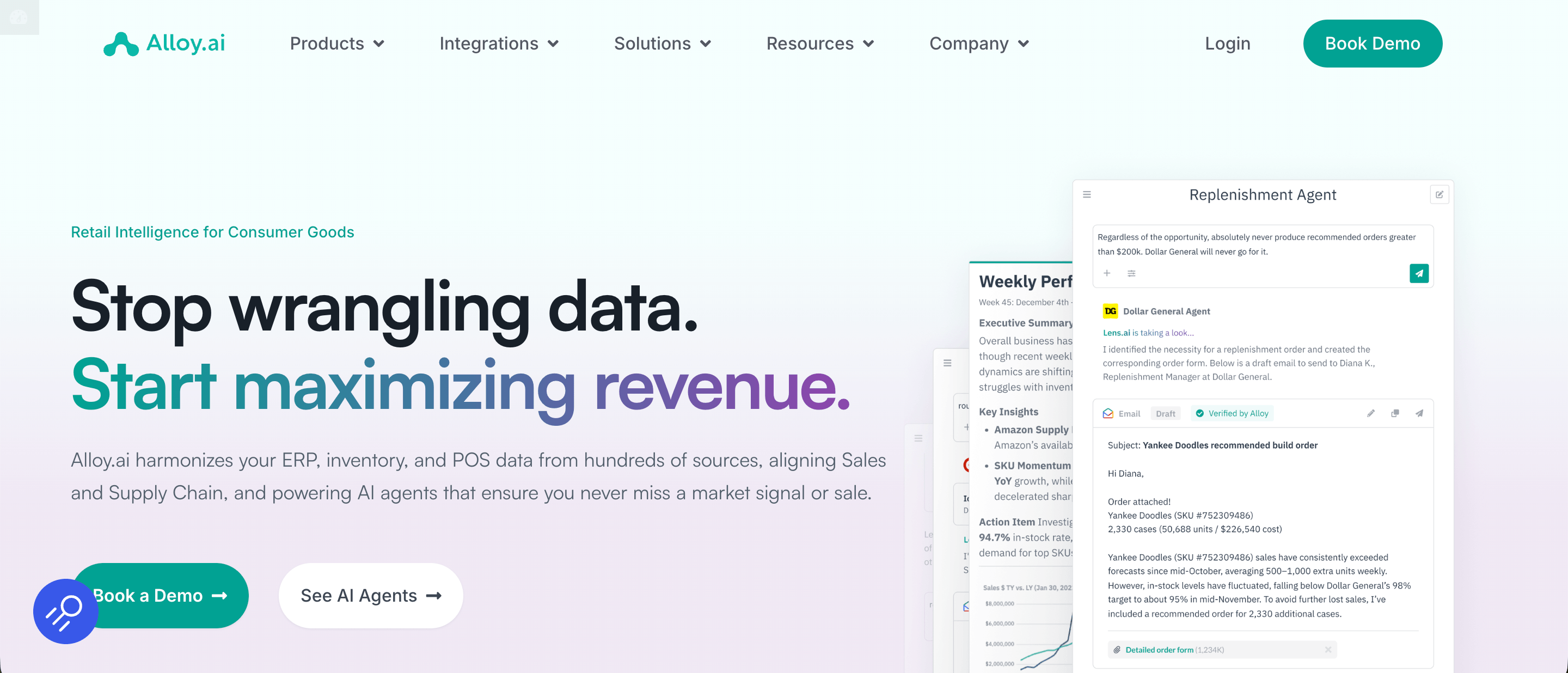
Alloy.ai is a retail analytics platform that helps CPG brands connect sales, inventory, and supply chain data across their retail networks. It’s designed for midmarket and enterprise brands selling through multiple retailers, especially those looking to improve demand forecasting, prevent stockouts, and better understand product performance across physical and online stores.
Why choose Alloy.ai over CommerceIQ?
- Greater focus on supply chain operations: While CommerceIQ emphasizes digital shelf performance and retail media optimization, Alloy.ai connects retail sales data with warehouse inventory, distributor data, shipments, and internal ERP systems.
- 450+ data integrations: Alloy.ai connects with retailers, distributors, ecommerce platforms, and internal business systems, giving brands a centralized view of their operations across multiple sales channels.
- More detailed inventory analysis: Track inventory down to individual stores and SKUs, identify phantom inventory, uncover distribution gaps, and detect potential stockouts before they affect sales.
- Demand forecasting based on actual sales: Alloy.ai uses POS data and inventory information to forecast consumer demand and help brands make better replenishment and inventory allocation decisions.
- Better visibility across physical retail networks: Brands can analyze product performance across stores, distribution centers, and retail partners instead of focusing primarily on ecommerce performance.
However, Alloy.ai isn’t primarily designed for retail media campaign management, automated advertising bids, or digital shelf content optimization, areas where CommerceIQ offers more specialized features. Alloy focuses more on connecting retail and supply chain data.
Want to learn how Alloy.ai can help you connect the dots in your CPG data? Book a free demo today.
2. Stackline
Stackline is a retail analytics and intelligence platform that helps consumer brands analyze market share, competitor performance, shopper behavior, and retail advertising. It’s designed for established CPG brands and ecommerce teams that want deeper insights into category trends and consumer purchasing patterns across Amazon, Walmart, Target, and other major retailers.
Why choose Stackline over CommerceIQ?
- Deeper competitive intelligence: Stackline’s Atlas platform tracks more than 1.2 billion products, providing detailed information on competitor sales, market share, pricing, promotions, and advertising activity.
- More detailed shopper analytics: Stackline analyzes consumer purchasing behavior across retailers, including customer retention, lifetime value, brand switching, and share of wallet. This helps brands understand who buys their products and how shopping habits change over time.
- Direct consumer engagement tools: Stackline’s Shopper OS includes CRM capabilities, loyalty programs, customer surveys, and verified review collection. These features go beyond CommerceIQ’s primary focus on ecommerce performance and retail media optimization.
- Advertising attribution across retailers: Stackline can connect Amazon advertising exposure with purchases at other retailers, including physical stores. This gives brands additional visibility into how advertising contributes to profitable growth beyond Amazon.
- Dedicated consumer research capabilities: Brands can conduct surveys with verified shoppers, test advertising concepts, and gather direct feedback on products and competitors through Stackline’s research tools.
However, CommerceIQ offers more specialized automation for digital shelf analytics and revenue recovery, including identifying and disputing Amazon chargebacks. Stackline also customizes pricing for each customer, making it difficult to estimate costs without contacting sales. Brands that need stronger supply chain and inventory management capabilities may find a better fit among other Stackline competitors.
3. Profitero
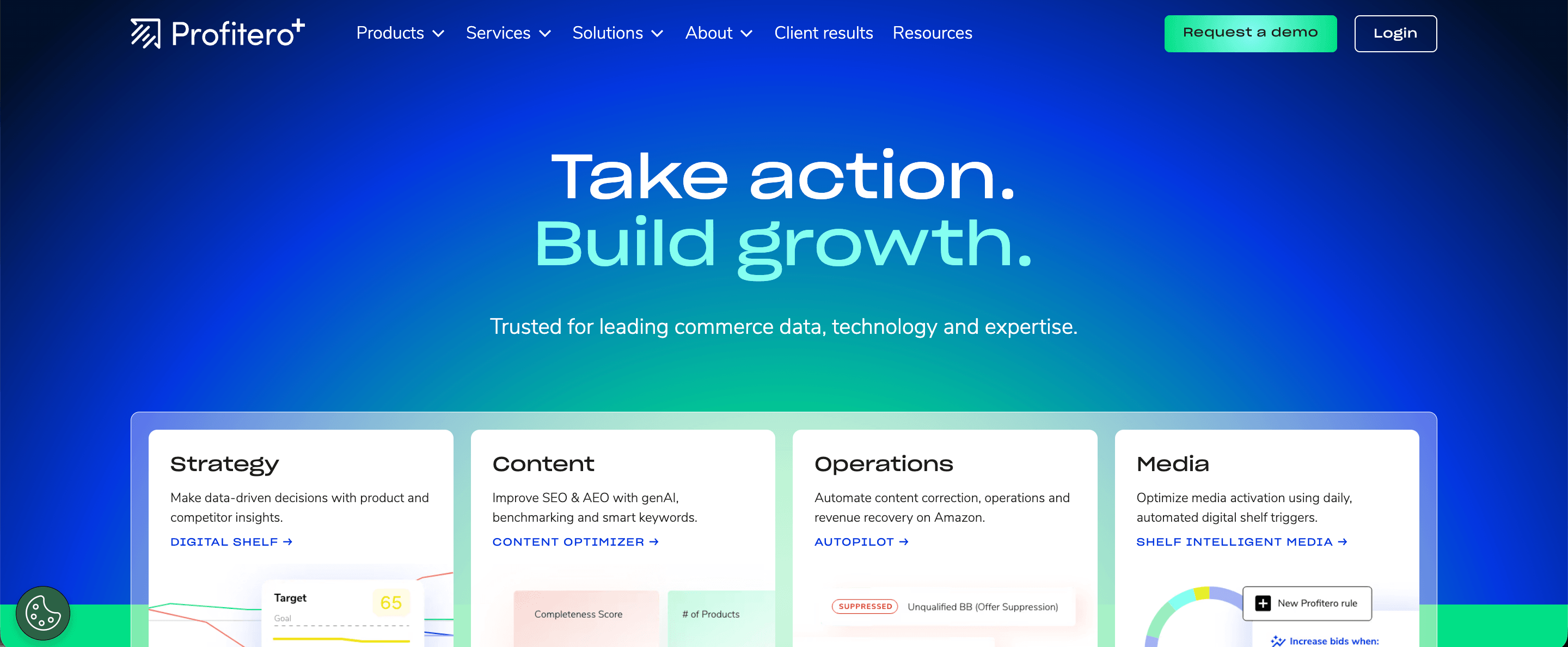
Profitero is a digital shelf analytics and ecommerce intelligence platform that helps consumer brands monitor product visibility, pricing, availability, and competitor performance across online retailers. It’s designed for CPG brands and enterprise ecommerce teams that want detailed market intelligence, stronger product content, and better control over retail media spend.
Why choose Profitero over CommerceIQ?
- Dedicated content optimization tools: Profitero’s Content Optimizer uses AI-powered recommendations to identify relevant keywords, benchmark product pages against competitors, and generate optimized product descriptions. This gives brands more direct support for improving product content and search visibility.
- Detailed competitive intelligence: Monitor competitor pricing, promotions, search rankings, and product availability to identify opportunities for profitable growth. Profitero also tracks unauthorized third-party sellers and potential revenue leakage from lost marketplace sales.
- Global retail coverage: Profitero monitors more than 80 million products across 1,400+ retailers in over 70 countries, allowing international brands to compare performance across markets using consistent metrics.
- Integrated retail media services: Profitero+ combines digital shelf intelligence with campaign planning, media buying, and optimization services. Brands can also access specialist support through Publicis Groupe’s global network and Mars United Commerce.
- More flexible reporting and data access: Profitero offers direct access to its analytics through Snowflake, allowing businesses to build custom dashboards and combine retail intelligence with other data sources. Its automated alerts and analytics also help teams make faster decisions.
However, Profitero’s broad range of analytics products and managed services may be excessive for businesses that primarily need retail media automation. CommerceIQ may be a better choice for teams that prefer to manage advertising, digital shelf performance, and retail operations through a single software platform rather than combining specialized products and services.
4. Pacvue
PacVue is a retail media management and commerce intelligence platform that helps brands and agencies manage advertising, track sales performance, and optimize their ecommerce operations. It’s designed for enterprise CPG brands, large ecommerce sellers, and advertising agencies that manage substantial ad spend across multiple retailers and marketplaces.
Why choose PacVue over CommerceIQ?
- Broader retail media coverage: PacVue supports advertising and commerce operations across 100+ retailers and marketplaces in more than 30 countries, including Amazon, Walmart, Target, and Instacart. This gives brands more options for managing international advertising campaigns.
- More advertising channels: PacVue supports sponsored search, display advertising, DSP, connected TV, and social commerce campaigns, making it useful for brands that want to coordinate advertising across more channels.
- Advanced campaign automation: Advertisers can configure custom bidding rules, budget pacing, keyword harvesting, and dayparting to control when and where ads appear. These features provide detailed control over campaign execution and ad spend.
- Dedicated agency capabilities: PacVue offers centralized campaign management, standardized reporting, and performance benchmarking across client accounts. Agencies can also compare retail media ROI across retailers and use incremental return-on-ad-spend reporting to demonstrate campaign results.
- Amazon Marketing Cloud integration: PacVue supports audience creation and activation through Amazon Marketing Cloud, allowing advertisers to use shopper insights to improve targeting and measure incremental campaign performance.
However, PacVue’s extensive advertising capabilities can make it unnecessarily complex for smaller brands with limited retail media budgets. Although it offers unified ecommerce management solutions, CommerceIQ may be a better choice for organizations that prioritize digital shelf optimization and sales analytics over advanced advertising execution. Both platforms serve the enterprise retail industry, so the better option depends on which capabilities a brand needs most.
5. NiQ Digital Shelf
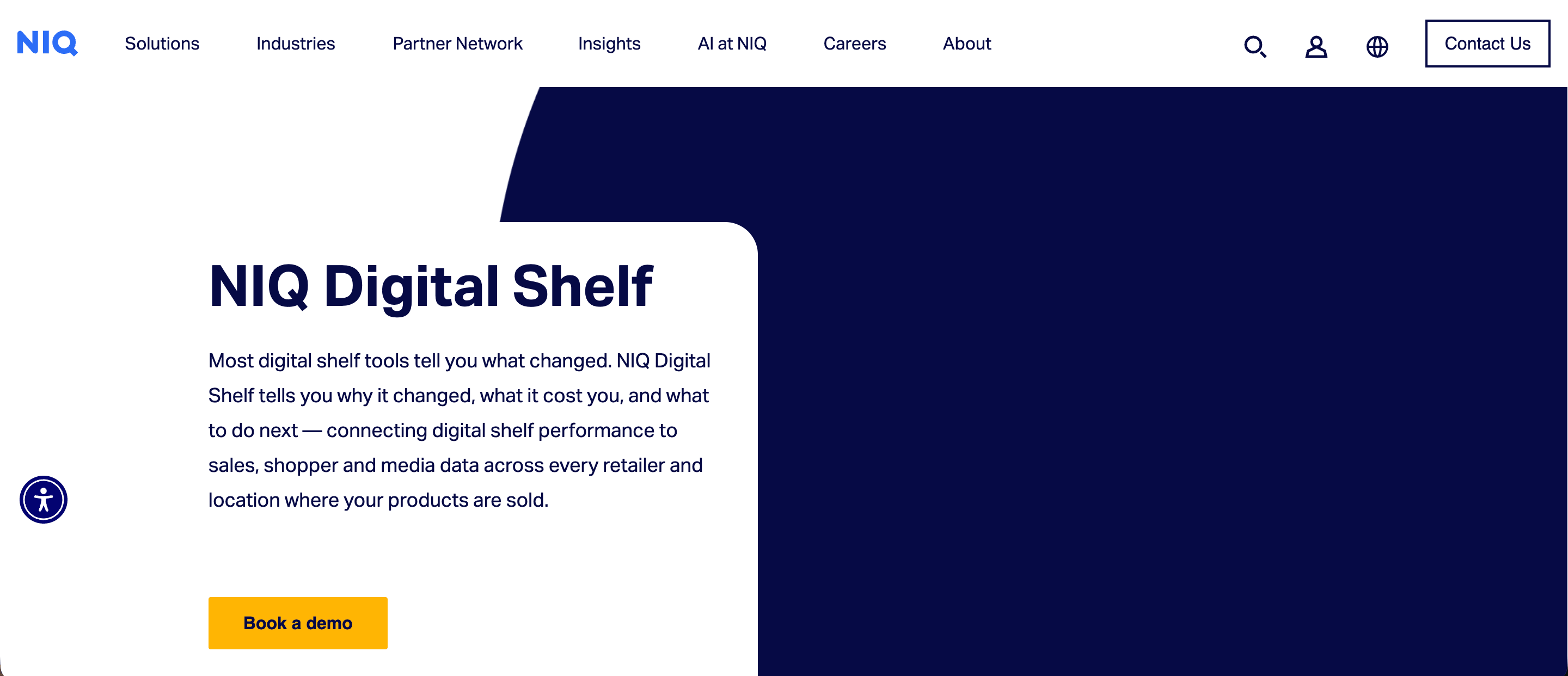
NIQ Digital Shelf is a retail ecommerce analytics platform from NielsenIQ that helps brands monitor product availability, pricing, search visibility, and content performance across online retailers. It’s designed for CPG manufacturers whose brands sell online through multiple retail partners and need detailed insights into how their products perform across different markets and store locations.
Why choose NIQ Digital Shelf over CommerceIQ?
- More granular store-level analytics: NIQ Digital Shelf collects data from more than 141,000 retail locations, helping brands identify availability issues, pricing inconsistencies, and distribution gaps at individual stores rather than relying on broader regional averages.
- Connected sales and shopper intelligence: NIQ combines digital shelf metrics with its broader sales, market share, and consumer data. Brands can better understand how changes in product visibility, availability, and pricing affect actual sales performance.
- Consistent product data across retailers: NIQ uses UPC identifiers to match products across different retail websites, helping brands compare performance without inconsistencies caused by different product names or classifications.
- Detailed search and content optimization: Monitor organic and paid search rankings, identify missing product information, track competitor activity, and receive keyword recommendations to improve visibility and fuel incremental sales.
- Retail media performance analysis: NIQ connects advertising data with digital shelf performance to identify which products and retailers offer the greatest opportunities. Brands can use these insights to allocate advertising budgets more effectively and increase retail media ROI.
- Dedicated consulting support: NielsenIQ provides personalized advisory services to help brands interpret their data, address retailer performance issues, and identify opportunities for improving distribution and product visibility.
However, NIQ Digital Shelf focuses primarily on analytics and recommendations rather than automated campaign execution and retail operations. CommerceIQ offers more extensive tools for automated bidding, purchase order management, and revenue recovery, making it a better choice for brands that want to manage these activities in one platform.
6. SmartScout
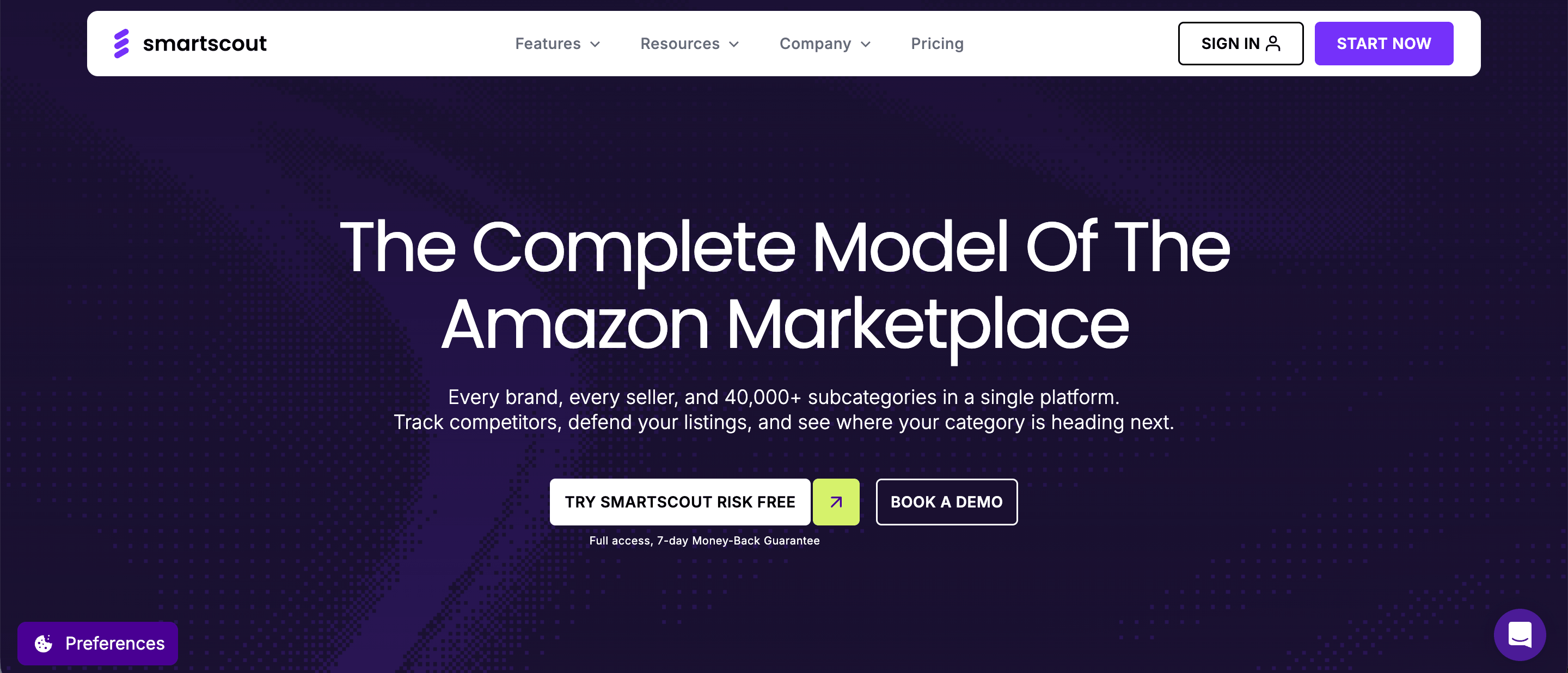
SmartScout is an Amazon marketplace intelligence platform that helps brands, sellers, and agencies research competitors, discover product opportunities, and analyze advertising performance. It’s designed for businesses operating on Amazon, one of the world’s largest marketplaces, that need detailed market research to make better business decisions about pricing, product selection, and advertising.
Why choose SmartScout over CommerceIQ?
- More detailed seller and brand research: SmartScout tracks over 2 million third-party sellers and provides access to data on millions of products and brands. Users can identify competing sellers, examine their product catalogs, and compare estimated sales across more than 40,000 Amazon subcategories.
- Dedicated product sourcing tools: SmartScout offers a product database, UPC Scanner, and FBA Calculator to help businesses evaluate product demand, competition, fees, and margin before purchasing stock. These capabilities are more relevant to wholesale sellers and resellers than CommerceIQ’s enterprise retail operations tools.
- Competitive advertising intelligence: SmartScout’s Ad Spy reveals which competitors advertise on specific keywords and products, along with estimates of their advertising activity. Sellers can use this information to identify targeting opportunities and improve advertising outcomes.
- Product listing optimization: SmartScout uses artificial intelligence to generate product titles, descriptions, and bullet points based on keyword research and competitor data. Its review sentiment analysis also helps brands understand customer experience issues and identify opportunities to improve their listings.
- Transparent subscription options: Unlike CommerceIQ’s custom enterprise pricing, SmartScout publishes subscription prices and offers plans for smaller Amazon businesses. Sellers can access product research tools without committing to a large enterprise contract.
However, SmartScout is primarily a marketplace research platform rather than a system for managing retail operations across multiple channels. CommerceIQ offers more extensive campaign automation, inventory monitoring, and retail media management capabilities, which may be more useful for large brands coordinating advertising budgets and supply chain operations. SmartScout’s revenue estimates and FBA profit calculations can help you evaluate potential profits, but you shouldn’t treat them as guaranteed sales or earnings.
7. DataWeave
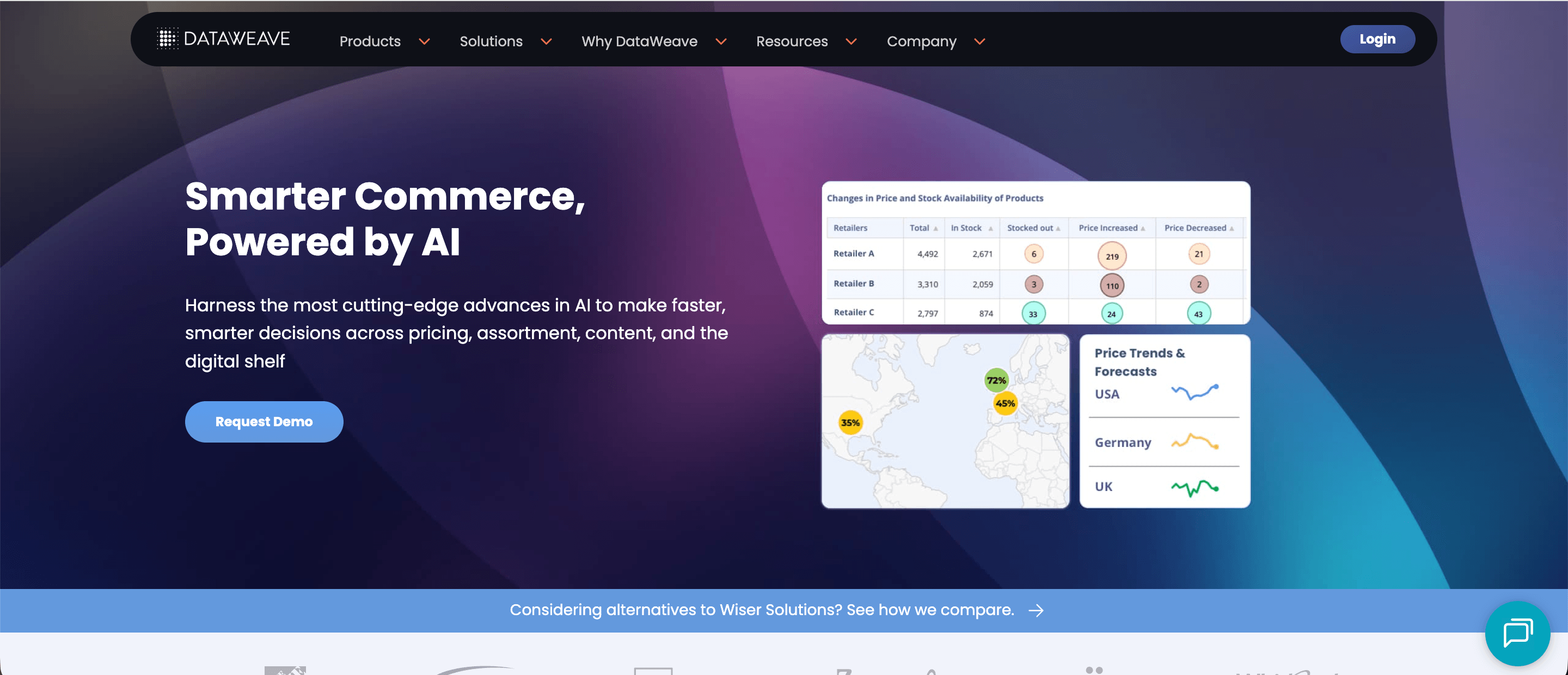
DataWeave is an ecommerce analytics platform that provides competitive intelligence, pricing analysis, digital shelf monitoring, and product assortment insights for retailers and consumer brands. It’s designed for companies whose pricing, merchandising, and e-commerce employees need detailed competitor data to make better decisions across multiple retailers and markets.
Why choose DataWeave over CommerceIQ?
- More specialized pricing intelligence: DataWeave monitors competitor prices across retailers, locations, and currencies, using AI to match identical, similar, and private label products. This helps companies make informed pricing decisions while protecting profitability.
- Detailed assortment analytics: Retailers can compare their product catalogs with competitors’, identify missing products, and spot emerging category trends. These insights help businesses optimize their product selection and respond to changing consumer demand.
- Dedicated brand protection tools: DataWeave monitors minimum advertised price (MAP) violations, unauthorized sellers, and counterfeit listings. Brands can identify problematic retailers or vendors and access documented evidence of pricing violations.
- Granular geographic insights: DataWeave tracks pricing, product availability, and assortment differences down to individual stores and ZIP codes. This gives retailers more flexibility to develop regional pricing strategies and address local inventory gaps.
- Flexible data collection and integration: DataWeave can monitor millions of SKUs across competitors at scale, with customizable tracking frequencies, historical data, and API access. Companies can integrate these insights into their existing analytics systems rather than relying exclusively on the platform’s dashboards.
However, DataWeave focuses primarily on collecting and analyzing competitive market data rather than executing e-commerce operations. CommerceIQ offers more extensive retail media automation, purchase order reconciliation, and advertising optimization capabilities, making it a better option for brands that want to manage these activities within the same platform.
Get the better alternative to CommerceIQ for retail analytics
CommerceIQ offers many useful features for retail media management and ecommerce optimization, but it may not be the right choice for every CPG brand. If your biggest challenges are inventory visibility, demand forecasting, and understanding what’s happening across your retail network, you may need a platform that focuses more on sales and supply chain analytics.
Alloy.ai brings your retail sales, inventory, and supply chain data together so you can see which products are selling, where demand is growing, and where stock issues could affect sales. Instead of switching between reports from different retailers and distributors, your team can work with a consistent view of performance across your entire retail network.
Whether you’re trying to reduce stockouts, improve replenishment, or find new sales opportunities, Alloy.ai gives you the data to act on what’s happening at the store and SKU level.
Book a demo with Alloy.ai to see how we can help you get more value from your retail data.