
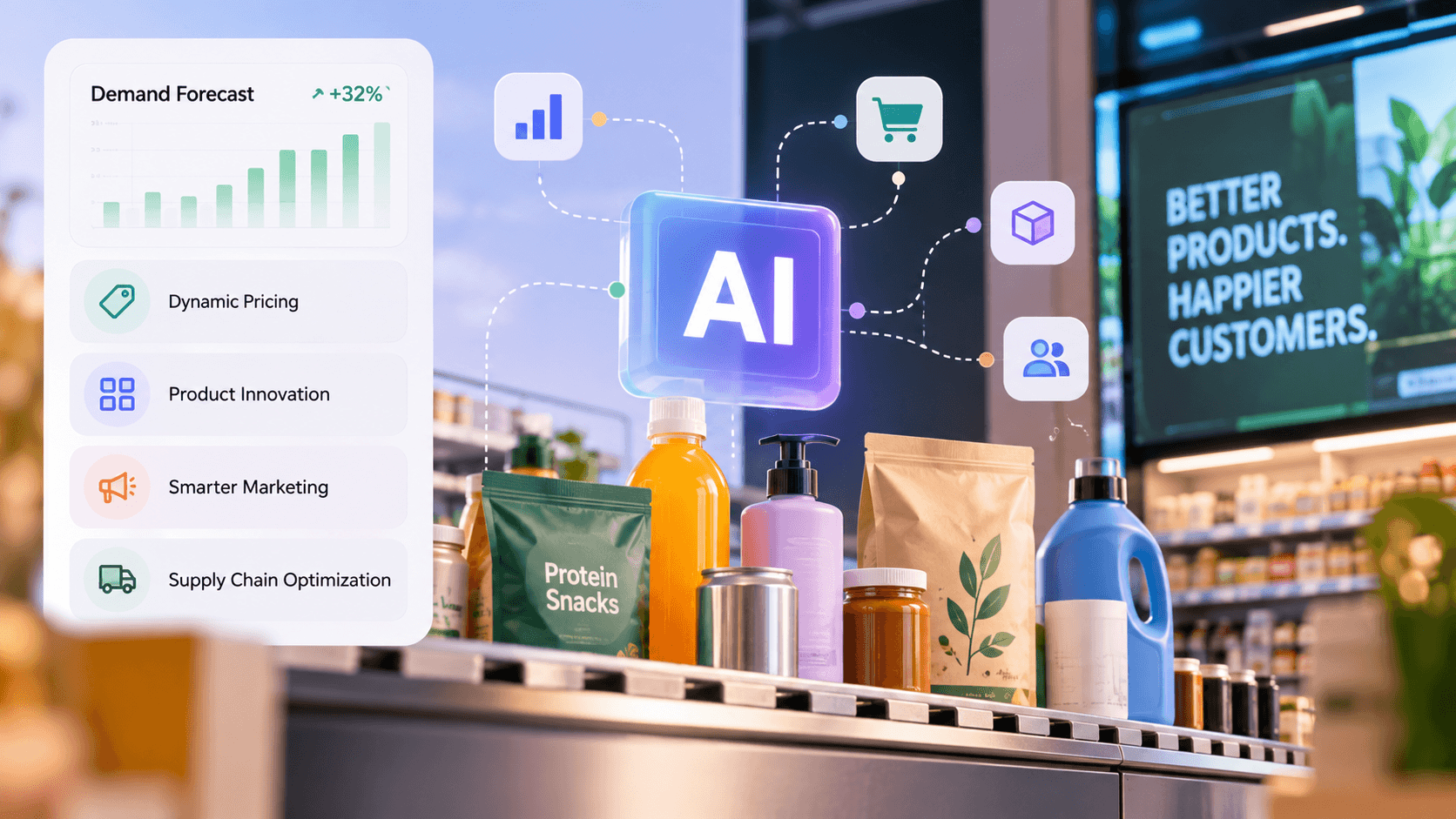
CPG brands have more data than ever, yet many still struggle to answer basic questions. Which products are about to run out of stock? Why are sales declining at certain retailers? How much inventory should they order ahead of the next promotion?
AI for CPG helps answer these questions before they turn into expensive problems. By analyzing retail sales, inventory levels, and demand patterns, AI can identify potential stockouts, improve forecasts, and recommend actions based on what’s actually happening in the market.
But not every AI application delivers the same value. Some help teams analyze data faster, while others can predict demand or prepare replenishment orders for approval.
In this guide, we’ll cover practical AI use cases for CPG companies, the benefits and challenges of adoption, and how to choose the right solution for your business.
TL;DR
- AI for CPG helps brands make better decisions by analyzing retail sales, inventory levels, consumer behavior, and supply chain data to identify risks and opportunities.
- Demand forecasting and inventory optimization are among the most practical applications. AI can predict stockouts, estimate future demand, and recommend replenishment quantities before shortages affect sales.
- AI supports much more than supply chain planning. CPG companies can use it to optimize trade promotion, inform pricing decisions, support consumer research, guide product development, and improve manufacturing quality control.
- Different AI technologies serve different purposes. Predictive AI forecasts demand, generative AI helps analyze information, computer vision monitors physical operations, and AI agents recommend actions.
- Data quality is one of the biggest barriers to AI adoption. Disconnected retailer systems, inconsistent product information, and outdated inventory records can undermine even advanced AI models.
- Successful AI implementation starts with a measurable business problem. Run a limited pilot, set baseline KPIs, compare predictions with actual results, and expand only after you demonstrate improvements.
- Alloy.ai helps CPG brands turn retail data into actionable recommendations. Its AI capabilities support demand forecasting, stockout prevention, performance analysis, and replenishment planning across retail networks.
Get AI-powered insights for your CPG data today. Book a free demo with Alloy.ai.
What is AI for CPG?
AI for CPG uses artificial intelligence to help consumer packaged goods companies predict demand, manage inventory, and make better decisions across operations.
It works by analyzing data from retailers, distributors, and internal business systems. Instead of waiting for weekly reports to reveal problems, CPG teams can spot risks earlier and decide where to act.
Here’s a practical example. Imagine a beverage brand sees sales increase by 30% across 50 Walmart stores. AI can help answer four questions:
- Which stores are at risk of running out? Compare recent sales velocity against available inventory.
- When will inventory run out? Forecast demand using current sales trends and incoming shipments.
- Where should inventory go first? Identify stores that need replenishment most urgently.
- How effective was the response? Monitor stock availability and sales performance after replenishment.
These applications rely on accurate CPG analytics and access to current retail data. Without reliable sales, inventory, and product distribution data, even sophisticated AI models can produce misleading recommendations.
The goal is to turn data into decisions: knowing which products need attention, where problems are developing, and what actions can prevent lost sales.
How does AI work in the CPG industry?
AI combines data from retail partners, internal business systems, and external sources to identify patterns that traditional reporting might miss.
For companies in the CPG industry, this typically involves four stages:
- Collecting data: Bringing together retail sales, inventory levels, shipments, promotions, and other relevant information.
- Identifying patterns: Analyzing historical performance alongside market trends and changing consumer preferences.
- Predicting outcomes: Estimating future demand, potential stockouts, and the impact of pricing or promotional decisions.
- Recommending actions: Helping teams adjust inventory allocations, improve replenishment plans, or investigate underperforming products.
However, different AI technologies handle different parts of this process.
Predictive AI and machine learning
Predictive AI uses historical data and current business signals to estimate what is likely to happen next.
Consider demand forecasting. Instead of assuming a product will sell the same quantity as last month, machine learning models can account for seasonal changes, promotions, and recent purchasing behavior.
CPG teams can use these predictions to:
- Estimate demand for individual products across stores and regions.
- Identify potential inventory shortages before they happen.
- Adjust production plans based on expected sales.
- Support revenue growth management through better pricing and promotional forecasts.
For example, our POS forecasting uses retail sales and inventory data to generate product- and location-level forecasts, helping brands plan around actual consumer demand.
Generative AI
While predictive models estimate what might happen, generative AI helps employees understand information and work with it more easily.
Imagine a sales manager asking, “Why did our beverage sales decline at Target last week?”
A generative AI assistant connected to company data could examine sales performance, identify unusual changes, and explain the findings in plain English.
Other practical applications include:
- Performance reporting: Turning retail sales data into readable summaries for management.
- Consumer research: Summarizing customer feedback to identify emerging product preferences.
- Product development: Generating concepts based on research findings and customer needs.
- Business analysis: Answering questions about product performance without requiring employees to build reports themselves.
For instance, Alloy.ai Lens lets teams ask questions about retail performance in natural language and investigate what drives changes in sales or inventory.
Computer vision
Computer vision allows AI systems to analyze images and video footage.
It’s particularly useful when CPG companies need to understand what’s happening inside physical stores or manufacturing facilities.
Common applications include:
- Shelf monitoring: Identifying missing products or incorrect shelf placements from store images.
- Planogram compliance: Checking whether retailers display products according to agreed arrangements.
- Quality control: Detecting damaged packaging or manufacturing defects.
- Promotional compliance: Verifying whether retailers installed promotional displays correctly.
However, identifying a missing product doesn’t necessarily explain why it disappeared.
Brands still need sales and inventory data to determine whether the problem involves replenishment, distribution, or store execution. This is where tracking on-shelf availability alongside retail inventory becomes useful.
Agentic AI
Agentic AI goes further by identifying problems and preparing actions based on predefined goals and business rules.
For example, suppose a retailer’s inventory for a popular product falls below its expected demand for the coming week.
An AI agent could:
- Detect the risk by monitoring sales velocity and remaining inventory.
- Calculate the shortage using expected demand and incoming shipments.
- Prepare a replenishment recommendation with the suggested order quantity.
- Send the recommendation for approval before anyone contacts the retailer.
Our Replenishment AI Agent already supports this type of process, monitoring retail performance and preparing order recommendations for human approval.
With the right supply chain integration, these recommendations can draw on both retail demand and internal inventory data, helping sales and supply chain teams respond to the same information.
What are the benefits of AI for CPG companies?
AI helps CPG brands make better decisions with the data they already collect. Instead of discovering problems after sales decline or inventory builds up, teams can identify risks earlier and respond before they become expensive.
Here are the main benefits:
- More accurate demand planning: AI analyzes sales history, seasonal patterns, and recent purchasing behavior to predict demand. CPG companies can adjust production and inventory allocations based on what consumers are actually buying instead of relying on outdated forecasts.
- Fewer stockouts and excess inventory: By comparing sales velocity with available inventory and incoming shipments, AI can identify products at risk of running out. Teams can prioritize replenishment where shortages would most impact sales.
- Greater visibility into operations: AI supports supply chain transparency by connecting information from manufacturers, distributors, and retailers. This gives teams a clearer picture of the entire supply chain, including where inventory is sitting and where shortages are developing.
- Faster responses to changing demand: Consumer expectations can shift quickly, particularly during promotions or seasonal events. AI helps brands spot emerging purchasing patterns and adjust inventory distribution before competitors respond, creating a competitive edge.
- Better retail and promotional decisions: AI can analyze promotional performance, product availability, and sales trends to identify what’s working. These actionable insights help account managers make informed recommendations about pricing, promotions, and replenishment.
- Stronger retailer relationships: Brands can approach retail partners with evidence of lost sales, inventory imbalances, or replenishment opportunities. Instead of requesting more stock without supporting data, they can show exactly which stores need attention and why.
Here’s a real example: Cascades used Alloy.ai to gain visibility into inventory across more than 20,000 retail stores. By connecting daily sales and inventory data, the company improved its ability to respond to demand fluctuations and make informed replenishment decisions.
10 practical AI use cases in CPG
AI can support nearly every part of a CPG business, from predicting retailer inventory needs to identifying which promotions are actually profitable.
The biggest opportunities come from using existing sales and supply chain data to answer specific business questions. Here are ten practical applications and how CPG brands can use them.
1. Demand forecasting and demand sensing
Traditional demand forecasting often relies on historical shipments and retailer orders. However, these numbers don’t always reflect what consumers are buying today.
AI models analyze point-of-sale (POS) data alongside seasonal patterns, promotional calendars, and inventory availability to produce more accurate forecasts.
For example, a beverage manufacturer could use AI to:
- Predict demand for each product across individual Walmart locations.
- Identify stores where sales are increasing faster than expected.
- Estimate how upcoming promotions will affect demand.
- Adjust production forecasts before shortages develop.
The important part is accounting for lost sales. If a store ran out of a product last month, its recorded sales won’t reflect how much consumers actually wanted to buy.
Our POS forecasting accounts for historical stockouts and promotional activity when estimating demand.
What to measure: Forecast accuracy, forecast bias, and the percentage of demand fulfilled.
2. Inventory optimization and stockout prevention
A brand might have thousands of units sitting in a distribution center while hundreds of retail stores are running out of the same product.
AI can identify these imbalances by comparing current inventory with expected demand across different locations.
Consider a snack manufacturer that sells through several national retailers. Its AI system might detect that:
- Stores in Texas have less than one week of inventory remaining, despite consistently strong sales.
- Stores in Ohio have six weeks of inventory, with demand declining.
The brand can investigate whether to redirect stock or adjust future orders before committing to additional production.
AI also helps identify excess inventory at risk of expiration, creating opportunities to save costs through better allocation and fewer write-offs.
The process begins with inventory visibility across retail partners, including accurate stock levels and incoming shipments.
What to measure: Stockout rates, inventory turnover, and weeks of supply.
3. Retail execution and shelf availability
A retailer’s inventory system might show 20 units of a product in stock even when the shelf is completely empty.
This is known as phantom inventory. Because the system believes inventory is available, it may never trigger a replenishment order.
AI helps identify these situations by looking for unusual combinations of sales and inventory data.
Here’s how a CPG brand could investigate:
- Identify stores reporting positive inventory but recording no sales for an unusually long period.
- Compare those stores against locations with similar sales patterns.
- Flag suspicious locations for a physical inventory check.
- Share the findings with retail partners so they can correct inventory records and restart replenishment.
Computer vision offers another option. Image recognition models can analyze store photographs to detect empty shelves, incorrect placements, or missing promotional displays.
What to measure: On-shelf availability, phantom inventory incidents, and estimated lost sales.
4. Trade promotion optimization
CPG brands spend heavily on discounts and retail promotions, but higher sales during a promotion don’t necessarily mean it was profitable.
AI can compare promotional results with expected baseline sales to estimate how much additional demand the campaign generated.
Suppose a cereal brand offers a 20% discount across 500 stores.
Sales increase by 35%, but the brand still needs to know whether the promotion generated enough incremental profit to justify the discount and promotional spending.
AI can help answer questions such as:
- How much of the increase came from genuinely additional purchases?
- Did the promotion reduce sales of the brand’s other products?
- Which stores generated the highest incremental profit?
- Would a smaller discount have produced a better return?
These data insights support better decisions while a promotion is running, provided the brand receives timely sales data.
With our revenue optimization capabilities, brands can monitor promotional lift against sales baselines at the product and store level.
What to measure: Incremental sales, promotional ROI, and gross margin.
5. Pricing optimization
Pricing decisions become difficult when the same CPG product performs differently across retailers and geographic markets.
AI can estimate price sensitivity by analyzing historical sales volumes, price changes, promotional activity, and competitor market data.
Consider a personal care brand considering a 5% price increase.
Instead of applying it nationally, the company could model how demand might change across regions and product categories.
The analysis could reveal that:
- Premium products have relatively stable demand despite higher prices.
- Entry-level products lose sales volume quickly when prices increase.
The brand could then test the proposed changes in selected markets, where retailer agreements permit, and compare actual performance against the forecasts.
This is particularly useful for revenue growth management because it connects pricing decisions with expected sales volume and profitability.
Our retail analytics guide discusses using granular sales data to evaluate price elasticity and promotional performance.
What to measure: Price elasticity, gross margin, and sales volume following price changes.
6. Supply chain planning and replenishment
AI can help coordinate supply chain functions by connecting retail demand with warehouse inventory, production capacity, and transportation schedules.
Imagine a food manufacturer supplying 1,000 grocery stores. A sudden demand spike means some locations need more deliveries, but available inventory is limited.
Rather than allocating stock based only on incoming orders, AI can evaluate:
- Actual consumer demand: Which locations are selling products fastest?
- Available inventory: What can each distribution center ship?
- Delivery constraints: Which shipments can arrive before inventory runs out?
- Business impact: Where would a shortage cause the greatest estimated lost sales?
The resulting recommendations can help planners prioritize inventory allocations and improve operational efficiency.
AI agents can also prepare replenishment orders for employees to review.
For example, our Retail Replenishment AI Agent identifies replenishment risks and prepares order recommendations using retail sales and inventory data.
What to measure: Order fulfillment rates, delivery performance, and replenishment lead times.
7. Consumer insights and trend prediction
Consumer preferences can change faster than traditional market research reports.
AI helps CPG brands identify emerging patterns by analyzing multiple sources of information, including:
- Retail sales data: Which products are gaining or losing popularity?
- Consumer reviews: What do customers like or dislike about existing products?
- Market research: How are purchasing habits changing across demographic groups?
- Syndicated market data: How is the broader product category performing?
For example, a beverage company might notice increasing demand for low-sugar drinks in several regions.
AI could compare these sales patterns with consumer feedback and category research to determine whether the trend is growing across the market or concentrated in specific locations.
The brand could then investigate whether to expand distribution, adjust its product assortment, or conduct additional consumer research.
In a rapidly evolving market, combining different sources helps companies distinguish temporary sales fluctuations from longer-term changes in consumer behavior.
What to measure: Category growth, market share, and sales velocity by product segment.
8. Product development and innovation
Developing a new CPG product involves considerable uncertainty. Even a promising idea can fail because of poor pricing, insufficient demand, or the wrong retail distribution strategy.
AI can support product development by analyzing consumer feedback, identifying unmet needs, and evaluating market trends.
For example, a snack manufacturer developing a new protein bar could use AI to:
- Analyze customer reviews of competing products to identify common complaints.
- Compare ingredient and flavor preferences across consumer segments.
- Generate potential product concepts based on the research findings.
- Estimate launch demand using comparable products and historical retail performance.
After launch, AI can monitor early sales to identify where demand is stronger or weaker than expected.
However, AI predictions should still be validated through consumer testing and actual sales performance.
Our article on Ferrero USA’s product launch and allocation decisions shows why early visibility into retail demand helps when deciding whether to increase production.
What to measure: New product sales velocity, repeat purchase rates, and launch forecast accuracy.
9. Personalized marketing and customer engagement
CPG marketing campaigns often reach broad audiences, even though purchasing behavior varies considerably across locations and consumer segments.
AI can help brands target promotions more precisely by analyzing customer purchase histories, engagement data, and regional sales performance.
For example, a skincare brand could use its own ecommerce data to identify customers who frequently purchase moisturizers but haven’t tried its new facial cleanser.
The company could then test personalized product recommendations or relevant promotional offers.
Retail sales data provides another opportunity. If a product sells exceptionally well in certain cities, the brand could prioritize local advertising and retailer promotions in those markets.
Individual personalization requires suitable customer data and the appropriate permissions. Aggregated retailer sales data can inform geographic marketing decisions, but it cannot identify individual shoppers.
CPG companies can also use our retail intelligence tools to evaluate geographic performance and measure the effects of marketing promotions.
What to measure: Campaign conversion rates, incremental sales, and customer retention.
10. Manufacturing quality control
AI can identify manufacturing problems before defective products reach retailers.
Computer vision systems can inspect production line images to detect damaged packaging, incorrect labels, or visible product defects.
Machine learning models can also monitor equipment sensor readings to identify unusual behavior that may indicate an upcoming breakdown.
Consider a beverage bottling facility.
An AI inspection system detects an increasing number of bottles with improperly fitted caps. Instead of discovering the issue after retailers report leaking products, the manufacturer can flag the affected production batch for inspection.
The manufacturer could then:
- Inspect the sealing equipment.
- Isolate affected batches before shipment.
- Review sensor data to identify when the problem started.
- Use the findings to adjust maintenance schedules.
These applications can reduce material waste and support cost savings by limiting defective production.
To extend the benefits beyond the factory, manufacturers need connected inventory and distribution records. This lets quality teams identify where affected batches shipped and coordinate corrective action.
Inventory collaboration across supply chain partners provides useful context for connecting upstream operations with downstream distribution.
What to measure: Defect rates, production waste, and unplanned equipment downtime.
What are the biggest challenges of adopting AI in CPG?
AI can improve decisions across the CPG value chain, but implementation isn’t always easy. Many consumer goods companies already have the data they need. The challenge is turning that data into a usable format and connecting AI recommendations to day-to-day operations.
Here are the biggest obstacles:
- Disconnected data sources: Sales, inventory management, and distribution data often live in separate systems. Without a unified view, AI models struggle to understand what’s happening across retail partners. Tools like Alloy help bring these sources together.
- Poor data quality: Retailers use different product identifiers, reporting schedules, and inventory definitions. Missing or inconsistent records can produce inaccurate forecasts. Companies need to standardize their data before using it to train models.
- Integration with existing systems: AI recommendations are only useful when employees can act on them. Connecting AI to ERP systems, demand planning software, and replenishment processes is often a major part of digital transformation.
- Unclear business value: Generative AI adoption is moving at a rapid pace, but experimenting with generative AI tools doesn’t automatically produce measurable improvements. Start with a specific problem, such as reducing stockouts, and establish performance benchmarks.
- Employee resistance: Sales and supply chain teams may question AI recommendations, particularly when they contradict established forecasts. Explain how predictions are generated and keep employees involved in important decisions.
- Data security and governance: AI systems may process sensitive pricing information, retailer agreements, and internal sales forecasts. Companies need clear rules governing data access and how they share information with external AI providers.
Start with a small, measurable project. Choose one retailer, product category, or recurring inventory problem. Validate the results before expanding AI across more business functions.
How to choose the right AI solution for CPG
Not every AI platform fits the realities of CPG operations. Some specialize in marketing and consumer insights, while others focus on inventory planning, retail analytics, or supply chain optimization.
The right choice depends on your existing data, business priorities, and the decisions you want AI to improve.
Here are six factors to evaluate before committing to a platform:
- Start with a specific business problem. Identify where AI could deliver the greatest business value. For example, if frequent stockouts are hurting sales, prioritize demand forecasting and replenishment capabilities over generative AI features.
- Evaluate your data foundation. Can the platform connect to retailer POS systems, distributor feeds, and internal ERP software? Check whether it can standardize product identifiers and combine data from different sources. AI predictions are only as reliable as the information behind them.
- Test the recommendations, not just the dashboards. Ask vendors to demonstrate how their software identifies a problem and recommends an action. For example, can it detect an upcoming inventory shortage, calculate the expected impact, and suggest a replenishment quantity?
- Check integration requirements. The solution should work with your existing data infrastructure and planning applications. Ask what your IT team needs to implement it, how often data is updated, and whether recommendations can be exported to operational systems. If that team is already stretched, some brands hire data engineers to own the connections between the platform, the ERP and the planning tools.
- Measure the expected return. Decision-makers should set clear performance targets before deployment. These might include fewer stockouts, improved forecast accuracy, lower inventory holding costs, or progress toward sustainability objectives through reduced product waste.
- Consider future requirements. Choose a platform that can support additional retailers and product categories as your business grows. The ability to adopt new AI capabilities can accelerate innovation and help you stay ahead of changing market conditions without repeatedly replacing your technology.
Before signing a contract, run a pilot using your own data. Select one retailer and a defined product category, then compare the platform’s predictions against actual outcomes over several reporting periods.
You can also use our Commerce Intelligence Buyer’s Guide to evaluate vendors with specific questions and a structured scoring template.
How to implement AI in CPG
Implementing AI doesn’t require replacing every system or launching dozens of projects simultaneously. Start with one business problem, use reliable data, and measure whether AI produces better decisions than your current process.
Here’s how to approach implementation.
1. Identify a business problem with measurable impact
Start by identifying where inaccurate predictions or delayed decisions are affecting performance.
For example:
- Frequent stockouts: Use predictive analytics to estimate when retailers will run out of inventory.
- Late deliveries: Explore route optimization to improve distribution efficiency.
- Underperforming product launches: Analyze early sales patterns to identify where demand exceeds expectations.
- Poor customer experience: Investigate whether product availability or changing consumer needs are contributing to declining sales.
Choose one problem and define what success looks like. If stockouts are the priority, your objective might be to reduce out-of-stock incidents by 15% across a selected retailer.
Our guide to AI in retail analytics covers additional applications worth considering.
2. Audit and connect your existing data
Before introducing AI, determine whether you have the information needed to support accurate predictions.
For retail demand forecasting, you’ll typically need:
- POS data: Daily or weekly sales by product and location.
- Inventory data: Available stock across stores and distribution centers.
- Shipment records: Incoming orders, delivery schedules, and replenishment lead times.
- Promotional data: Discounts, marketing campaigns, and historical promotional performance.
Check for missing records, inconsistent product identifiers, and reporting delays. A model trained on unreliable inventory data will struggle to predict shortages accurately.
Our data platform connects and standardizes information from retail partners and internal business systems.
3. Establish baseline performance metrics
You need a clear picture of current performance before you can measure AI’s impact.
Suppose your demand planning team wants to improve forecast accuracy.
Record current forecast error across selected products, then compare it with predictions from your AI solution.
Track business outcomes alongside model accuracy. Better forecasts should eventually lead to fewer stockouts, healthier inventory levels, and improved order fulfillment.
For example, our POS forecasting capabilities help brands predict consumer demand at the product and location level.
4. Launch a pilot with a limited scope
Choose one retailer, a manageable product group, and a specific business objective.
A practical pilot might involve 20 SKUs across 100 stores over eight weeks.
During the pilot:
- Connect the necessary sales and inventory data.
- Configure AI to identify potential stockouts.
- Review recommended replenishment quantities.
- Have employees approve appropriate actions.
- Record actual sales and inventory outcomes.
Our Replenishment AI Agent identifies inventory risks and prepares order recommendations for human review.
5. Compare predictions against actual results
Don’t judge success by the number of alerts or recommendations generated.
Measure whether AI produces better business outcomes.
Compare pilot performance against your original baseline and, where possible, a similar group of products that didn’t receive AI recommendations.
Look for improvements in forecast accuracy, stock availability, and inventory turnover.
Investigate unsuccessful predictions, too. Did the model miss a promotion? Was retailer inventory inaccurate? Did employees act on recommendations quickly enough?
Our Performance Reporting AI Agent helps teams analyze performance changes and identify possible causes.
6. Expand successful applications across the business
Once you’ve demonstrated measurable improvements, introduce AI to additional retailers and product categories.
Use what you learned during the pilot to refine your data requirements and establish clear rules for approving recommendations.
Next, connect AI outputs to existing planning systems so teams can make data-driven decisions using the same information.
For example, integrating retail POS data with SAP IBP allows demand planners to incorporate consumer purchasing patterns into their forecasts.
Expand gradually, monitor performance after each rollout, and maintain human oversight for decisions with significant financial consequences.
How Alloy.ai can help with your CPG operations
AI is most useful when it helps your team act on problems before they affect sales. But that requires accurate retail data and tools built around the decisions CPG companies make every day.
At Alloy.ai, we bring together sales, inventory, and supply chain data from more than 450 sources, giving your team a clearer picture of what’s happening across your retail network.
Our AI capabilities help you turn that visibility into action:
- Predict demand more accurately: Use store-level POS data to anticipate demand changes and improve inventory planning.
- Prevent lost sales: Our Replenishment AI Agent identifies potential stockouts, calculates recommended order quantities, and prepares recommendations for retail partners.
- Understand performance faster: Ask questions about sales and inventory using Alloy.ai Lens instead of digging through multiple reports.
- Make better replenishment decisions: Identify where demand is outpacing supply and prioritize the locations that need attention.
Whether you’re looking to improve forecasting or get more value from your existing retail data, we can help you identify where AI can make a measurable difference.
Ready to see what AI can do for your CPG operations? Book a demo to see Alloy.ai in action with your business needs.