
- Ben Merva
Here’s the thing about AI in retail analytics: the phrase means something different depending on who’s saying it. Ask someone in the retail industry, and you’ll hear about in-store cameras, foot traffic counters, and shelf pricing. Ask a consumer brand that sells through those retailers, and the answer should be something else entirely.
The money behind it is real. The artificial intelligence in retail market is projected to grow from $14.23 billion in 2025 to $82.72 billion by 2031—a 34.7% CAGR—according to Mordor Intelligence. NVIDIA’s 2026 State of AI in Retail and CPG survey found that 91% of retailers and CPG companies are using or assessing AI, and 89% say it has helped grow revenue. Industry groups like the National Retail Federation now put AI adoption near the top of their agenda.
But for brands selling through retail partners, the promise of AI usually stops at the retailer’s front door—most coverage describes the retailer’s world, not yours.
This guide takes the brand’s side. We’ll cover what AI-powered retail analytics means for consumer goods companies, five use cases that move real dollars, how it compares with traditional BI and predictive analytics, and how to size up a platform before you buy. If you want the broader primer first, start with this retail analytics guide.
Table of Contents
What is AI in retail analytics?
It’s the use of machine learning and predictive analytics on retail data—point-of-sale transactions, historical sales data, valuable customer data, inventory feeds, and supply chain signals—to sense demand shifts, surface revenue opportunities, and recommend action. For consumer brands selling through retailers, it predicts how products will perform inside stores and acts before problems land, instead of leaving inventory management to guesswork.
The clearest contrast is with traditional business intelligence. Traditional BI reports on what happened last week, after an analyst spends a day analyzing data. AI predicts what happens next week. And agentic AI takes the next step on its own, without waiting for a report. The difference shows up as operational efficiency: fewer manual pulls, faster decisions.
It helps to think in four levels. Descriptive analytics tells you what happened. Predictive analytics tells you what will happen. Prescriptive tells you what to do about it. Agentic actually does it. Artificial intelligence—machine learning at the core—is what makes everything past that first level work at SKU and store granularity across 50-plus retail accounts. These AI technologies analyze customer data and read customer behavior no spreadsheet jockey, however caffeinated, can keep up with. Our CPG analytics primer walks through those tiers in more depth.
How AI is changing retail analytics for consumer brands
Artificial intelligence moves retail analytics for consumer brands from manual, backward-looking reporting to proactive sensing and action. It automates data ingestion, sharpens demand forecasting at the store level, flags inventory management problems before they cost you, drafts the response, and unifies every channel into a single view. These AI-powered analytics deliver real operational efficiency: less time wrangling data, more time capturing revenue.
From manual portal-pulling to automated data ingestion
You used to download POS reports from a dozen retailer portals—Walmart Luminate, Target Partners Online, Kroger’s 84.51, Amazon ARA—paste the numbers into spreadsheets, reconcile the formats by hand, and only then get to analyzing data. Many retailers each export a different layout. AI-powered platforms run that whole pipeline through pre-built connectors for the data retailers hand you, with automatic normalization. Hundreds of hours a month come back, labor costs drop, and the feed refreshes as real-time data—daily instead of weekly.
From static reports to demand-sensing forecasts
Old-school BI shows what sold last week. Machine learning trained on POS history, seasonality, market trends, and promotional calendars forecasts what sells next week, down to the SKU and store. McKinsey’s research puts the gains in perspective: AI-driven demand forecasting can cut errors by 20% to 50% and reduce lost sales and product unavailability by up to 65%. That’s not a rounding error.
From reactive firefighting to proactive anomaly sensing
Instead of learning about an out-of-stock when your buyer calls—annoyed—AI surfaces the risk days ahead and ranks it by dollar impact. Phantom inventory, a sudden spike in customer demand, a supply chain bottleneck building three states away: all sensed automatically. The shift is subtle but big. You stop reacting to yesterday and start protecting next month’s revenue.
From reporting to agentic action
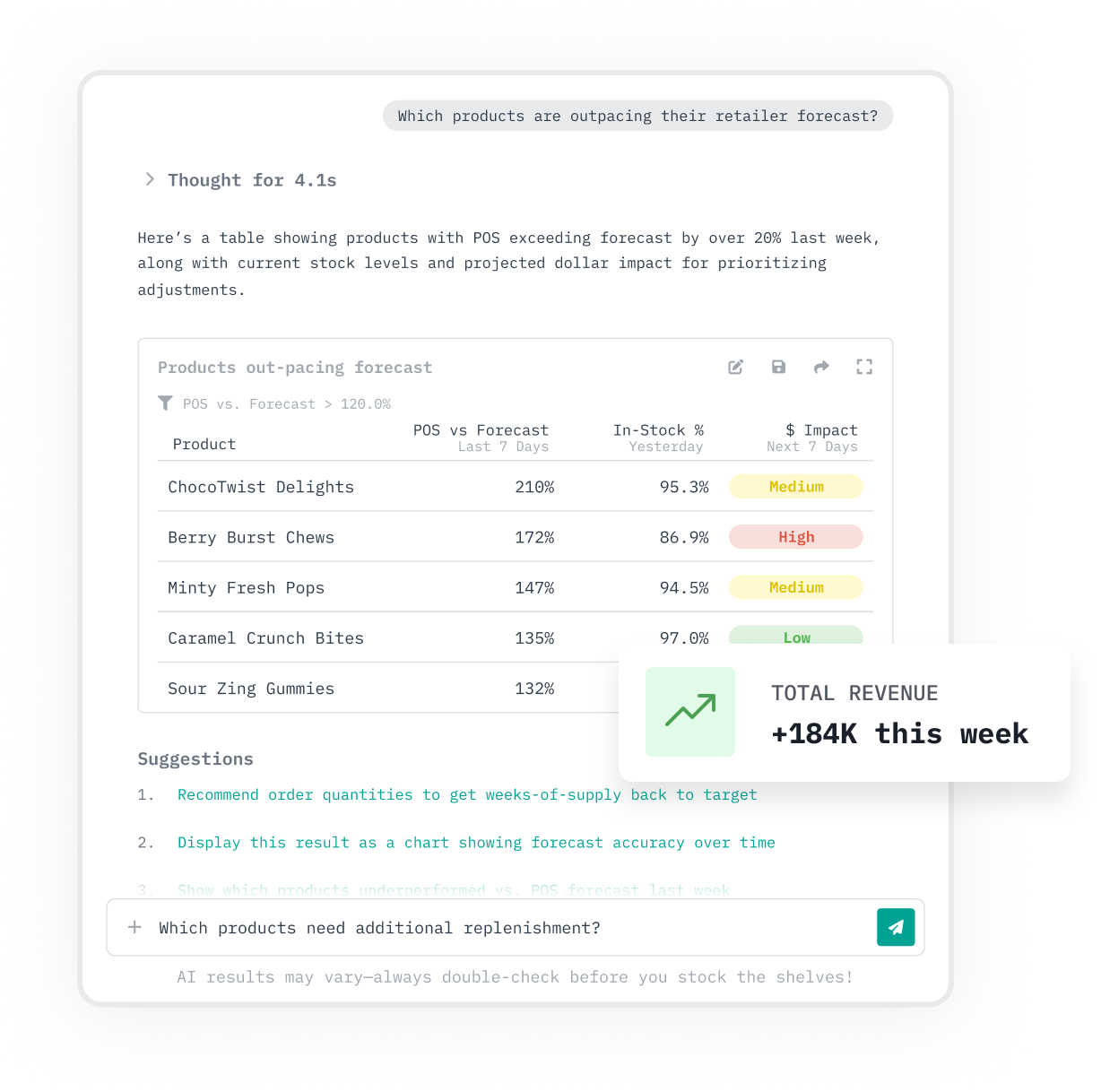
These AI technologies don’t stop at naming the problem. Alloy.ai’s Replenishment AI Agent calculates the exact order quantity, builds the case with supporting charts and customer insights, and drafts the email to the retail buyer for your approval. The Performance Reporting AI Agent turns raw data into an executive narrative and explains the why behind a shift, so leaders glean valuable insights without waiting. Reports write themselves; you review them.
From siloed channels to unified omnichannel intelligence
Brick-and-mortar lives in one system, the online shopping experience in another, distributors in a third, supply chain management in a fourth. AI stitches them into a single model. Cross-retailer scorecards, promotion comparisons across marketing channels, customer feedback signals, and supply chain risk checks all run off the same data—so the customer experience and customer interactions stay consistent, and the number in your Monday meeting matches the one your planner sees.
For brands looking to improve customer interactions beyond retail analytics, AI customer support can help automate common questions and deliver faster assistance.
Book a Demo
See Alloy.ai
Synchronize execution to eliminate waste, mitigate risk, and capture every revenue opportunity.
Once you submit a demo request form:
- A sales rep will email you within 24 hours to schedule a brief intro call.
- Our team will provide an overview of Alloy.ai and learn more about your data goals and objectives.
- We’ll create and walk you through a live demo, customized to your specific data needs.
Schedule a Demo
5 high-impact AI use cases in retail analytics for CPG brands
Five use cases drive most of the measurable return: demand-sensing forecasts, proactive out-of-stock prevention, real-time promotion measurement, phantom inventory detection, and agentic replenishment. Each one replaces a slow, manual, after-the-fact process with AI-powered analytics and predictive analytics that sense early and act fast. Together they protect customer satisfaction, turn scattered retail data into recovered sales, and hand brands a real competitive advantage. These AI technologies are what retail AI is for.
1. Demand-sensing forecasts that feed planning systems
Forecasting from shipment data is like driving by watching the rear-view mirror—you see where you’ve been, not the curve ahead. Shipments lag real demand by weeks, and seasonal spikes add noise that static models smooth over, leaving you blind to future customer demand even when the historical sales data is sitting right there.
AI works from POS sell-through at the SKU and store level, blends in seasonality and promo calendars, and keeps learning as fresh data arrives. Alloy.ai runs nine forecasting model types, from feed-forward neural networks to ARIMA—machine learning algorithms tuned to real customer demand. The artificial intelligence capabilities behind it are worth a closer look. The payoff is concrete: up to 35% better demand planning accuracy in Alloy.ai customer data—fewer expedite orders, less cash frozen in the wrong inventory.
2. Proactive out-of-stock prevention
Out-of-stocks are a quiet revenue leak. You usually find out from the retailer’s buyer, and by then the sales window has closed, the customer experience has soured, and the shopper has bought a competitor’s product instead. To remain competitive and improve customer satisfaction, brands have to see the gap coming.
AI watches weeks-of-supply, replenishment cadence, and demand velocity across every SKU and store combination, then flags which locations will stock out before they do—ranked by dollars at risk. Alloy.ai’s Replenishment AI Agent goes further and drafts the recovery order for approval, turning inventory management from a fire drill into a review-and-approve task. This kind of automated inventory management helps brands report 35%+ fewer out-of-stocks (Alloy.ai customer data) and millions in recovered sales.
3. Promotion performance measurement from day one
Roughly two-thirds of trade promotions don’t break even, according to Nielsen’s analysis. Ouch. Without granular, real-time measurement, you can’t tell whether a promotion drove new volume or just pulled forward sales—and weak pricing strategies plus scattershot marketing campaigns make it worse.
AI measures lift at the SKU and store level from day one, not three weeks after the promotion ends. It separates real incremental lift from cannibalization and forward-buying, factors in consumer behavior and competitor pricing, and helps you optimize pricing strategies event by event. Disciplined pricing strategies, dynamic pricing, and sharper marketing strategies turn trade spend into a lever. Dynamic pricing also keeps your marketing campaigns honest, and tighter marketing strategies mean your marketing campaigns fund what works. Dynamic pricing only pays when the measurement underneath it is real.
4. Phantom inventory detection and lost-sales quantification
Phantom inventory is the gremlin of retail: the retailer’s system says units are on hand, but the shelf is empty. Because the system thinks stock exists, automatic replenishment never fires, consumer behavior shifts to the next brand, and the product just… doesn’t sell. You can’t optimize inventory you can’t see.
AI catches it by comparing reported on-hand inventory against actual sales velocity. The model can analyze transaction patterns store by store; when one shows stock but rings up zero or near-zero sales for an abnormal stretch, it flags likely phantom inventory and puts a dollar figure on the lost sales—the evidence you need for a buyer conversation. One Alloy.ai customer drove $4 million in incremental sales by finding and fixing phantom inventory across their network. That’s a number you bring to the board.
5. Agentic replenishment and performance reporting
Replenishment is usually manual and reactive: your team spends hours building the case for a bigger order, and analysts spend more hours turning raw exports into a story leadership will read. None of that is operational efficiency.
Agentic artificial intelligence rewrites that workflow. Alloy.ai’s Replenishment AI Agent monitors 450+ retailers around the clock, catches demand surges as they happen, calculates the exact order quantity, builds a persuasive case with charts, and drafts the buyer email for approval. The Performance Reporting AI Agent assembles executive narratives and root-cause explanations automatically. Unlike generic ai tools, these agents act. As Omni Talk co-CEO Chris Walton put it, the winners start with the boring use cases that solve specific P&L problems, then scale—and replenishment and reporting are exactly that. Inbox time drops up to 40% (Alloy.ai client data), and teams move from wrangling data to capturing revenue.
See how Alloy.ai’s AI agents sense demand shifts and surface revenue opportunities across your retail network. Book a demo.
AI-powered retail intelligence vs. traditional BI tools: what is the real difference?
Traditional BI tools like Tableau and Power BI are visualization layers: they connect to data and let analysts build reports. An AI-powered retail intelligence platform automates the whole path from data ingestion to action, with AI-powered analytics that sense problems and surface revenue opportunities across retail operations. Unlike bolt-on dashboards, these ai powered solutions act—software that enables retailers and the brands selling through them to work from the same data. Most AI tools only chart the past; one shows you yesterday, the other acts on tomorrow.
Data readiness comes first. BI tools expect you to build and maintain a pipeline from every retailer portal yourself—pipelines that break the moment a retailer changes a column header, and data quality suffers every time. A retail intelligence platform ships with pre-built connectors and normalizes the formats for you. Analytical depth comes next: BI shows what happened, AI-powered analytics sense what’s coming and recommend the move, and agentic AI takes it—turning data into customer insights that optimize retail operations. That gap, between a chart and a drafted purchase order, is the whole ballgame.
Last is time to value. Custom BI builds drag on for months and needs a data team to babysit them; a purpose-built platform tends to deliver inside weeks. The honest caveat: BI tools are great at flexible, ad-hoc visualization, and plenty of brands across the retail sector keep one around. The retail sector isn’t short on dashboards; it’s short on action. The point isn’t that BI is bad—it’s that it was never built to run your retail business for you. Modern AI analytics were.
| Capability | Traditional BI (Tableau / Power BI) | AI-powered retail intelligence (Alloy.ai) |
|---|---|---|
| Data ingestion | Manual ETL from each portal | 450+ pre-built connectors, automated |
| Data normalization | Custom development required | Automatic across all retailer formats |
| Demand forecasting | Not included | Demand-sensing at SKU / store level |
| Anomaly detection | Manual threshold alerts | AI-prioritized by $ impact |
| Replenishment | Not included | Replenishment AI Agent auto-drafts orders |
| Performance reporting | Manual analyst work | Performance Reporting AI Agent auto-generates |
| CPG-specific KPIs | Custom build required | Out of the box |
| Time to value | 3–6 months | Weeks |
Inventory management, replenishment, and inventory tracking
The most time-sensitive application. Real-time sell-through shows you inventory levels falling before a stockout actually happens—not after a buyer calls to complain. Inventory tracking at the SKU-store level lets you manage inventory levels proactively: right-size replenishment orders, replenish inventory before it runs out, and reduce the overstock markdowns that quietly compress profit margins.
How to evaluate an AI-powered retail analytics platform
Evaluate an AI retail analytics platform on five things: automated data ingestion, real AI agents that act, retailer coverage for your specific accounts, supply chain optimization, and clean export into your planning systems. Start with your biggest data headache and work outward toward data-driven decision-making. The right AI-powered analytics remove manual work; they don’t add another tool to feed.
Start with your data problem. If you’re hand-pulling data from ten-plus retailer portals every week, or you have no single view across stores, ecommerce, and distributors, your first requirement is automated, pre-built ingestion—not another empty bucket to feed before you get any valuable insights.
Push past the buzzword. Ask whether the AI software has agents that rank anomalies by dollar impact, and whether it actually does something—drafts an order, writes a report, answers a natural language processing query—or just pings you. Plenty of AI tools only alert; those AI tools are a BI tool wearing an AI badge.
Check retailer coverage. Selling through Walmart, Target, Kroger, Amazon, and twenty more? Confirm those exact partners are already connected. A platform with 450+ pre-built connections shouldn’t make retail leaders or retail executives wait on integrations or stall their supply chain analytics.
Look at supply chain integration. Analytics that stop at POS miss half the story. The platform should tie sell-through to DC inventory, warehouse stock, and ERP data so it senses supply-side risk, not just demand-side trends—the basis of real supply chain optimization.
Test planning-system fit. Can it export forecasts into SAP IBP, Blue Yonder, Kinaxis, or Anaplan? If AI analytics can’t flow into execution, you’ve just built another silo that ignores live market trends.
For a longer checklist, our complete retail analytics guide goes deeper, and the platform overview shows the agentic AI analytics in practice.
Bring your trickiest retailer accounts, and we’ll show you how Alloy.ai connects, normalizes, and acts on the data. Book a demo.
What this means for CPG brands
AI for retail analytics isn’t one thing. It runs from in-store cameras on the retailer’s side to agentic supply chain management on yours. For a consumer brand selling through retail partners, the AI that runs your retail business senses demand shifts at the SKU and store level, heads off out-of-stocks, protects the customer experience, and drives customer retention by keeping shelves full, and surfaces hidden revenue and real economic value. Full shelves are the quiet engine behind increasing customer loyalty.
The gap in most coverage is plain: it describes the retail industry from the retailer’s chair, not the brand’s. Alloy.ai is built for your chair—agentic ai powered analytics layered on unified POS, inventory, and supply chain data. The same platform supports the customer segmentation and personalized shopping experiences brands build from browsing and purchase history; by reading purchase history and browsing behavior, it helps you personalize customer experiences, sharpen the customer experience, and refine customer segmentation at scale. Named customers like Crayola, BIC, Valvoline, Bosch, SimpliSafe, and Melissa & Doug already run on it.
Frequently Asked Questions
What is agentic AI in retail analytics?
Agentic AI in retail analytics is AI that goes past analysis and alerts to take action on its own. Alloy.ai’s Replenishment AI Agent monitors 450+ retailers around the clock, detects surges in customer demand or stock risks, calculates the order quantity, drafts a buyer email with supporting charts, and presents it for approval. The Performance Reporting AI Agent writes executive narratives and root-cause explanations automatically.
How does AI detect phantom inventory in retail?
AI detects phantom inventory by comparing reported on-hand stock with actual sales velocity. When a store shows units available but rings up zero or near-zero sales for an abnormal period, the model flags likely phantom inventory and quantifies the lost sales in dollars. This matters because a retailer’s automatic replenishment won’t reorder product it believes is already on the shelf.
Can AI retail analytics integrate with existing planning systems?
Yes. AI-powered retail intelligence platforms like Alloy.ai export demand-sensing POS forecasts directly into planning systems such as SAP IBP, Blue Yonder, o9 Solutions, Kinaxis, and Anaplan. That lets real consumer demand serve as the baseline for your demand plans, supporting data-driven decision-making that connects sell-through signals to production, procurement, and distribution—without building custom data pipelines.
How does AI improve demand forecasting for consumer brands?
AI improves demand forecasting by replacing static, order-based models with algorithms that learn from POS sell-through, seasonality, promotional calendars, customer preferences, and external signals. The forecasts run at the SKU and store level, adapt as new data lands, and can lift accuracy by up to 35%. They also sense demand shifts weeks before they show up in retailer orders.
Book a Demo
See Alloy.ai
Synchronize execution to eliminate waste, mitigate risk, and capture every revenue opportunity.
Once you submit a demo request form:
- A sales rep will email you within 24 hours to schedule a brief intro call.
- Our team will provide an overview of Alloy.ai and learn more about your data goals and objectives.
- We’ll create and walk you through a live demo, customized to your specific data needs.