
POS Forecasting
Predict Demand.
Eliminate the guesswork of shipment-based planning. Synthesize real-time POS data into high-definition consumer forecasts that allow you to identify supply risks, capitalize on sales trends, and command your inventory strategy.
TRUSTED BY THE WORLD’S TOP BRANDS






Forecasting Challenges
The Risk of Planning in the Dark
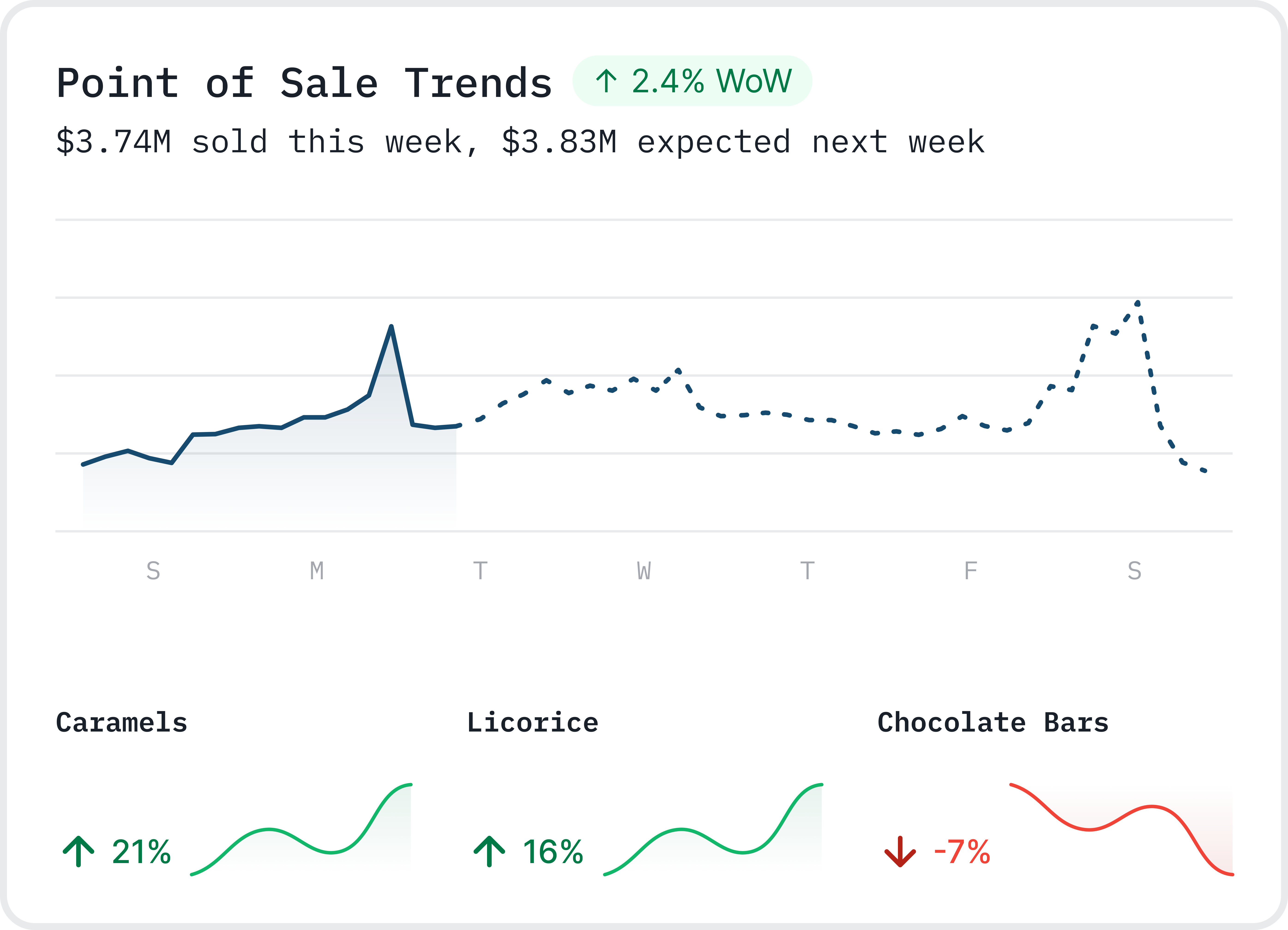
Most business plans are built on orders and shipments—data that tells you where your product went, but not the volume of inventory already in the channel or how it’s actually selling. When you lack a clear view of consumer behavior at the shelf, you’re forced to rely on lagging indicators or partner forecasts that may not exist. This disconnect leads to over-production, missed sales during viral surges, and defensive conversations with partners. Alloy.ai imports POS data in real time, giving you a weekly SKU-location forecast.
For Analytics and Supply Chain Leaders
Demand Sensing with Industry-Aware Models
Reliable demand sensing requires more than just general data science; it requires a model that understands the volatility of the shelf. Alloy.ai uses proprietary logic designed specifically for consumer goods—automatically adjusting for historical out-of-stocks and promotional lifts while intelligently handling new product launches and SKU transitions to ensure your forecast reflects true consumer demand.
-
Generalized Additive Model (GAM)
A machine learning model that simultaneously evaluates year-on-year trends, seasonality, holidays, and error to forecast future patterns. -
Seasonal Historical Average (SHA)
An Alloy.ai proprietary model built specifically for products with high seasonality. It accounts for recent sales volume and seasonal patterns over multiple years to match supply with consumer reality. -
Automated Feature Engineering
No manual data prep required. The system automatically decomposes your sales history into trend, seasonality, and holidays, while Outlier Detection identifies and adjusts for unusual behavior to keep the model clean.


Operational Execution
Precision Planning Across the Lifecycle
We’ve moved beyond simple “point-in-time” forecasting. Alloy.ai provides a dynamic view of demand that evolves alongside your business, whether you’re launching new SKUs or expanding your retail footprint.
-
New Product Forecasting and Chaining
Eliminate the "cold start" problem. We use GenAI and vector embeddings to match new launches to similar existing products and link discontinued SKUs to their replacements for a seamless sales transition. -
Evolving Location Counts
Finally, a forecast that grows with you. Our models automatically adjust as you expand into new stores, ensuring you never under-forecast during a critical retail rollout. -
Unconstrained Demand and Promo Baselines
See what you could have sold. We estimate "lost sales" from historical out-of-stocks and strip away promotional noise to reveal your true baseline demand. -
SKU-Location Level Granularity
Ensure the right product is in the right place at the right time with forecasts generated down to the individual store level.
Commercial Strategy
Rigorous Analytics for Total Confidence
For the teams that live in the details, Alloy.ai provides the transparency and specialized metrics needed to validate every plan and eliminate bias.
-
Tailored CPG Accuracy Metrics
In addition to industry standards like MAPE and WAPE, we provide a proprietary Rolling WAPE metric. It’s specifically designed for CPG to account for slight timing variances in demand spikes, giving you a more practical, less "noisy" view of accuracy. -
Forecast Bias Tracking
Proactively identify if your team is consistently over- or under-forecasting with built-in visibility into Mean Error, MPE, and tracking signals. -
AI-Assisted Clustering
We use vector embeddings to calculate precise seasonality curves for small-volume items that wouldn't normally have enough data to forecast reliably. -
Automated Retail Holiday Logic
Our models stay synced with the retail holiday calendar, automatically accounting for peak season shifts so you’re never caught off guard.

The Answers You Need
Forecasting Questions You Can Answer Instantly
- How does our internal shipment forecast compare to actual consumer consumption at the shelf?
- Which SKU-location combinations are trending toward a stockout based on the next 4 weeks of predicted demand?
- Is our new product launch on track to hit its target, or do we need to adjust production now?
- What would our inventory health look like if we grew at a specified rate compared to last year's patterns?
FAQs
Everything you need to know about our product. Can’t find the answer you’re looking for? Reach out to our support team below.
How does Alloy.ai generate detailed POS forecasts for consumer brands?
Alloy.ai connects to retail data portals and imports POS data in real time, producing short- and long-term demand sensing forecasts at the SKU/store/channel/day level of granularity. This detailed forecasting enables brands to identify supply shortages and sales opportunities across various channels.
How good are Alloy.ai forecast models?
We’ve benchmarked our POS forecasts against those from top retailers and found that Alloy.ai forecasts perform nearly as accurately or better.
Does Alloy.ai factor promotions in its forecast models?
Alloy.ai focuses on providing a highly accurate, “de-promoted” baseline forecast to power your planning processes. Our models are designed to strip away the “noise” of historical promotions to reveal the true underlying demand signal. Users can tag past promotional events (discounts, displays, etc.) and input the measured percentage lift. Alloy.ai then automatically cleans that historical POS data, ensuring your baseline forecast isn’t artificially inflated by one-time events. To maintain a single source of truth for operational plans, the anticipated lift for upcoming promotions should be layered onto this clean baseline outside of Alloy.ai, within your existing planning tools.
I am currently computing my forecasts in Excel, how will Alloy.ai be better?
Alloy.ai eliminates the manual data maintenance and formula risks in Excel, replacing error-prone spreadsheets with an automated forecasting engine powered by granular, near-real-time data. Robust, multi-model predictions can be exported weekly, making remaining steps easy: selecting preferred forecast model at the Retailer/SKU level, applying “human-in-the-loop” adjustments, and seamlessly integrating the final numbers into your existing planning workflows and conversations.
I currently have an existing Planning software in place, how will Alloy.ai fit?
Alloy.ai is not a replacement for planning software, but it has a role in making it accurate! Most legacy planning systems rely on internal “ship-from” data, which lacks visibility into what’s actually happening at the shelf. Alloy.ai can provide the “shelf-level” reality in order to produce an accurate demand signal for the retailers we have in scope. Alloy.ai’s highly-tuned forecasts enable real-world consumer behavior within your existing ERP or S&OP tools as a comparison data set to their lagging indicators. There are certain planning activities, including manual adjustments and calculating lift from future promotional activities, that will not be handled within our software.
What forecasting models does Alloy.ai offer to enhance forecast accuracy?
Alloy.ai provides four forecasting models: Historical Average- Calculates the average of recent sales over a specified historical period. Annual Growth- Projects future demand by following the previous year’s demand patterns at a specified growth rate. GAM (Generalized Additive Model)- A machine learning model that evaluates year-on-year trends, seasonality, holidays, and errors to forecast future patterns. Seasonal Historical Average- Considers historical sales data with a focus on seasonal variations to predict future demand.
How can brands utilize POS forecasts to improve their supply chain management?
Brands can compare their sell-in plans to actual sell-through, even if retailers don’t provide a POS forecast. Alloy.ai’s forecasts can be exported into planning systems to enhance shipment forecast accuracy. Additionally, the platform provides order recommendations and calculates weeks-of-supply based on future demand versus historical sales, aiding proactive inventory management and reducing the risk of stockouts or overstock.
Book a Demo
See Alloy.ai
Synchronize execution to eliminate waste, mitigate risk, and capture every revenue opportunity.
Once you submit a demo request form:
- A sales rep will email you within 24 hours to schedule a brief intro call.
- Our team will provide an overview of Alloy.ai and learn more about your data goals and objectives.
- We’ll create and walk you through a live demo, customized to your specific data needs.